 Historical Figure MBTI
4 min read
#194 · 3-20-26 · Ancient Athens
Alcibiades
The Master of the Shifting Mask
c. 450 – 404 BCE
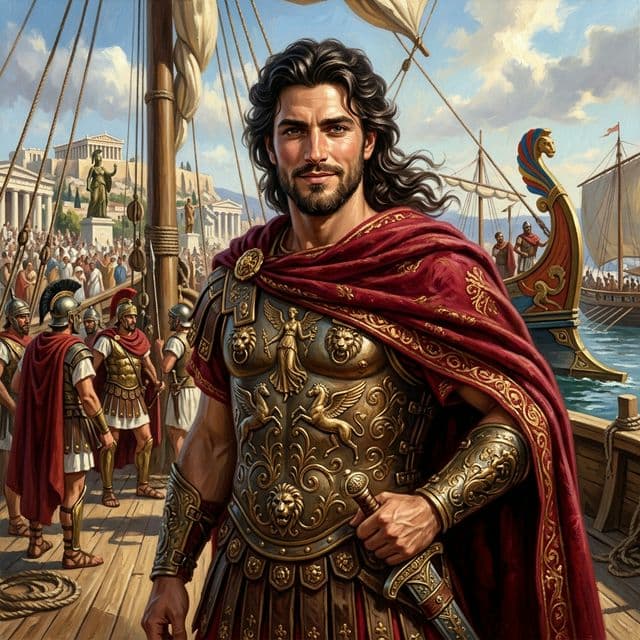
AI-assisted portrait of Alcibiades
The Architecture of Impact
Alcibiades did not just inhabit a role; he dominated a room. As the most charismatic and controversial figure of the Peloponnesian War, he possessed an almost supernatural ability to read the moment and adapt his entire personality to it. His life was a series of tactical shifts—from Athenian general to Spartan advisor to Persian collaborator—all driven by an insatiable need for agency and effect.
His journey was defined by the rejection of fixed identity in favor of ultimate situational power. He thrived in the chaos of the immediate, using his brilliance to navigate scandals and power struggles with a combination of high-stakes physical presence and ruthless internal logic.
Historical Context
Alcibiades was the nephew of Pericles and a protege of Socrates, born into the highest tier of Athenian society. He led the disastrous Sicilian Expedition, was accused of sacrilege, and fled to Sparta, then to Persia, before being recalled to Athens in a final, spectacular reversal of fortune. His life spanned the rise and fall of the Athenian empire, and his actions were often the decisive weights that tipped the scales of history during the Great War.
The Psychological Verdict
Alcibiades reads most clearly as ESTP. He was a master of sensory engagement and tactical impact (Se), guided by a cold, situational logic (Ti) that allowed him to manipulate the external dynamics of any environment he entered.
Se — Dominant
Alcibiades lived in the "Now." He was a man of action, physical splendor, and immediate results. His athletic prowess, his battlefield courage, and his legendary charm were all expressions of dominant Se. He didn't plan for decades; he conquered the current hour, moving with the fluidity of an apex predator through the changing political currents of the Mediterranean.
Ti — Auxiliary
Beneath the performative exterior lay a sharp, strategic engine. His ability to advise the Spartans on Athenian weaknesses or the Persians on Greek dynamics shows a detached, analytical understanding of vulnerability and systems. This was Ti in service of Se: an internal model of how the world works, used to achieve immediate, impactful goals.
Fe — Tertiary
His charisma was his greatest tool. Alcibiades used tertiary Fe to read and mirror his audience, becoming "more Spartan than the Spartans" when in Laconia, and "more Persian than the Persians" in Sardis. He understood how to leverage social expectations and emotional dynamics to secure his placement and his survival.
Ni — Inferior
What Alcibiades lacked was a terminal vision. His life was a series of spectacular immediate successes that eventually led to a lack of coherent direction. His inferior Ni manifested in a blindness to the long-term consequences of his betrayals, resulting in an end that was as chaotic and unmoored as his career had been brilliant.
The Mirror Athens Couldn’t Put Down
Every city he turned against ended up missing him. Athens exiled him; he went to Sparta. Sparta sent him away; he went to Persia. Persia tired of him; he came back to Athens, was welcomed as a savior, then abandoned again when a subordinate lost a battle he wasn’t even at. Socrates is the figure most associated with Alcibiades in the ancient sources — not because they were alike, but because they were the great unsolved problem of each other. Socrates saw in him someone who could have been great; Alcibiades saw in Socrates the one person who genuinely didn’t want anything from him. Pericles had been his guardian and his model. But Alcibiades took Periclean ambition and stripped it of its civic attachment, leaving only the engine running without the destination. He was killed in Phrygia in 404 BCE, reportedly by agents of the Thirty Tyrants, or Sparta, or both. The city that produced him never quite produced anyone like him again — which may have been the point.
Not the one who stood for the city. But the one who made the city pivot around him.
Connected Figures
Further Reading
- Alcibiades — David GribbleThe most thorough modern scholarly study of Alcibiades, examining how ancient sources constructed his reputation.
- The Peloponnesian War — Thucydides (translated by Martin Hammond)The primary ancient source — Alcibiades appears throughout Books V–VIII as a central and destabilizing agent.
- Parallel Lives: Alcibiades — Plutarch (translated by Ian Scott-Kilvert)Plutarch's paired biography of Alcibiades and Coriolanus remains the most vivid portrait of his character.
- A War Like No Other: How the Athenians and Spartans Fought the Peloponnesian War — Victor Davis HansonVivid military and political context for the world Alcibiades operated in.
