 Historical Figure MBTI
4 min read
#161 · 3-18-26 · Ancient Athens
Socrates
He left no answers behind. Only better questions.
c. 470 — 399 BC
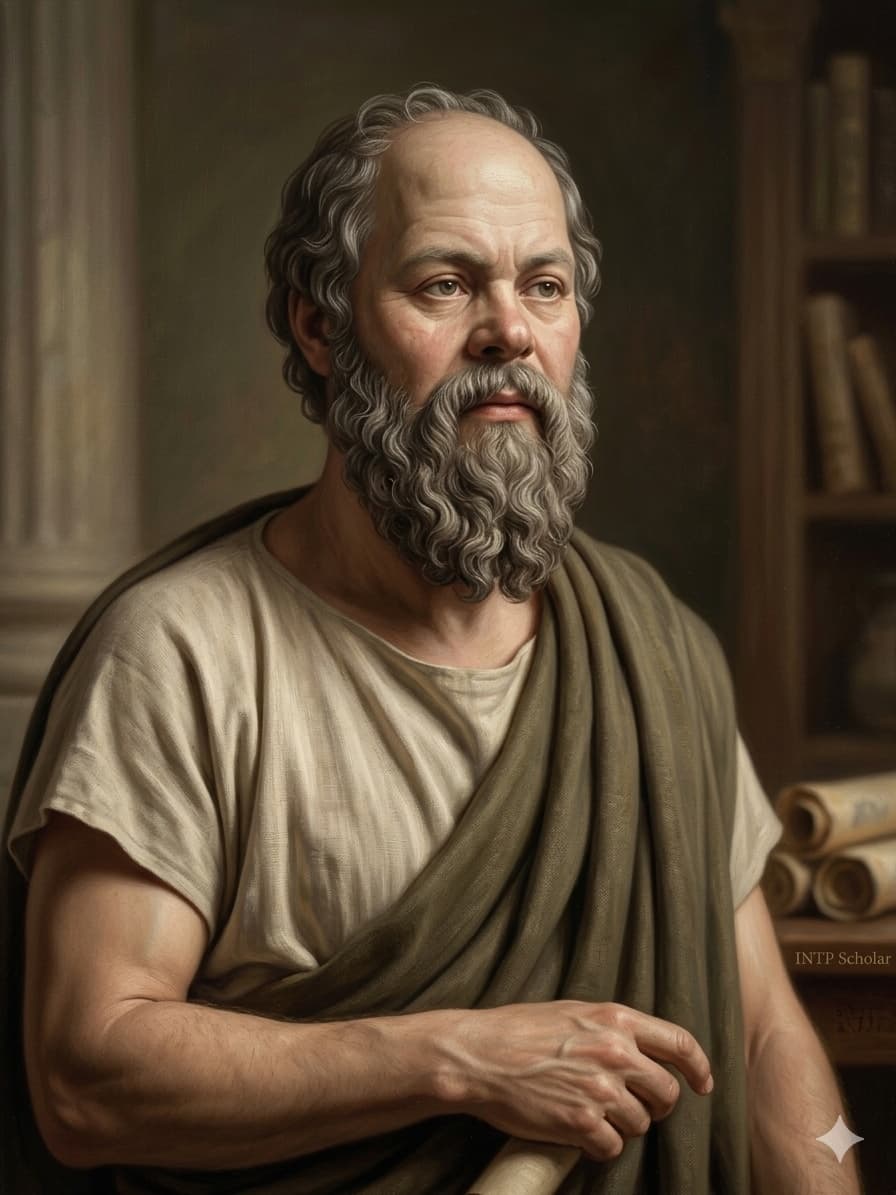
Portrait of Socrates
The Man Who Asked Too Much
In the streets of Athens, barefoot and unassuming, Socrates did not build schools, write treatises, or claim to possess knowledge. Instead, he asked questions — endlessly, precisely, and often uncomfortably.
He spoke to craftsmen, politicians, poets, and young men, not to teach in the conventional sense, but to expose something deeper: that what people believed they knew was often built on contradiction. His conversations unraveled certainty. Definitions collapsed. Confidence turned into hesitation.
And yet, this was not chaos for its own sake. Socrates was not a performer chasing reaction. There was a direction to his questioning — a quiet, persistent search for what remained true after every false assumption was stripped away.
Socrates did not claim to know. But he refused to stop thinking.
He left no writings of his own. What remains comes through others, especially Plato — a student who preserved not just his ideas, but the method itself: dialogue as a tool of truth.
The Psychological Verdict
Socrates is often typed as an ENTP — the archetypal debater, playful challenger, provocateur of ideas. And on the surface, this seems plausible. But a closer look reveals something quieter, more internally anchored, and far less performative.
Socrates was not exploring ideas for novelty or stimulation. He was refining them toward precision — toward something that could withstand scrutiny from every angle.
This suggests INTP.
Ti — Dominant
At the core of Socrates’ method is internal logical consistency. His questioning was not expansive, but reductive. He would take a concept — justice, virtue, courage — and test it, again and again, against edge cases and contradictions.
Each answer was not a springboard for more possibilities (Ne), but a structure to be examined, dismantled, and rebuilt more accurately. He wasn’t asking, “what else could this mean?” He was asking, “does this actually hold up?”
This is Ti at its purest — truth not as consensus, but as internal coherence.
Ne — Auxiliary
Socrates’ ability to generate counterexamples, analogies, and unexpected angles reveals strong Ne — but in service of Ti. He could pivot a conversation instantly, introducing new perspectives that exposed hidden flaws in reasoning.
But this wasn’t playful ideation for its own sake. The ideas always returned to the same function: testing the integrity of the original claim. Ne expands — but here, it expands to stress-test logic.
Si — Tertiary
There is a grounded, almost stubborn consistency in Socrates’ approach. He returned to the same fundamental questions throughout his life. His method did not evolve into something radically new — it deepened. Refined. Repeated.
Even his lifestyle — simple, austere, resistant to change — reflects a quiet Si stability. He was not chasing new experiences or reinventing himself. He remained rooted in a familiar pattern of inquiry and existence.
Fe — Inferior
Socrates’ relationship with the social world was complicated. He cared about the moral state of Athens deeply. His mission was, in part, to improve others by exposing their false beliefs. But his delivery often disregarded emotional impact.
This is not Fe absence, but Fe weakness. There is a desire to engage the collective — but without the instinct to maintain harmony while doing so. He spoke truth as he saw it, even when it fractured the room.
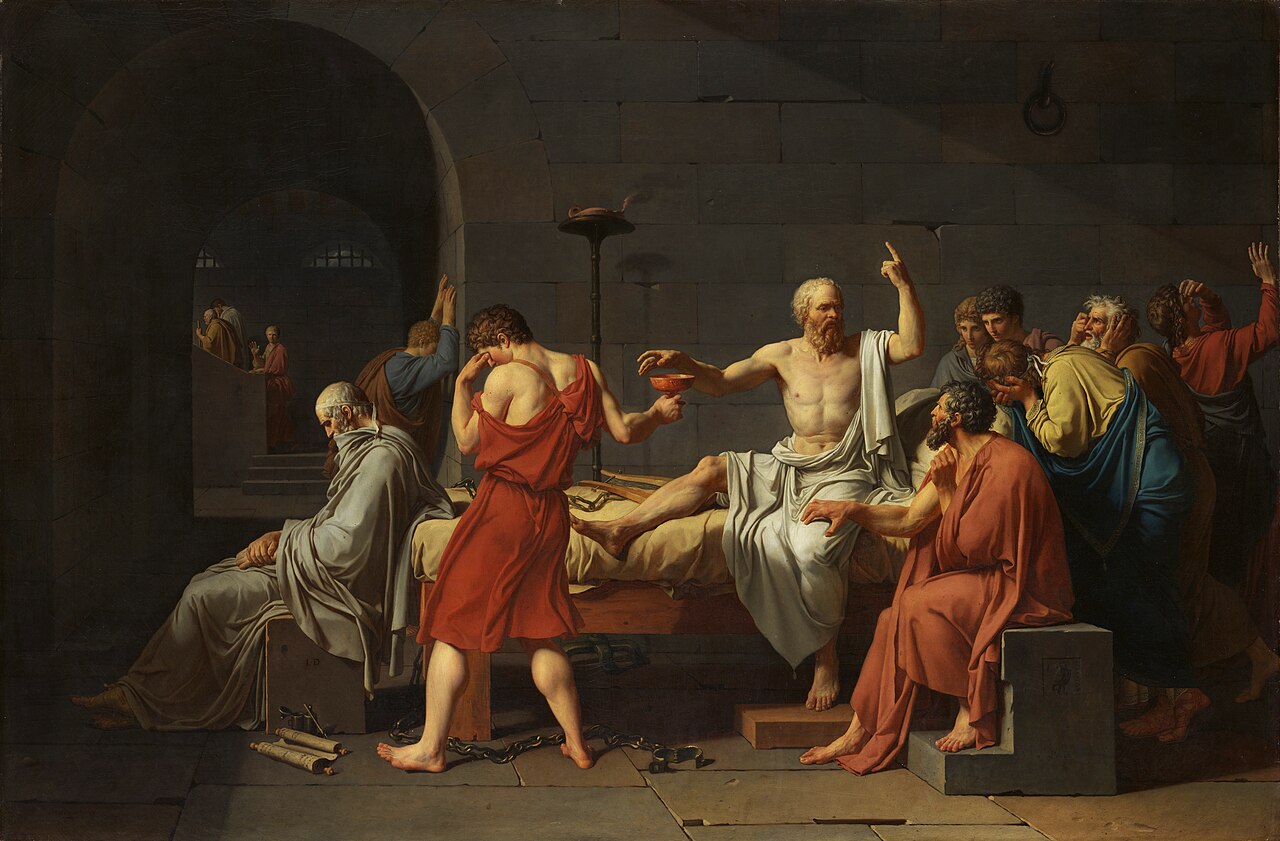
Why not ENTP?
Precision over Play
ENTPs lead with Ne, often prioritizing the exploration of possibilities over final clarity. Socrates did not present this way. He was not content to leave ideas open-ended; he pressed relentlessly toward clarity and the collapse of flawed reasoning.
Indifference over Performance
Accounts consistently describe Socrates as indifferent to appearance, status, and social navigation. His engagement with others was not about connection or stimulation typical of dominant Ne-Fe. It was about inquiry. Debate was not his theatre; it was his laboratory.
Connected Figures
Further Reading
- The Last Days of Socrates — Plato (trans. Hugh Tredennick, Penguin Classics)Four dialogues — Euthyphro, Apology, Crito, Phaedo — covering his trial, imprisonment, and death.
- Memorabilia — Xenophon (trans. Amy Bonnette)A student's counter-portrait: the practical, pious Socrates that Plato's idealism sometimes obscures.
- The Hemlock Cup: Socrates, Athens and the Search for the Good Life — Bettany HughesA richly textured biography that places Socrates firmly inside the political and material life of Athens.
- Socrates: A Man for Our Times — Paul JohnsonA concise intellectual biography tracing his influence from antiquity to the present.
