 Historical Figure MBTI
4 min read
#167 · 3-18-26 · Ancient Athens
Diogenes of Sinope
CYNIC PHILOSOPHER AND RADICAL PRACTITIONER OF LIVED FREEDOM.
c. 412 — 323 BCE
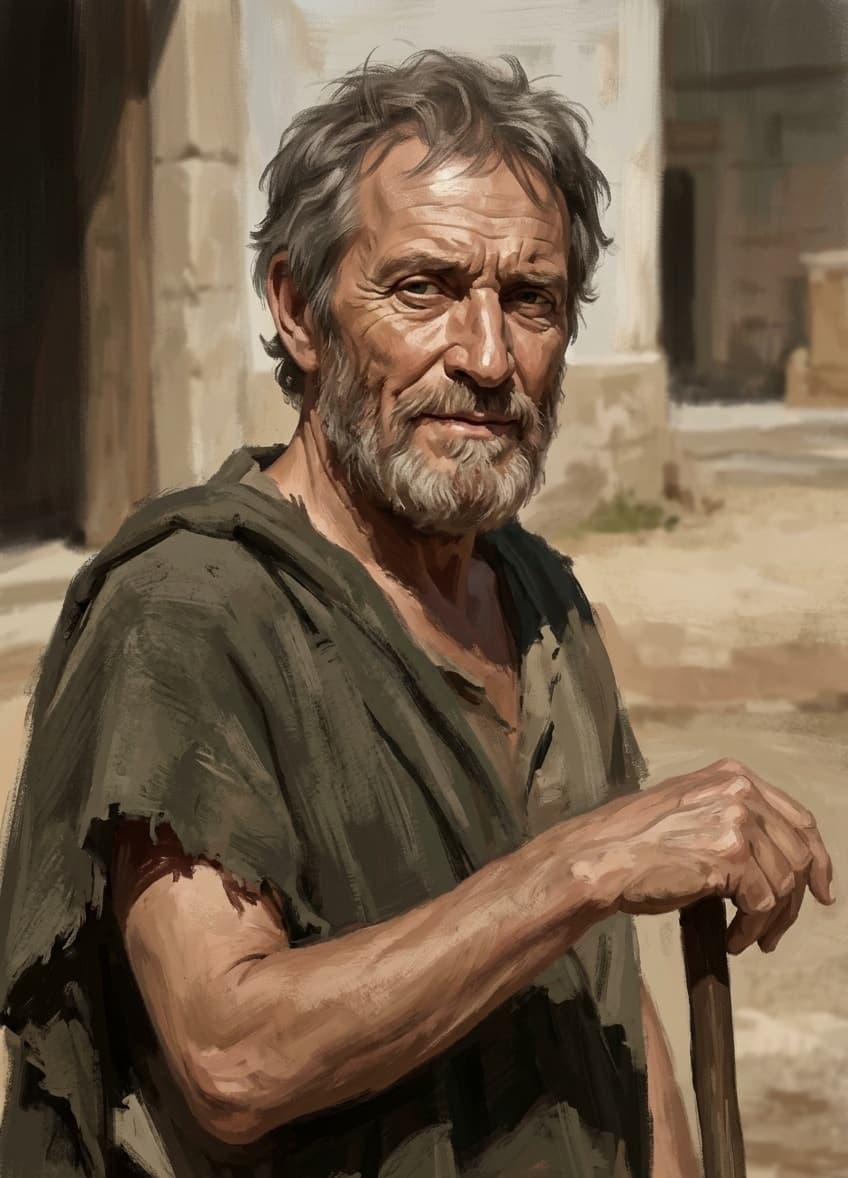
AI-assisted portrait of Diogenes of Sinope

The Man Who Lived His Philosophy
Born in Sinope in the 4th century BCE, Diogenes did not simply question society — he rejected it outright. Exiled from his hometown, he arrived in Athens with little, and chose to keep it that way. He lived in public spaces, owned almost nothing, and stripped life down to its bare essentials.
But this was not retreat. It was confrontation.
Diogenes did not write elaborate treatises or construct abstract systems. Instead, he turned his life into a demonstration. He begged, mocked, provoked, and performed — exposing the contradictions of Athenian society not through argument, but through action.
When Plato defined man as a “featherless biped,” Diogenes reportedly plucked a chicken and presented it as “Plato’s man.” When Alexander the Great offered him anything he wished, Diogenes replied: “Stand out of my sunlight.”
This was not philosophy explained. It was philosophy enacted.
The Psychological Verdict
Diogenes is sometimes typed as ISTP for his independence or ENTP for his provocations. But both interpretations miss the immediacy and performative force of his behavior.
A closer look suggests a clearer fit: Diogenes aligns most consistently with ESTP.
This was not a withdrawn observer or an abstract challenger. It was a man fully engaged with the present — using reality itself as his medium.
Se — Dominant
Diogenes lived entirely in the physical world. His philosophy was grounded in direct experience: hunger, cold, comfort, sunlight. He reduced life to what could be immediately felt and acted upon.
But more than that, he used the environment. His actions were responsive, situational, and often improvisational — whether mocking passersby, challenging social norms, or staging demonstrations in real time.
This is Se at its clearest: not reflecting on reality, but engaging it directly, moment by moment.
Ti — Auxiliary
Beneath the chaos of his behavior was a sharp internal logic. Diogenes’ actions were not random — they were pointed.
Every provocation exposed a contradiction: social norms vs natural living, wealth vs self-sufficiency, reputation vs reality.
His philosophy strips things down to essentials, rejecting unnecessary constructs. This reflects Ti’s precision — cutting through illusion to reveal underlying simplicity. He didn’t argue in long chains of reasoning. He showed the conclusion instantly.
Fe — Tertiary
Diogenes’ relationship with society was not indifferent — it was interactive. He understood social expectations well enough to subvert them effectively.
His provocations depended on an audience. His humor, mockery, and boldness all required a sense of how others would react. This suggests tertiary Fe: an awareness of social dynamics used not to maintain harmony, but to disrupt it.
He did not ignore people. He used them as mirrors.
Ni — Inferior
Diogenes shows little interest in long-term vision or abstract metaphysical systems. He rejects not just societal norms, but the very frameworks that attempt to explain them at a distance.
Where others speculate about ideal forms or future states, Diogenes collapses everything into the present moment. His philosophy is immediate, not predictive.
This reflects inferior Ni — a lack of investment in overarching vision, paired with a preference for what is directly in front of him.
Analysis
Why not ISTP?
ISTPs tend to withdraw, observe, and act with quiet precision. Their engagement with the world is often selective and internally guided. Diogenes does the opposite. He is public, performative, and confrontational. His philosophy requires constant interaction with others — provoking, challenging, and exposing in real time. This level of outward engagement and environmental responsiveness aligns far more with Se-dominance than with the more reserved ISTP profile.
Why not ENTP?
While Diogenes is witty and provocative, his method is not primarily conceptual. ENTPs explore ideas through dialogue, argument, and abstraction. Diogenes bypasses this entirely. He does not debate Plato — he mocks him with a physical demonstration. He does not construct hypothetical arguments — he embodies them. His focus is not on what could be thought, but on what can be shown. This is not Ne-driven exploration. It is Se-driven demonstration.
Not written. Not spoken. Lived.
Connected Figures
Further Reading
- The Cynics: The Cynic Movement in Antiquity and Its Legacy — R. Bracht Branham & Marie-Odile Goulet-Cazé (eds.)The essential scholarly collection on Cynicism — covers Diogenes' life, sources, and philosophical legacy.
- Lives of the Eminent Philosophers — Diogenes Laërtius (trans. Pamela Mensch)The primary ancient source for Diogenes' anecdotes and reported sayings, in Book VI.
- Antisthenes of Athens: Texts, Translations, and Commentary — Susan PrinceReconstructs the Cynic founder whose school Diogenes joined and then transformed.
- Philosophy as a Way of Life: Spiritual Exercises from Socrates to Foucault — Pierre HadotPlaces Diogenes in the broader tradition of philosophy as lived practice rather than doctrine.
