 Historical Figure MBTI
5 min read
#165 · 3-18-26 · Ancient Athens
Antisthenes
FOUNDER OF CYNIC PHILOSOPHY AND DISCIPLE OF SOCRATES.
c. 446 — 366 BCE
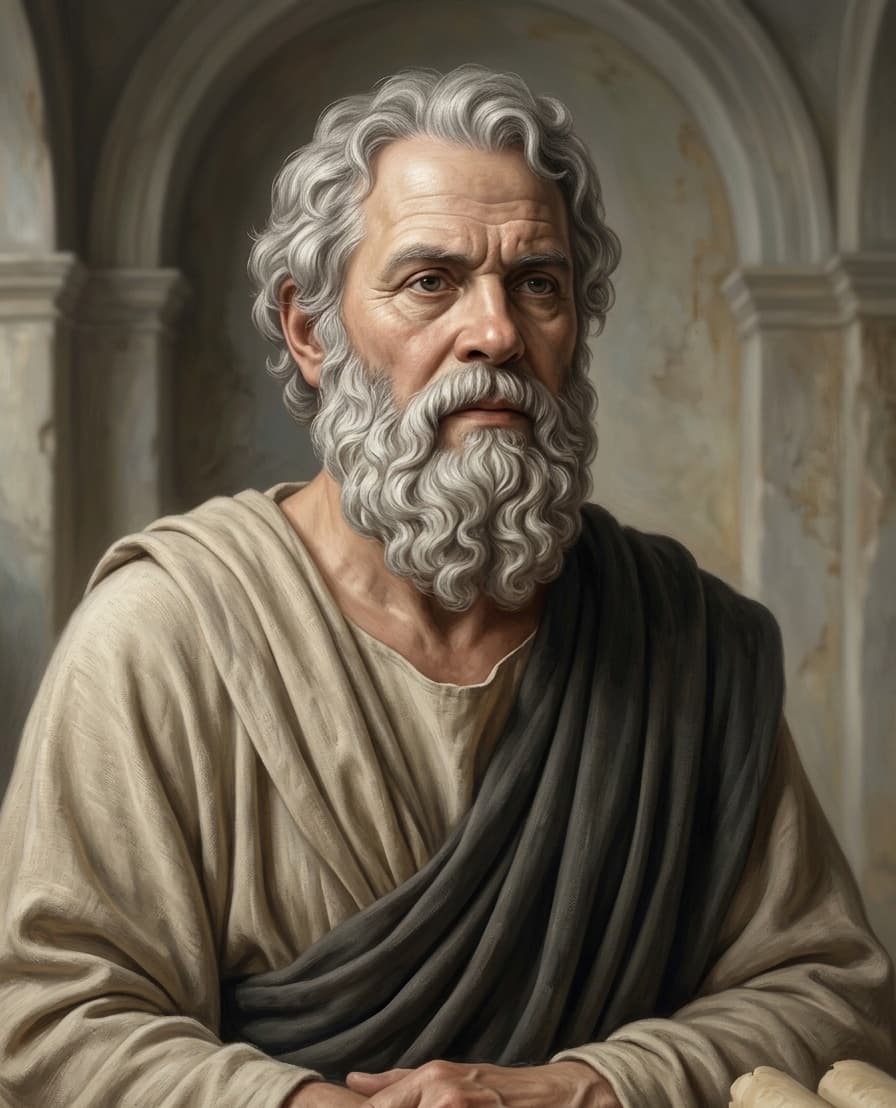
AI-assisted portrait of Antisthenes
The Man Who Walked to Discipline
Born around 446 BCE, Antisthenes stood at the edge of Athenian society — not fully inside it, not entirely outside. His father was Athenian, but his mother was foreign, likely Thracian or Phrygian. In a city where identity and legitimacy were tightly bound to lineage, this placed him in a liminal position: close enough to participate, distant enough to never fully belong.
This tension did not make him withdraw. It made him precise.
Before becoming a follower of Socrates, Antisthenes was trained in rhetoric, moving within the intellectual currents of Athens. But his life took a decisive turn when he encountered Socratic philosophy — not as an abstract system, but as a lived discipline. He is said to have walked nearly nine kilometers each day just to hear Socrates speak.
Not occasionally. Repeatedly. This was not curiosity. It was commitment.
After Socrates’ death, while others transformed his teachings into complex philosophical systems, Antisthenes did something different. He reduced them. Sharpened them. Lived them. His philosophy, later associated with Cynicism, was not built to explain the world — it was built to strip it down.
Virtue, to him, was not theoretical. It was practiced.
The Psychological Verdict
Antisthenes is sometimes typed as INFP due to his rejection of social norms and emphasis on virtue. But this reading leans too heavily on surface themes — anti-materialism, independence — and misses the structure beneath them.
A closer look suggests a different conclusion: Antisthenes aligns more consistently with ISTJ.
This was not a philosopher of inner feeling or identity exploration. It was a philosopher of discipline, repetition, and lived principle.
Si — Dominant
Antisthenes’ life reflects a deep commitment to routine, endurance, and consistency. His daily walk to hear Socrates is not just an anecdote — it is a pattern. He did not seek scattered insights or novel ideas; he returned, again and again, to the same source, refining understanding through repetition.
His philosophy mirrors this orientation. Virtue is not discovered through inspiration, but through training. Through habit. Through the steady alignment of action with principle.
This is Si at its clearest: grounding truth in what is practiced and proven over time.
Te — Auxiliary
There is a firmness to Antisthenes’ philosophy — a sense of what one should do. He did not merely suggest a way of life; he asserted it.
His rejection of luxury, comfort, and social pretense was not framed as a personal preference, but as a standard. A correct orientation toward life. His teachings reduce complexity into actionable clarity: live simply, endure hardship, discipline desire.
Reflecting Te — not expansive system-building, but direct, externalized structure applied to behavior.
Fi — Tertiary
While not emotionally expressive, Antisthenes does reveal an internal value core. His commitment to virtue is unwavering, even when it isolates him socially. He does not seek approval or recognition, and shows little interest in adapting his values to fit others.
But this Fi is restrained, not exploratory. It does not manifest as personal storytelling or emotional nuance, but as quiet conviction. A value held — and then enforced through action.
Ne — Inferior
Antisthenes shows little interest in abstract possibility or conceptual expansion. In fact, much of his philosophy pushes against it.
His critique of universals — “a horse I can see, but horsehood I cannot” — reflects skepticism toward abstraction itself. Where others build layered theories, Antisthenes collapses them. Definition, to him, becomes tautology. Language is reduced to direct reference. This is not Ne exploring what could be. It is Ne constrained — brought back down to what is.
Analysis
Why not INFP?
The INFP reading typically comes from Antisthenes’ rejection of society and emphasis on virtue. But INFPs center their philosophy around internal meaning — identity, emotional truth, personal values. Antisthenes does not speak in this register. He does not ask, “What feels true to me?” He asserts, “This is how one should live.” His philosophy is impersonal, disciplined, and externally enacted. It lacks the emotional introspection, symbolic exploration, and fluidity of Fi–Ne. This is not identity-driven rejection. It is principle-enforced restraint.
Why not INTJ?
While Antisthenes engages in philosophical thought, he does not build forward-looking systems or unified conceptual frameworks. He does not seek to synthesize reality into abstract models. Instead, he simplifies. Grounds. Reduces. His thinking moves away from abstraction, not toward it — rejecting Plato’s Forms, limiting definitions, and prioritizing what can be directly known. This is not Ni vision shaping the future. It is Si anchoring to what is already real.
He did not attempt to preserve Socrates through theory. He preserved him through discipline. Not the idea of virtue — but the repetition of it.
Connected Figures
Further Reading
- The Cynics: The Cynic Movement in Antiquity and Its Legacy — R. Bracht Branham & Marie-Odile Goulet-Cazé (eds.)The standard scholarly collection on Cynicism from Antisthenes through the late antique tradition.
- Antisthenes of Athens: Texts, Translations, and Commentary — Susan PrinceThe most thorough modern treatment — collects and translates the surviving fragments with detailed commentary.
- Socrates: A Man for Our Times — Paul JohnsonA readable account of the Socratic circle, situating Antisthenes within the wider community of disciples.
- Lives of the Eminent Philosophers — Diogenes LaërtiusThe primary ancient source for Antisthenes' biography and fragments, written in the 3rd century CE.
