 Historical Figure MBTI
4 min read
#166 · 3-18-26 · Ancient Athens
Gorgias
SOPHIST, RHETORICIAN, AND MASTER OF PERSUASIVE LANGUAGE.
c. 483 — 375 BCE
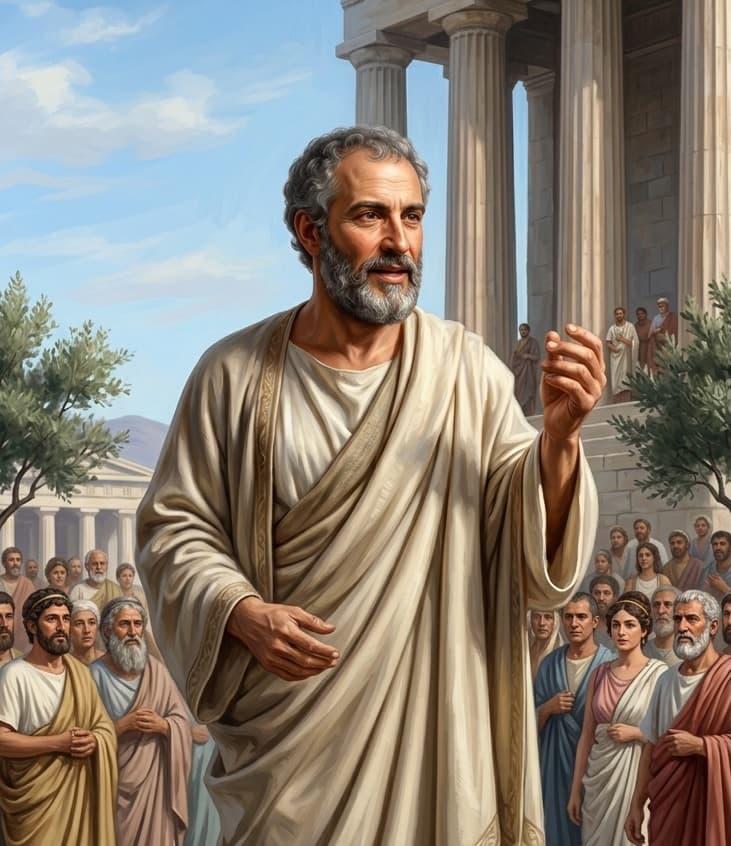
AI-assisted portrait of Gorgias
The Man Who Made Words Bend Reality
Born in the 5th century BCE in Leontini, a Greek city in Sicily, Gorgias entered the Greek world not as a philosopher of truth, but as a performer of language. He arrived in Athens as an ambassador, but what he truly brought with him was something far more disruptive: a new way of using words.
To Gorgias, language was not merely a tool for describing reality. It was a force that could shape it.
His speeches dazzled audiences. His style was rhythmic, poetic, almost hypnotic — designed not just to communicate, but to move, persuade, and overwhelm. Where others sought clarity, Gorgias explored possibility. Where others tried to define truth, he questioned whether it could even be known.
In his famous work On Non-Being, he pushed argument to its edge: nothing exists; if it exists, it cannot be known; if it can be known, it cannot be communicated.
This was not nihilism in the modern sense. It was demonstration. Gorgias was not simply making claims. He was showing what language could do.
The Psychological Verdict
Gorgias is sometimes mistaken for an ENFJ due to his charisma and rhetorical influence. But a closer look suggests something more exploratory and less anchored in relational harmony.
Gorgias aligns most consistently with ENTP.
This was not a teacher of shared values. It was a challenger of certainty.
Ne — Dominant
At the core of Gorgias’s thinking is expansion — the ability to take an idea and stretch it beyond its expected limits.
His arguments are not grounded in what is, but in what could be argued. On Non-Being reads less like a sincere doctrine and more like an exploration of possibility taken to its extreme. He follows lines of reasoning wherever they lead, even into contradiction.
This is classic Ne: not committing to a single truth, but generating multiple frames through which reality can be interpreted.
Ti — Auxiliary
Beneath the flourish of his rhetoric lies a precise internal logic. Gorgias’s arguments are structured, deliberate, and internally consistent — even when they lead to absurd conclusions.
His goal is not chaos, but demonstration: if the logic holds, the conclusion follows. This reflects Ti’s role in refining and testing ideas, ensuring that even the most provocative claims maintain structural integrity.
He doesn’t just play with ideas. He proves they can stand.
Fe — Tertiary
Gorgias’s power came from his ability to engage an audience. His speeches were crafted to captivate, persuade, and emotionally move others. He understood rhythm, timing, and the social dynamics of attention.
But this Fe serves his exploration, not the other way around. He is not primarily concerned with maintaining harmony or guiding people toward shared values. Instead, he uses social awareness as a medium for impact.
Connection, for Gorgias, is a stage.
Si — Inferior
Gorgias shows little attachment to tradition, stability, or established knowledge. He does not defer to what has been accepted or practiced over time. Instead, he challenges it — often by pushing it to absurdity.
His work destabilizes certainty rather than reinforcing it. This suggests inferior Si: a loose relationship with precedent, paired with a tendency to question or overturn it entirely.
Analysis
Why not ENFJ?
ENFJs use rhetoric to align people — to bring others toward a shared moral or social vision. Gorgias does something different. He does not guide his audience toward a stable conclusion. He unsettles them. His arguments often dissolve certainty rather than build consensus. The goal is not unity, but demonstration of language’s power. This is not Fe leading with vision. It is Ne leading with possibility.
Why not INTP?
While Gorgias shares Ti with INTPs, his orientation is outward. His work is not confined to private analysis, but expressed through public performance. He thrives in engagement, persuasion, and real-time intellectual play. INTPs tend to refine ideas internally. Gorgias externalizes them — testing them in front of others.
Not what is true — but what can be made to seem so.
Connected Figures
Further Reading
- The Older Sophists — Rosamond Kent Sprague (ed.)The standard English sourcebook — collects surviving fragments of Gorgias alongside those of Protagoras, Hippias, and Antiphon.
- The Sophists — W. K. C. GuthrieVolume III of Guthrie's History of Greek Philosophy; the most thorough English treatment of Gorgias in his intellectual context.
- Plato's Gorgias — Plato (trans. W. R. M. Lamb)The primary ancient source — Plato's dialogue stages the conflict between rhetoric and philosophy; essential for understanding how Gorgias was received.
- Sophist — Susan C. JarrattReframing the Sophists — argues that figures like Gorgias deserve a more sympathetic reading as proto-rhetorical theorists rather than mere deceivers.
