 Historical Figure MBTI
#311 · 3-26-26 · Catherinian Russia
Elizaveta Rubanovskaya
Radishchev's Second Wife · Voluntary Exile · Her Sister's Successor
1757 — 1797
5 min read
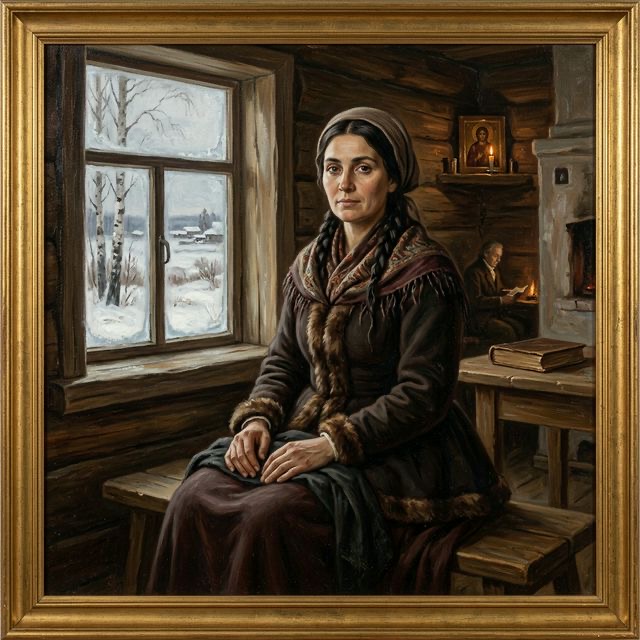
AI-assisted Portrait of Elizaveta Rubanovskaya
The Woman Who Chose Siberia
In 1790, Alexander Radishchev was sentenced to death for A Journey from St. Petersburg to Moscow, a sentence commuted by Catherine the Great to ten years of Siberian exile at Ilimsk — a garrison town thousands of miles from St. Petersburg, a place of genuine hardship and deprivation. He was sent there with no expectation of return. He had four young children, born to his first wife, Anna Rubanovskaya, who had died in 1783. Anna's younger sister, Elizaveta Rubanovskaya, had been helping to raise these children. When Radishchev was exiled, Elizaveta made a choice that no law or social pressure required: she went with him.
She was thirty-three years old. She was not his wife — they formalized their relationship later, in Siberia. She was not obligated to follow him. The journey was genuinely dangerous; the conditions at Ilimsk were genuinely harsh. She went because she had made a calculation, or a commitment, that admitted no alternative. She died there in 1797, seven years into the exile, at the age of forty. Radishchev survived and eventually returned to St. Petersburg, but he carried her death — added to Anna's — as one of the defining weights of a life defined by loss.
The choice Elizaveta made is almost impossible to fully explain in practical terms. It must be understood as the expression of a personality capable of following a conviction to its extreme consequences — not out of impulsiveness but out of a settled inner certainty about what love and loyalty required. This is not the decision of someone making a calculation about outcomes. It is the decision of someone who had looked at the situation clearly and concluded that there was only one thing to do.
Love as Vocation
The concept of voluntary exile — choosing to accompany a condemned man into Siberian punishment — had a cultural meaning in late eighteenth-century Russia that it would gain more fully in the nineteenth century with the Decembrist wives. Elizaveta Rubanovskaya's choice preceded that tradition by several decades and helped establish its emotional logic. The woman who follows her husband into punishment does not diminish herself; she enacts a form of love that the society around her cannot quite contain or categorize, and that therefore becomes, in retrospect, heroic.
Radishchev's intellectual and political commitments were, by 1790, fully formed: he had written a book that cost him everything, and he would write again in Siberia, thinking through the philosophical questions that his imprisonment had intensified. Elizaveta was not his intellectual interlocutor — that role had been, in different ways, his first wife's and his own solitary thinking. She was his human anchor in a place that was designed to destroy the human in him. She raised his children in exile conditions, managed their household on inadequate resources, kept him functioning when the combined weight of guilt, deprivation, and isolation might otherwise have broken him entirely.
Her death in 1797, before Radishchev's sentence was completed, added to the series of losses that had defined his adult life: Anna dead in 1783, then Elizaveta in 1797, then return to St. Petersburg under Alexander I's short-lived liberal thaw, then suicide in 1802 — a death whose exact circumstances remain ambiguous but that reads as the final payment of a debt he had been accumulating for decades. Elizaveta did not cause this trajectory, but she was among its most essential witnesses and most devoted companions.
Psychological Verdict
The choice Elizaveta Rubanovskaya made — voluntary exile, death in Siberia — is the action of a person with a settled inner vision of what her life was for. The ISFJ performs loyalty through daily care; the INFJ performs it through commitment to a long-range conviction that overrides circumstantial calculation. Elizaveta's decision was not the response to an immediate emotional situation — it was the expression of a view about love and duty that had been forming over years of caring for her dead sister's children and loving their father. When the crisis came, she had already decided.
This Ni-driven conviction distinguishes her from the ISFJ pattern her sister Anna more nearly exemplifies. The ISFJ sustains the present; the INFJ commits to a future they have already, in some sense, seen. Elizaveta saw, in 1790, what kind of person she needed to be in 1797 — and she was that person, at the cost of her life. That she died in Siberia is not the tragedy of someone who made a mistake. It is the completion of a choice that was always going to look like this. The saddest fact is simply that she was forty.
Connected Figures
Further Reading
- A Russian Philosophe: Alexander Radishchev, 1749-1802 — Allen McConnellA Radishchev biography that traces Elizaveta's extraordinary choice to follow him into Siberian exile after her sister's death.
- A Journey from St. Petersburg to Moscow — Alexander RadishchevThe banned book that sent Radishchev to Ilimsk — the sentence Elizaveta chose to share rather than let him serve alone.
- Russia in the Age of Catherine the Great — Isabel de MadariagaProvides the imperial context for Catherine's harsh response to Radishchev, the decision that shaped Elizaveta's remaining years.
