 Historical Figure MBTI
#312 · 3-26-26 · Catherinian Russia
Gavrila Derzhavin
Poet · Statesman · Ode-Writer to Catherine · Russia's First Great Bard
1743 — 1816
6 min read
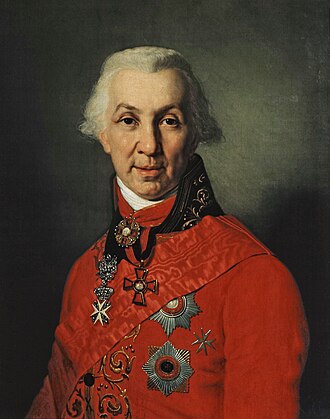
Portrait of Gavrila Derzhavin
The Soldier Who Became Russia's Voice
Gavrila Derzhavin began as a common soldier in the Preobrazhensky Guards, the lowest enlisted rank, from a Tatar-descended provincial gentry family with little money and fewer connections. The path to Russia's most celebrated poet, governor of two provinces, Secretary of State, and Minister of Justice was a series of confrontations — with superiors, with bureaucrats, with the Empress herself. Derzhavin won most of them.
His ode “Felitsa,” addressed to Catherine the Great in 1782, made him famous overnight. The poem praised her wisdom while mocking the courtiers around her, and it did both with a directness no one had yet dared. That directness was not a literary pose; it was character. He was fired from more positions than most officials ever held.
The ESTJ profile is the natural frame. Dominant Te drove him to organize, document, and confront. Auxiliary Si gave his poetry its texture — the dense accumulation of specific experience, named places, named people, the particular weight of lived time. He is Russia's first great poet of the actual.
The ESTJ who ran provinces and wrote odes with equal directness, Derzhavin understood that the highest praise and the fiercest accountability were different expressions of the same blunt honesty.
The Bureaucrat-Poet
As governor of Tambov from 1786 to 1788, Derzhavin opened schools, reformed the courts, and documented every obstruction with meticulous official reports. His superiors found him impossible in exactly the way dominant-Te people are: he would not accept that things were done badly simply because they had always been done badly.
“Felitsa” is a Te performance as much as a poem: it praises Catherine's virtues by contrasting them with the courtiers' vices with a precision that makes the contrast feel systematic rather than flattering. The Empress recognized that the praise was based on accurate observation — Derzhavin had observed the court with an administrator's eye and arranged the catalogue into verse.
Alexander I dismissed him as Secretary of State in 1803 after repeated arguments in Council sessions. Alexander's reported comment — that Derzhavin was “too zealous” — is the classic response of authority to dominant Te without social lubricant. He fought not because he was aggressive but because he had identified problems, and the correct response to identified problems is to address them.
Memory as Form
Auxiliary Si gave his poetry its distinctive density. He did not write about abstract love or nature; he wrote about specific people in specific places. His poems are full of proper names — Plenira, Milena, Felitsa, Zvanka — each anchoring a web of felt association.
“The Waterfall” opens with the actual Kivach waterfall in Karelia, which Derzhavin had seen as governor of Olonets. The poem moves outward to Potemkin's death, the nature of fame, what survives a great life — but the physical image stays anchored beneath the philosophical movement. Si starts in the concrete and does not let abstraction float free.
His poem “Life at Zvanka” (1807) catalogs his estate on the Volkhov River in loving detail — the food, the river, the garden, the household rhythms — with the ESTJ's conviction that the particular deserves the same serious attention as the grand. For Derzhavin, Zvanka was not a retreat from reality; it was reality distilled.
The Innovator Who Didn't Know He Was
Tertiary Ne surfaces in bursts, mixing registers unexpectedly. In Derzhavin it produced the sudden collision of high and low, sacred and comic, imperial and domestic: his odes veer without warning from celestial rhetoric to folk sayings, from praise of the Empress to a game of cards. This was the natural movement of a mind that found unexpected juxtapositions genuinely amusing.
Russian scholars explain this as a conscious break from Lomonosov's strict stylistic doctrine. But Derzhavin was not a theorist — he was a bureaucrat who also wrote poems, and his Ne produced innovations as instinct rather than manifesto. He broke the rules not because he was rebelling but because the interesting thing was on the other side of them.
The Elegist
Inferior Fi erupts under grief into feeling that has no practiced channel. For most of Derzhavin's life the function was quiet. He was devoted to his first wife, Ekaterina Bastidon (Plenira in his poems), with the focused loyalty of a man who does not distribute his feelings widely but gives them with great intensity to a few.
When Plenira died in 1794, the inferior Fi finally had its say. The elegies he wrote for her are among the most moving poems in the Russian eighteenth century precisely because they do not feel like the work of a practiced elegist — they are raw with the helplessness of a strong man who suddenly discovers the external world has taken away the thing he most relied on. He could not manage grief with the same efficiency he managed everything else. He eventually remarried — Darya Dyakova (Milena) — but the Plenira elegies remain the window into an interior life he otherwise kept firmly closed.
Why ESTJ Over ENTJ
Why not ENTJ?
The ENTJ operates from Ni-auxiliary — long-range strategic vision building toward a future already imagined. Derzhavin shows almost none of this. His reforms as governor were reactive: he saw an injustice and addressed it, without interest in transforming the broader system. The ENTJ poet would have written about where Russia was going; Derzhavin wrote about where Russia was. He was dismissed from official positions precisely because he would not play the long game.
The ESTJ verdict holds because blunt external organization, deep attachment to accumulated experience, instinctive innovation, and grief-erupting inferior Fi all map onto his life with unusual precision. The poet who wept at Pushkin's verses in 1815 was not a literary strategist recognizing his successor. He was an ESTJ in the grip of his inferior function, feeling something too big for his usual tools.
Connected Figures
Further Reading
- The Literature of Eighteenth-Century Russia — Harold B. SegelTwo-volume anthology and survey that situates Derzhavin within the arc of Russian classicism — the standard English introduction to the period.
- A History of Russian Literature — D. S. MirskyMirsky's chapters on Derzhavin remain among the sharpest critical assessments in any language — essential background for understanding his place between classicism and Romanticism.
- Derzhavin: A Biography — Vladislav KhodasevichA sympathetic, richly detailed life by Russia's great émigré poet — reads as much as a poet's meditation on his predecessor as a scholarly biography.
