 Historical Figure MBTI
#300 · 3-26-26 · Catherinian Russia
Pyotr Vyazemsky
Prince · Poet · Critic · Last Voice of the Golden Age
1792 — 1878
7 min read
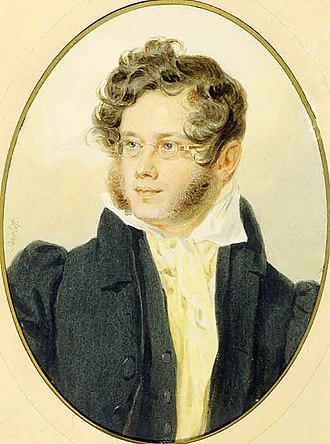
Portrait of Pyotr Vyazemsky
The Wit Who Outlived His Age
Pyotr Vyazemsky was born in 1792 to one of the oldest aristocratic families in Russia, and he died in 1878 in Baden-Baden — a man who had shaken hands with Pushkin and lived to read Tolstoy, who had fought at Borodino as a teenager and outlasted virtually every writer who had defined Russian literature's greatest era. The longevity was not merely biological. It was a peculiarly ENTP form of punishment: to remain curious and alive while the world that gave you meaning falls away piece by piece, and to keep generating opinions about the ruins.
His friendship with Nikolai Karamzin — who was, effectively, a second father — shaped his literary formation; his friendship with Pushkin shaped everything after. Their correspondence is among the masterworks of Russian epistolary prose: two men of exceptional intelligence sparring, confiding, quarreling, and laughing across decades and hundreds of letters. Vyazemsky's letters are funnier than Pushkin's and often more penetrating. He wrote the way he thought — in fast, associative bursts, a new idea careening into the next before the first was fully formed.
Vyazemsky was the ENTP as historical witness — a mind built for argument and connection, condemned by extraordinary longevity to watch every conversation partner disappear.
The Generator
The defining feature of Vyazemsky's literary output is not any single great work but an inexhaustible generativity. His posthumously published notebooks, the Staryye zapisnye knizhki (Old Notebooks), run to thousands of pages: observations, epigrams, anecdotes, stray thoughts, overheard conversations, half-formed arguments. This was not the compulsion of a diarist recording events but the Ne writer stockpiling connections — every fact a seed for another idea, every person a new angle on human nature.
His role in founding the Arzamas literary circle in 1815 was characteristically Ne. Arzamas was an idea about what Russian literature could become — lighter, more ironic, less ponderous than the old Shishkov school, more open to European Romanticism. Vyazemsky supplied the intellectual energy and polemical verve. He had a gift for articulating what a movement was for before the movement fully knew itself. His criticism shows the same pattern: rapid, impressionistic engagements with Pushkin, Fonvizin, Zhukovsky that caught something essential and moved on — better at the provocative claim than the systematic argument, the horizon perpetually receding.
The Polemicist
If Ne supplied the raw material, Ti was the instrument Vyazemsky used to shape it into argument. He was not just witty — he was precise. His epigrams work not through emotional appeal but through logical compression: the thing said in the fewest possible words that also happen to expose the exact point of absurdity. A witty remark makes you smile; a Ti-driven epigram makes you wince and nod simultaneously, because it has named something true that you had been avoiding.
His literary polemics carried the same quality. When he argued against the archaic school of Shishkov or against misreadings of Pushkin, he was not merely opinionated — he was constructing cases, identifying the specific logical flaw in the opponent's position and dismantling it. His political journalism in the 1820s shows the same characteristic: genuine liberal convictions argued with careful specificity rather than vague idealism. His essay on censorship, his notes on the Decembrist moment — these are the documents of a man who has actually thought through his positions rather than simply felt them. The argument must be logically valid before it can be emotionally satisfying.
The Friend
Tertiary Fe in an ENTP produces a particular kind of friendship — deep, genuine, expressed primarily through wit and argument, uncomfortable with direct emotional declaration but nonetheless real. Vyazemsky's friendship with Pushkin was the central relationship of his adult life: two decades of correspondence arguing about poetry, politics, women, and Russia, each calling the other out with the frankness that only close friendship permits.
The night of Pushkin's fatal duel in January 1837, Vyazemsky was in St. Petersburg. He spent the two days of Pushkin's dying at his bedside and was among the handful of intimates present when he died. His letters in the weeks that followed are among the most affecting things he ever wrote — not because they are rhetorically polished but because the loss had stripped away all the wit and left something rawer underneath. Fe, when tertiary, emerges most forcefully in catastrophe: the ENTP who cannot easily say “I love you” in ordinary times finds, in grief, that it was always there.
The Survivor
Inferior Si makes old age particularly cruel when the past becomes the only territory where the people one loved still exist. Vyazemsky outlived Pushkin by forty-one years, Lermontov by thirty-eight, Gogol by twenty-seven, Karamzin by fifty-five — becoming a kind of walking anachronism, a man from the 1820s who had wandered into the reign of Alexander II.
His late-life conservatism — the shift toward Orthodox piety, the retreat from his earlier liberal positions — is often read as betrayal or senility. It is better understood as inferior Si grasping for stability when Ne has exhausted its supply of new worlds to generate. Vyazemsky in his seventies was not the man he had been in his thirties; but then, no one he had known in his thirties was alive to notice.
His late poetry is among his most interesting work — slow, elegiac, stripped of quick wit. Poems like “Still Life” and his late meditations on time and death have a quality his younger work rarely achieved: genuine stillness. Si, even as the inferior function, eventually teaches its lesson, and his final poems are the record of an ENTP who had run out of arguments with mortality.
Why ENTP Over ENFP
Why not ENFP?
The ENFP leads with Ne and anchors in Fi — values-driven idealism expressed through personal enthusiasm and moral passion. Vyazemsky was not this. His wit was weapons-grade rather than warm, his arguments built on logical structure, his literary criticism precise in ways Fi-dominant writers rarely achieve. ENFPs fight for causes because they believe in them with the whole self; Vyazemsky fought for positions because he had constructed watertight cases for them and expected everyone else to follow the logic.
The clearest distinction is in how each type handles being wrong. The ENFP takes correction personally, because the position was an expression of self. Vyazemsky could abandon an argument the moment he saw a better one — Ti in action, not Fi. His correspondents noted how quickly he could pivot in debate, acknowledging a counterpoint and building a new position without apparent ego damage. His deep friendships and eventual grief demonstrate that Fe was real — but it was never the instrument through which he processed the world. That work belonged to Ti, and before Ti, to the Ne that never stopped generating the next idea.
Connected Figures
Further Reading
- Pushkin: A Biography — T. J. BinyonThorough account of Pushkin's circle — Vyazemsky appears throughout as Pushkin's closest intellectual correspondent and eyewitness to his death.
- The Cambridge History of Russian Literature — edited by Charles A. MoserContains dedicated sections on the Arzamas circle, Romanticism in Russia, and Vyazemsky's critical and poetic contributions.
- Karamzin: A Russian Sentimentalist — Anthony G. CrossTraces the Karamzinian school that formed Vyazemsky, with attention to the literary networks of early nineteenth-century Russian letters.
