 Historical Figure MBTI
#301 · 3-26-26 · Catherinian Russia
Nikolai Karamzin
Historian · Sentimentalist · Author of Poor Liza
1766 — 1826
7 min read
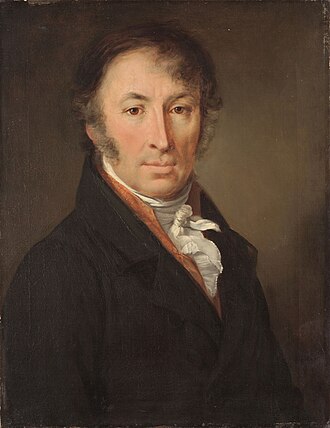
Portrait of Nikolai Karamzin
The Sentimentalist Who Made Russia Cry
In 1792, a twenty-five-year-old writer published a story about a peasant girl named Liza who drowns herself in a Moscow pond after a nobleman abandons her. Within months, Russians were making pilgrimages to the Simonov Monastery pond, carving “Here poor Liza drowned” into tree bark, weeping at the water's edge. Nikolai Karamzin had taught Russian literature something it had not yet learned to feel: that a serf girl's inner life was as worthy of grief as an aristocrat's. In 1792, that was a revolution.
Karamzin was more than a single novella. He modernized the language toward spoken usage, imported European Romanticism, produced the twelve-volume History of the Russian State, and mentored Pyotr Vyazemsky into the literary aristocracy that would eventually produce Pushkin. But the emotional key to everything he built is already in that story about Liza: the conviction, felt rather than argued, that individual feeling is the primary moral fact of human existence. The INFP does not build moral systems — he builds moral experiences. Karamzin's entire career operates on this principle: first feel, then understand.
Russia's first great sentimentalist was an INFP who understood that the most powerful moral arguments are not arguments at all — they are experiences of feeling that reason cannot reach.
The Interior Moral Universe
Dominant Fi locates moral truth inside the self — in felt value rather than codified rule. Poor Liza's central claim — that a serf girl's suffering is real suffering — is never stated as a proposition. It is enacted through the reader's grief. Karamzin trusted that feeling would do what argument could not. As a young man he fell perhaps catastrophically in love — the object possibly Elizaveta Protasova, who died before any union could form. That wound fed directly into the sentimental worldview saturating his early fiction. The INFP does not transform grief into philosophy; he transforms it into art and calls the art his philosophy.
His political conservatism looks like a contradiction until you read it through Fi. He was not defending an abstract theory; he was defending what he loved. Russia as it existed, with its particular textures and traditions, was something he felt deeply. The INFP conservative clings to what he loves the way other people cling to people — and abstract reform threatened to dissolve that reality into a scheme.
The Traveler's Eye
Auxiliary Ne generates connections and fresh angles of perception. In Karamzin it showed most vividly in the Letters of a Russian Traveler, his account of a European journey through Germany, Switzerland, France, and England in 1789–1790. The letters are a sustained exercise in noticing — how things differ from expectations, what one literary tradition has that another lacks, what a weeping willow at Rousseau's tomb makes you feel. Russia had not seen this form before: the personal, emotionally honest travelogue that treats the writer's own responses as the real subject. Karamzin imported it wholesale from European Romanticism and made it Russian.
Ne gave Karamzin his remarkable breadth. He wrote poetry, fiction, history, political philosophy, criticism, and travel writing; he edited the Moscow Journal and the Vestnik Evropy. The INFP with strong Ne uses whatever form is available to express the same essential moral vision from a new angle. Karamzin's career is variations on a single theme: the importance of individual inner life. The forms kept changing; the feeling never did.
The Historian's Memory
Tertiary Si is the archive-keeper — the function that holds things in careful order, faithfully. In Karamzin it is most visible in his magnum opus: the twelve-volume History of the Russian State, on which he labored for his last twenty years. The History is not a theoretical text. It does not argue a philosophy of history; it accumulates — chronicle after chronicle, reign after reign, organized with patient fidelity to the record. Karamzin was the first Russian writer to work systematically with the medieval chronicles, transforming them into readable, emotionally accessible prose.
The tertiary nature of Si explains why history, not philosophy, attracted him. A dominant-Si figure organizes the record because order is intrinsically satisfying. For Karamzin the archive served something else: his Fi conviction that past Russian lives mattered, that their suffering deserved to be felt by the present. He was not a historian by temperament; he was a sentimentalist who turned to history because it offered the largest possible field of human feeling.
The Conservative Who Resisted Reform
Inferior Te is the function the INFP reaches for under pressure — it appears late, with effort, and often clumsily. When Karamzin engaged political systems explicitly — in his 1811 Memoir on Ancient and Modern Russia, written for Alexander I — the result was revealing. He opposed Speransky's constitutional reforms with genuine conviction, but his arguments were not structural or strategic. A dominant-Te thinker would construct a precise institutional case. Karamzin's argument appeals instead to historical memory, to the accumulated character of Russian civilization, to the felt reality of what Russia is — arguing from Fi, with Si supporting him, reaching awkwardly toward Te to give the argument political legitimacy.
The Memoir was a serious act of political intervention, read by the Tsar himself. But Karamzin could not sustain the Te register. He kept sliding back into history as feeling, Russia as love, reform as loss. The political argument and the sentimental argument were the same argument for him — which is the most honest thing about it.
Why INFP Over INFJ
Why not INFJ?
The INFJ's dominant Ni builds convergent systems — theories that unify experience into a single coherent vision. Karamzin's History is not a theory of Russian civilization; it is a feeling-archive of it. An INFJ historian would have imposed a thesis. Karamzin accumulated. INFJs organize their Fe outward toward a community or cause; Karamzin's moral life was always private and interior. His conservatism resists the INFJ pattern too: an INFJ conservative would defend institutions for strategic reasons; Karamzin defended Russia because he loved it, with the unsystematic intensity of dominant Fi.
The deepest distinction is Poor Liza itself. An INFJ story builds toward something — a revelation, a sense that suffering has meaning in a larger design. Karamzin's story does not build toward anything. Liza dies, the narrator weeps, the pond remains. No redemptive frame, no systematic lesson, no Ni closure — only the irreducible fact of her grief and the reader's grief answering it. That trust in feeling as its own final justification is the signature of the INFP.
Connected Figures
Further Reading
- Nicholas Karamzin and Russian Society in the Nineteenth Century — J. L. BlackThe standard scholarly account of Karamzin's political and cultural influence; essential for the Memoir on Ancient and Modern Russia.
- Karamzin's Memoir on Ancient and Modern Russia: A Translation and Analysis — Richard PipesPipes translates the pivotal conservative document and situates it within the reform debates of Alexander I's reign.
- Russia in the Age of Catherine the Great — Isabel de MadariagaComprehensive background on the Catherinian Russia that shaped Karamzin's formation — court culture, Enlightenment currents, and literary life.
- A History of Russian Literature — Victor TerrasAuthoritative literary-historical survey with a substantive treatment of Karamzin's sentimentalism and his role in the modernization of the Russian literary language.
