 Historical Figure MBTI
#299 · 3-26-26 · Catherinian Russia
Ekaterina Kolyvanova
Princess Vyazemskaya · Derzhavin's Ward · Matriarch of a Literary Family
1769 — 1849
3 min read
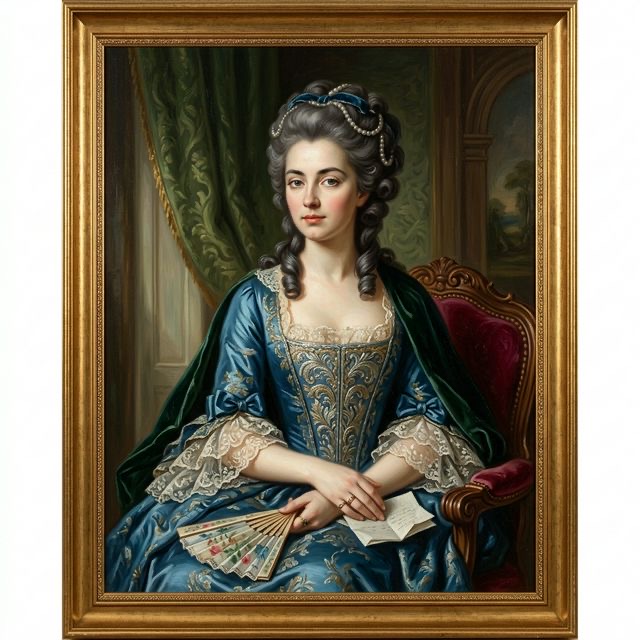
AI-assisted Portrait of Ekaterina Kolyvanova
The Mother of a Literary World
Ekaterina Kolyvanova was born in 1769 and raised, after her father's early death, as a ward in the household of Gavrila Derzhavin, Russia's reigning ode-poet. She emerged speaking multiple European languages, versed in literature and music, and equipped with something rarer: a genuine sense of what intellectual life looked like from the inside. In 1792 she married Prince Andrei Vyazemsky and brought to that marriage the cultural capital Derzhavin's world had given her.
Her Moscow home became a literary center — not through institutional prestige but through personal magnetism, through a hostess who knew which people were interesting and how to put them in the same room. Pyotr Vyazemsky adored her and credited her with forming his literary sensibility before any tutor had a chance. She died in 1849 at eighty, having known Derzhavin as a child and lived to see the generation that would read Turgenev.
Between Derzhavin and Pushkin
The position Kolyvanova occupied was generational. She had grown up in the household of Derzhavin — the Enlightenment ode tradition, heavy and imperial — and she raised a son who became the intimate friend of Pushkin and a founding voice of the Arzamas circle that broke with everything Derzhavin stood for. She was the human link between two eras that saw themselves as opposed, and she navigated that without apparent difficulty.
This bridging function reflected her temperament — a capacity for genuine interest in people across generational and stylistic lines, an ability to see what mattered in a writer without being captured by any single literary ideology. Her household was not a salon of one school but a space where the interesting people of each generation encountered one another. Nikolai Karamzin was close to the Vyazemsky family for years: she had known him through Derzhavin's circle and watched her son inherit that friendship. The Russian literary tradition's capacity for intimate connection across generations owed something to women like her.
Psychological Verdict
The evidence is thin, as it is for most women of her era whose lives were not themselves the subject of memoir. What survives comes through her son's recollections and the literary culture she helped sustain. But the pattern is consistent enough to suggest an ENFJ — a personality oriented toward building emotional and social environments, toward connecting people and generations, toward nurturing the intellectual life of those in her orbit. The ENFJ does not dominate through argument or production but through cultivation: making possible the conditions in which others flourish.
Her role as Derzhavin's ward and then as a literary hostess suggests the Fe-dominant pattern in its most productive form — the person who functions as an emotional center, organizing the energies around her without insisting on recognition. That her son became what he became, and her home became what it became, is the record of an ENFJ who worked through relationships rather than texts. The life has no canonical document, only a long series of rooms where the right people kept finding one another.
Connected Figures
Further Reading
- Nicholas Karamzin and Russian Society in the Nineteenth Century — J. L. BlackCovers the Karamzin circle Kolyvanova's Moscow salon fostered across generations, from Derzhavin's era to her son Pyotr's.
- Russia in the Age of Catherine the Great — Isabel de MadariagaThe standard account of Catherinian Russia's literary and administrative elite, the world Kolyvanova was raised inside as Derzhavin's ward.
- Catherine the Great: Portrait of a Woman — Robert K. MassieProvides the broader court context for a woman whose life bridged Derzhavin's generation and the coming age of Pushkin.
