 Historical Figure MBTI
4 min read
#298 · 3-25-26 · Catherinian Russia
Benedicta
Noble Lady · Peripheral Figure · Witness to the Catherinian Age
dates uncertain
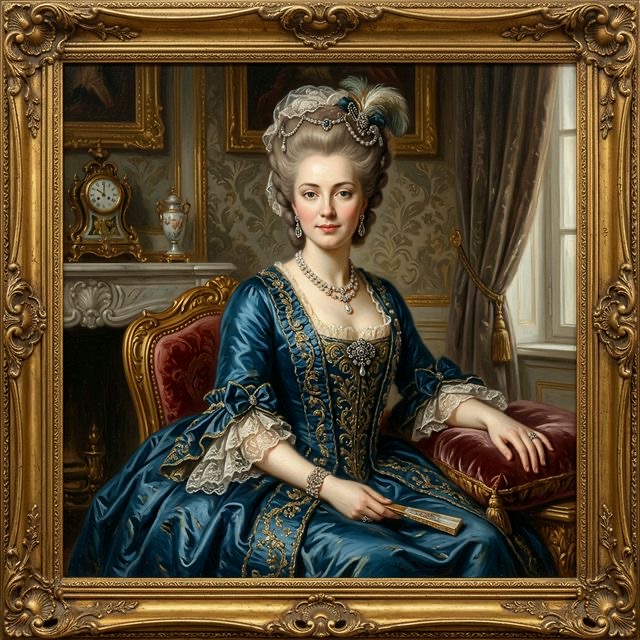
AI-assisted Portrait of Benedicta
A Name Without a Life
Benedicta is, in the honest accounting of what history has preserved, almost entirely unknown. The name itself is Latin in origin — the feminine form of Benedictus, meaning “blessed” — and was used among the Baltic German and German noble families of Russia's imperial period, suggesting a probable connection to the Lutheran noble world of the Catherinian court. Beyond this, the record is thin: no confirmed birth date, no confirmed death date, no documented deeds or relationships that would anchor her to a specific family or moment.
She appears in the Catherinian Russia cluster as a peripheral figure — someone whose name surfaces in connection with the families and networks of this era without the kind of biographical documentation that would allow a confident reconstruction of her life. This is not unusual. The historical record of eighteenth-century Russia, like that of most premodern societies, preserved the careers of administrators, military commanders, and rulers while leaving most women — especially those whose significance was relational rather than institutional — in varying degrees of shadow. Benedicta may have been a noblewoman connected to the Baltic German families of the Sievers or Putyatin networks; she may have been a figure encountered in family correspondence or estate records; she may have been a woman whose life was entirely ordinary by the standards of her class, leaving no particular trace precisely because it offered no occasion for drama or document.
The world she inhabited, if she inhabited it at the time this cluster represents, was one of considerable upheaval and considerable richness. Catherine II's Russia was a country in the middle of remaking itself — importing Enlightenment ideas from the West, reorganizing its provincial administration, fighting wars on its southern and western frontiers, and managing the social contradictions of an empire built on serfdom at the very moment when European philosophy was beginning to question whether serfdom could be justified. The Baltic German noble families who served Catherine were participants in this project, occupying a middle position between the empress's reforming ambitions and the conservative Russian nobility that resisted them. A woman named Benedicta in this world would have lived inside these tensions, whether she was aware of them or not.
The Baltic German Noblewoman's World
To understand Benedicta, even without knowing her specifically, is to understand the social world she most likely occupied. Baltic German noble families in Catherinian Russia maintained a distinctive culture — Lutheran and German at home, loyal and Russian in imperial service, caught between two identities in a way that required constant negotiation. The women of these families were typically educated to a standard higher than their Russian noble counterparts: French was expected, German was native, Russian was necessary, and a grounding in music, literature, and history was the mark of a respectable household. They managed complex estates, educated children, maintained correspondence networks across the empire and back to the Baltic provinces and Germany, and served as the social administrators of households whose men were often away on imperial business.
The Sievers family, the most prominent of the Baltic German administrative families represented in this cluster, provides the most likely frame for Benedicta's world. Count Jacob Sievers governed Novgorod for nearly twenty years and maintained an extensive correspondence network; his daughter Elisabeth von Sievers married into the Russian Putyatin family. Benedicta may have been another daughter, a niece, a family connection, or simply a woman from a neighboring Baltic German family who appears in the margins of this network's documentation. Without more specific evidence, any of these possibilities remains equally plausible.
Psychological Verdict
Benedicta resists typing not because the question is unanswerable in principle but because the historical record provides no material to work with. MBTI typing of historical figures is always inferential — it works from behavioral evidence, decision patterns, the texture of surviving letters and accounts — and in Benedicta's case, that evidence simply does not exist. She is present as a name, not as a documented personality. Any type assignment would be speculation dressed as analysis.
What can be said is that a woman in her probable social position — Baltic German noblewoman in Catherinian Russia, educated, embedded in a network of imperial service families — would have needed to be socially capable, linguistically flexible, and emotionally resilient. The specific demands of navigating between German Protestant and Russian Orthodox social worlds, managing a household whose men were often absent on state business, and maintaining the family's social standing across two cultures: these required a range of competencies that did not map neatly onto any single personality type. The historical record leaves us with a silhouette, not a portrait — the shape of a life without its interior. Benedicta remains, honestly, unknown.
Connected Figures
Further Reading
- Russia in the Age of Catherine the Great — Isabel de MadariagaSituates the shadowy Baltic German noble networks, like the ones Benedicta may have belonged to, within Catherine's reign.
- The Romanovs: Autocrats of All the Russias — W. Bruce LincolnTraces how families such as the Sievers and Putyatins, Benedicta's probable connections, served the Romanov state.
- Catherine the Great: Portrait of a Woman — Robert K. MassieOffers the texture of Catherinian court society in which an undocumented noblewoman like Benedicta would have moved.
