 Historical Figure MBTI
5 min read
#295 · 3-25-26 · Catherinian Russia
Count Jacob Sievers
Governor · Reformer · Architect of Provincial Russia
1731 — 1808
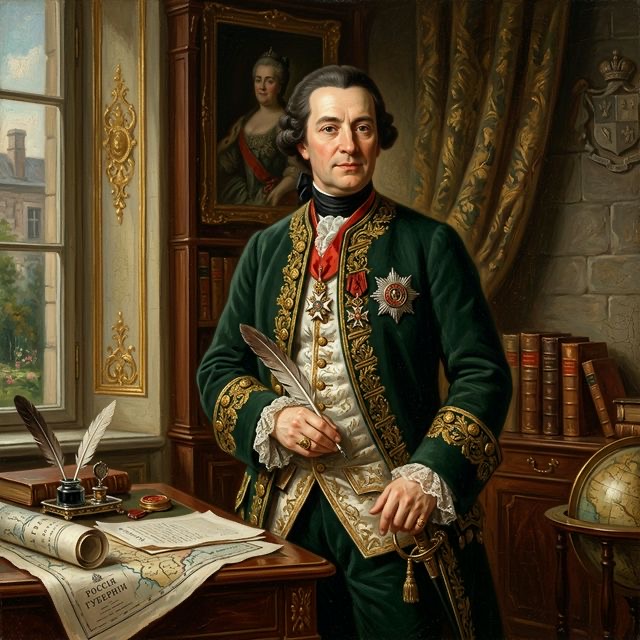
AI-assisted Portrait of Count Jacob Sievers
The Man Who Redesigned a Country from the Inside
Most administrators manage what exists. Jakob Johann von Sievers — Count Jacob Sievers to Catherine II's court — arrived in Novgorod in 1764 and began working on what should exist instead. He governed that vast northwestern province for nearly twenty years: building canals, reforming grain markets, opening schools, producing technically rigorous reports that no peer of his century had matched. Good governance, for Sievers, was not reaction but design.
He came from Baltic German nobility — Lutheran families the Russian crown had recruited since Peter for their competence. Rising through military and civil appointments, he reached Novgorod: vast, thinly administered, economically stagnant. What he brought was a vision of what the province could become, and the patience to build toward it over decades.
That's the INTJ signature: Ni paired with Te — the long-range interior blueprint executed through relentless systematic action, with the conviction that the present arrangement is not a given but a problem to be solved.
His crowning achievement: the 1775 provincial reform drew heavily on years of his field reports. When the moment came to legislate, the blueprint was already written. That is the INTJ in politics — not the man who seizes the room when crisis erupts, but the man whose prepared vision fills the vacuum when the room catches up.
The Reformer Who Worked Twenty Years Ahead of His Time
Ni dominant personalities perceive deep structure — systemic forces that will produce tomorrow's problems if left unaddressed today. When Sievers surveyed Novgorod's grain supply, he did not report shortage; he traced the cause to transportation bottlenecks, mapped improvable waterways, and proposed the canal works needed to fix it. Not describing a crisis — describing a system, and pointing to its leverage points.
His dispatches from Novgorod were famous at court — not the usual petitions or incident reports, but structural analyses with concrete reform proposals. Catherine read them carefully, recognizing a mind that saw what she was building toward and could map what would need to change.
The 1775 reform is the monument to this long-range vision. Sievers had argued for provincial reorganization for years before it was drafted — documenting how the existing system was too large to govern coherently, how absent intermediate institutions left vast stretches ungoverned, how rival jurisdictions created legal chaos. When Catherine moved, the statute codified what one man had been seeing since the 1760s.
Canals, Committees, and the Architecture of Order
An INTJ without Te produces nothing. Sievers's auxiliary Te turned his interior blueprint into physical reality: improved canal systems linking the Volga and Baltic networks, new roads, administrative committees with clear mandates, schools in towns that had none before. He was tireless and demanding — expecting subordinates to produce the same systematic documentation he produced himself.
His reports to Catherine were structured arguments dense with statistics, comparative assessments, and explicit policy recommendations — Te marshaling evidence in the service of the Ni blueprint, with the rigor of an engineer.
His later diplomatic work — representing Russia in the Polish partition negotiations of the 1790s — showed the same discipline in a different domain. He found it harder than provincial administration: Te functions best when the external world is organized enough to be grasped systematically, and Polish partition politics were anything but.
The Conviction Beneath the Administrator's Exterior
Sievers was not a man of visible emotion. His public persona was precise, methodical, focused on results. But tertiary Fi in an INTJ manifests as deep interior conviction — a moral sense that operates below the professional surface and only becomes visible when challenged.
For Sievers, that conviction centered on reform. He believed provincial poverty, administrative chaos, and missing infrastructure were consequences of bad organization that could be changed. When colleagues obstructed through indolence, he responded with a sharpness that surprised those who knew only his cool exterior. The emotion was real; well hidden most of the time.
His correspondence with Catherine occasionally breaks into something more personal — a note of frustration revealing a man pursuing what he believes in, not merely executing a job. He clashed with officials who used obstruction to protect serfdom from scrutiny. Fi tertiary: principled irritation, mostly internalized, erupting when provocation is too direct to ignore.
Why INTJ Over ISTJ or ENTJ
Why not ISTJ?
The ISTJ masters established procedures, maintains continuity, produces reliable results within the given framework. Sievers arrived in Novgorod and immediately identified what the framework got wrong. The 1775 reform was not incremental improvement; it was structural redesign based on his long-running argument that the existing structure was conceptually flawed. An ISTJ would have been an excellent governor of the existing province. Sievers redesigned what a province was.
Why not ENTJ?
The ENTJ shares Sievers's Te efficiency but leads with Te rather than Ni — tending toward action and direct command. An ENTJ would have moved faster, demanded visible results sooner, and collided more dramatically with the court's political environment. Sievers's twenty-year Novgorod governorship required Ni persistence: content to work quietly toward a vision without the ENTJ's need to be seen leading.
An ISTJ renovates what exists; an ENTJ mobilizes people toward what he directs; an INTJ sees what the structure should be and works steadily toward it, with or without applause. Sievers spent twenty years submitting reports for things Catherine had not yet done, and when she finally did them, moved to the next problem. That patience, that interior certainty: INTJ in its clearest form.
Connected Figures
Further Reading
- Catherine the Great: A Profile in Power — Isabel de MadariagaThe standard scholarly account of Catherine's reign, with substantive treatment of the 1775 provincial reform that Sievers helped shape.
- Russia in the Age of Catherine the Great — Isabel de MadariagaA comprehensive political history of the Catherinian era — essential context for Sievers's administrative career and the reform programme he contributed to.
- The Baltic Germans in Russia — Erik AmburgerTraces the broader community of Baltic German service nobles — the world Sievers came from and operated within throughout his career.
- Catherine the Great: Life and Legend — John T. AlexanderA readable narrative of Catherine's court and governance, situating the provincial reform within the wider arc of her reign.
