 Historical Figure MBTI
4 min read
#286 · 3-25-26 · Catherinian Russia
Countess Elizabeth Karlovna Sivers
Countess · Baltic Noblewoman · The Sievers Family's Quiet Anchor
dates uncertain
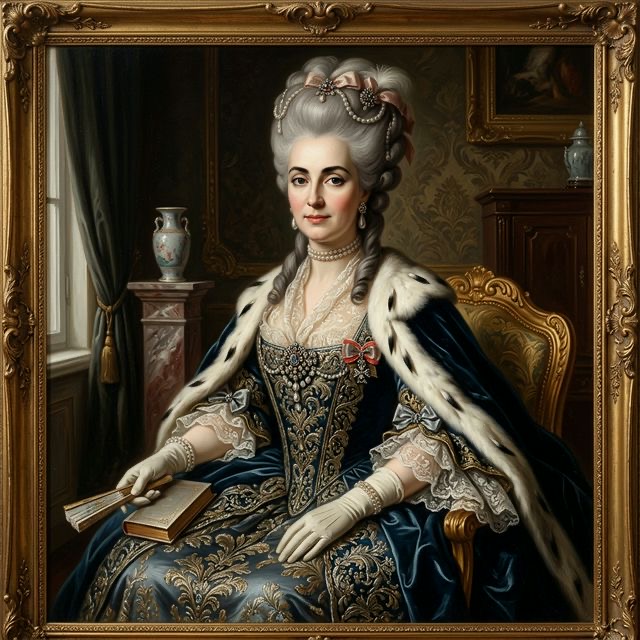
AI-assisted Portrait of Countess Elizabeth Karlovna Sivers
The Baltic German World She Inhabited
The Sievers — or Sivers — were a Baltic German noble family who had served the Russian Empire since Peter the Great consolidated control over the Baltic provinces in the early eighteenth century. Baltic Germans occupied a peculiar and privileged position in the Russian imperial system: Lutheran by faith, German by culture, Russian by political allegiance, they supplied the empire with an extraordinary proportion of its military officers, provincial governors, diplomats, and imperial administrators across more than a century. The family name Sievers appears repeatedly in the records of Catherinian Russia, most prominently in Count Jacob Sievers, the reforming governor of Novgorod province who worked closely with Catherine II on provincial administration and served as her envoy to Poland during the partitions.
Countess Elizabeth Karlovna Sivers is associated with this family, likely as a wife or daughter of one of its leading members, though the historical record is frustratingly thin on her specific identity and dates. The name "Karlovna" — meaning "daughter of Karl" — suggests a patronymic rather than a married name, placing her as a daughter of someone named Karl within the Sievers family network. The title Countess reflects the hereditary rank that Baltic German noble families carried into Russian imperial service. Whether she moved in the orbit of Saint Petersburg society, spent her years on Baltic estates, or lived as part of the administrative households of Novgorod or another provincial capital is not recorded. She exists in this cluster as a figure of the Sievers world rather than as a fully documented individual.
That world — Baltic German noble service in Catherinian Russia — was itself a distinctive psychological and cultural phenomenon. These families navigated between two civilizations, maintaining German Lutheran culture while building Russian imperial careers, producing men of great administrative capability and women who held the domestic and social structures of that dual world together. It was a milieu that rewarded order, protocol, and quiet competence over visibility or self-promotion.
Psychological Verdict
The historical record for Countess Elizabeth Karlovna Sivers is too sparse to support confident MBTI typing. What survives is a name, a noble title, and a family connection — not enough evidence of decisions, relationships, writings, or behavioral patterns from which to draw psychological conclusions with any reliability.
The world she inhabited — Baltic German noble service culture in Catherinian Russia — tended to select for and reward certain temperaments: disciplined, orderly, attentive to rank and protocol, invested in the preservation of family standing across generations. If we were to speculate loosely, the women of this milieu often displayed the structured, tradition-oriented qualities associated with the SJ temperament family. But speculation of this kind is exactly what the thin historical record does not support. Elizabeth Karlovna Sivers resists typing, and that resistance is itself historically meaningful — it marks the limit of what can be known about the women who inhabited the periphery of Catherinian power without leaving a documentary trace of their own.
She appears here as part of the Sievers network, as a figure of that particular Baltic-Russian world, and as a reminder that the Catherine era was populated by hundreds of women whose inner lives we cannot reconstruct — whose personalities shaped the households, families, and social worlds that the better-documented men moved through.
Connected Figures
Further Reading
- Russia in the Age of Catherine the Great — Isabel de MadariagaThe standard account of Catherinian Russia, situating the Sievers family's Baltic German service tradition Elizabeth Karlovna belonged to.
- The Romanovs: Autocrats of All the Russias — W. Bruce LincolnTraces how families like the Sievers served the Romanov state generation after generation, often without individual record.
- Catherine the Great: Portrait of a Woman — Robert K. MassieProvides the court texture in which an undocumented noblewoman such as Elizabeth Karlovna Sivers would have lived.
