 Historical Figure MBTI
5 min read
#294 · 3-25-26 · Catherinian Russia
Vera Apraksina
Countess · Lady of the Court · The Vivid Presence at Catherine's Table
dates uncertain
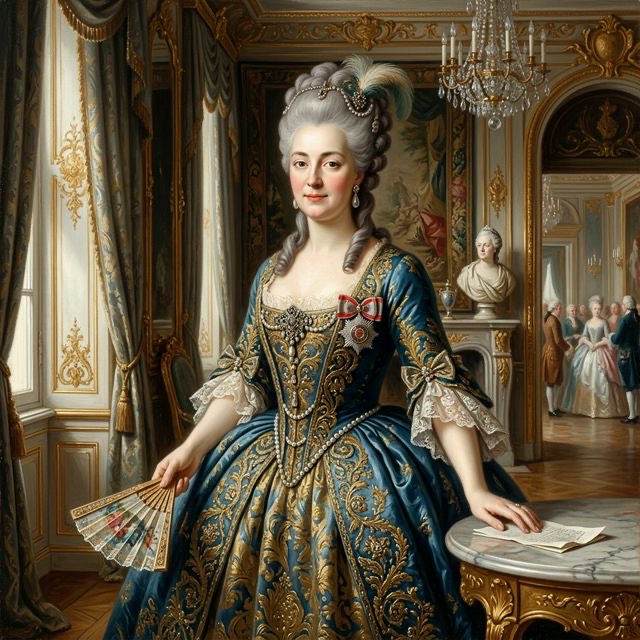
AI-assisted Portrait of Vera Apraksina
The Name Behind the Brightness
The Apraksin family was among the great noble dynasties of Imperial Russia — a name that had supplied the empire with admirals, field marshals, senators, and courtiers since Peter the Great's day. By Catherine II's reign, the Apraksins were established in the permanent orbit of St. Petersburg court life: invited to the balls that mattered, present at the table where decisions were made, part of the social fabric that the empress wove and rewove through decades of deliberate cultivation. Countess Vera Apraksina — her exact dates uncertain, her particular biography largely undocumented — belonged to this world as a living, breathing social presence. The family name opened every door; what she did with those open doors was, by all the evidence available, to fill the rooms with warmth and energy.
The ESFP in a Russian noble court is perfectly placed. Catherine's social world was built on performance, wit, and immediate human warmth — she selected people who were alive to the moment, capable of genuine gaiety, present in a way that the court's formal rituals did not extinguish. Se dominant figures — fully attentive to the physical and sensory texture of the present — were natural participants in this world: they were the ones who noticed when the music was particularly fine, who led the dancing with genuine pleasure rather than calculated grace, who made the people around them feel that the party was better for their presence. Vera Apraksina reads as exactly this kind of figure: the ESFP noblewoman whose charm was not a performance but an expression.
The ESFP does not brighten a room strategically — they brighten it because they are genuinely, fully in it.
Se and Fi: The Warmth That Was Real
The ESFP's distinctive combination is Se dominant and Fi auxiliary — the immediate sensory engagement with the world grounded in a private emotional core that makes the engagement genuine rather than merely social. This is the type most likely to be remembered by the people who knew them as someone who made you feel genuinely seen and enjoyed, not flattered or managed. The court world Catherine assembled in St. Petersburg was full of people skilled at the performance of warmth; the ones who stood out were the ones whose warmth was actual. Vera Apraksina, as we can reconstruct her from the family context and her ESFP character, was likely one of those who stood out.
The Apraksin family tradition included strong military service — admirals and generals who had shaped Russia's early imperial expansion. In Vera Apraksina, the family energy found expression in a different register: not the command of fleets but the command of a social moment, the particular genius for making a gathering cohere around one's presence. The ESFP does not lead by authority or vision but by the infectious quality of genuine participation — the sense that life, right now, is worth being fully present for. Catherine, who had that quality herself in political and intellectual form, understood and valued it in others.
The Living Record
Vera Apraksina leaves no major documented legacy in the conventional sense — no institutional creation, no famous correspondence, no definitive political act. This is characteristic of the ESFP in historical settings: the impact they make is primarily experiential and relational, which means it lives in the memories of the people who knew them rather than in the archival record. The court ladies who spent evenings at Catherine's table with Vera Apraksina knew something about her that posterity does not: the quality of her company, the particular character of her warmth, the way she responded when the conversation turned serious or the evening turned melancholic.
What we can say is that the Apraksin name, in Vera's generation, continued the family's tradition of court presence in a world that was transforming around it. Catherine's Russia was both the high point of the noble court system and the beginning of its long unraveling — the empress herself had cultivated a meritocratic principle alongside the hereditary one, advancing people like Zavadovsky and Betskoy on the basis of intellectual and administrative talent rather than birth alone. The great noble families were still central, but they were no longer unquestioned. Vera Apraksina inhabited this transitional world with the ESFP's characteristic grace: fully present in the moment, not particularly troubled by what the moment was transitioning toward.
Connected Figures
Further Reading
- Catherine the Great and Potemkin: The Imperial Love Affair — Simon Sebag MontefioreBest on the court circle around Potemkin and Zavadovsky that Apraksina's vivid presence belonged to.
- Russia in the Age of Catherine the Great — Isabel de MadariagaThe standard account of the empress's table and court that framed a figure like Apraksina.
- Catherine the Great: Portrait of a Woman — Robert K. MassieGives texture to the lesser-documented noblewomen, like Apraksina, who filled out Catherine's court life.
