 Historical Figure MBTI
5 min read
#293 · 3-25-26 · Catherinian Russia
Pyotr Zavadovsky
Count · Minister of Education · Catherine's Gentlest Favourite
1739 — 1812
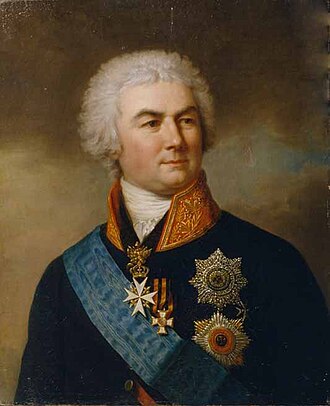
Portrait of Pyotr Zavadovsky
The Man Who Wept, and Was Trusted Anyway
In the catalog of Catherine the Great's favourites, Pyotr Vasilievich Zavadovsky stands apart. He was not the most powerful, not the most glamorous. He was, by most accounts, prone to tears. When Catherine ended their romantic relationship in 1777, he did not accept the transition with the equanimity court protocol required. He wept. He fell into melancholy.
And yet Catherine called him “the most sensitive of my friends” and kept him close for decades. She understood that his emotional openness was not weakness but a different kind of intelligence. He came from Ukrainian Cossack nobility and brought to court life a quality of genuine feeling that Catherine, surrounded by performers and schemers, clearly valued. She eventually appointed him Russia's first Minister of Public Education under Alexander I, a position he held from 1802 to 1810.
That's the INFJ at its most recognizable: the person in a court of masks who cannot wear one, and is ultimately trusted more because of it.
The INFJ does not thrive in environments that reward performance over substance. What Zavadovsky could do — what INFJ does better than almost any other type — was hold a coherent vision over long periods and organize his efforts around it with quiet persistence. His vision was of Russia educated, its intellectual potential developed.
The Long View of Russian Possibility
Ni dominant means living in a sustained relationship with the future — not as plans to be executed but as a felt sense of what the present moment is tending toward. For Zavadovsky, this manifested as an educational vision that predated his appointment and shaped its form from the start. He had thought about what Russian education could be — not as a series of policies but as a coherent picture of the society those policies should produce.
As minister he oversaw the creation of a national primary school system, supported new universities in Moscow, Kazan, Kharkov, and St. Petersburg, and established the principle — novel in Russia — that education was a state responsibility rather than a private matter for families and the church. These were not incremental improvements; they were the beginnings of an entirely new conception of the empire's intellectual infrastructure.
The connection to Ivan Betskoy's earlier projects is significant. Betskoy had the vision of the enlightened reformer; Zavadovsky had the patience to translate that vision into durable institutions. His Ni was organizational, persistent, long-term in a way that required no audience.
The Openness That Catherine Could Not Replace
Fe auxiliary means that the Ni vision is expressed through and for people — not as an abstract program but as genuine felt investment in their wellbeing. Zavadovsky cared, unusually for Catherine's court, about the actual people his policies would affect: the students who would attend the schools he was building, the rural families who might for the first time see their children receive a formal education.
His weeping when Catherine ended the relationship is often read as weakness, but it is better understood as Fe fully operational. He had been genuinely present with her, not performing the role of favourite. The men who succeeded him were more socially polished, more emotionally contained — better adapted to the revolving-door logic of Catherine's court — but they did not have what Zavadovsky had: the quality of attention that makes a person feel genuinely seen.
Catherine understood this precisely. The man who wept was the man who could be trusted to care about the right things when given real responsibility. His ministerial work justified that trust.
The Systematic Mind Behind the Feeling
Ti tertiary means real analytical capacity deployed in service of the Ni-Fe core. Zavadovsky's ministerial work was not merely sentimental; the university charters he wrote, the school networks he designed, the curricular frameworks he proposed — these required genuine intellectual rigor. They were products of systematic thinking applied to a coherent vision, not emotional enthusiasm in search of institutional form.
This is what distinguishes him from the INFP type he superficially resembles. The INFP's world is organized by Fi: personal values, internal authenticity. Zavadovsky's world was organized by Ni and Fe, structured by Ti to keep the vision tethered to organizational reality. The melancholy was real. The effectiveness was also real.
Why INFJ Over ISFJ or INFP
Why not ISFJ?
The ISFJ preserves and refines what has been established rather than envisioning what could replace it. An ISFJ in Zavadovsky's position would have maintained Betskoy's system with careful stewardship. But Zavadovsky was building a system that had not previously existed, animated by a vision of what Russian intellectual life could become. The ministerial work was Ni-driven: it began with a picture of the future and worked backward.
Why not INFP?
The INFP's depth is primarily internal — a private world of values and authentic self-expression. Zavadovsky's depth was relational: he was affected by Catherine because he was genuinely present with her; he built schools because he genuinely cared about the people they would serve. Fi depth turns inward; Fe depth turns outward. His melancholy was not the INFP's private wound — it was the INFJ's grief at the gap between what the world is and what the vision requires.
Zavadovsky's INFJ character is legible in the specific shape of his life: the sensitivity recognized as intelligence by the one person who mattered most to him, the educational vision that organized his work across decades, and a melancholy that was not self-pity but genuine grief at the difficulty of caring about things in a world that often does not. He was, as Catherine said, the most sensitive. He was also, in the fullness of his life, among the most effective.
Connected Figures
Further Reading
- Catherine the Great and Potemkin: The Imperial Love Affair — Simon Sebag MontefioreCovers Zavadovsky's unusually gentle tenure as favorite and his continued trust after leaving that role.
- Russia in the Age of Catherine the Great — Isabel de MadariagaThe standard account of the educational reforms Zavadovsky administered as Minister of Education.
- Catherine the Great: Portrait of a Woman — Robert K. MassieGives context for how a favorite as unassuming as Zavadovsky kept the empress's confidence for decades.
- The Memoirs of Catherine the Great — Catherine IIThe empress's own voice on the court and favorites, including men like Zavadovsky she trusted quietly.
