 Historical Figure MBTI
4 min read
#297 · 3-25-26 · Catherinian Russia
Prince Nikolai Putyatin
Prince · Military Servant · The Quiet Hand of the Old Russian Nobility
dates uncertain
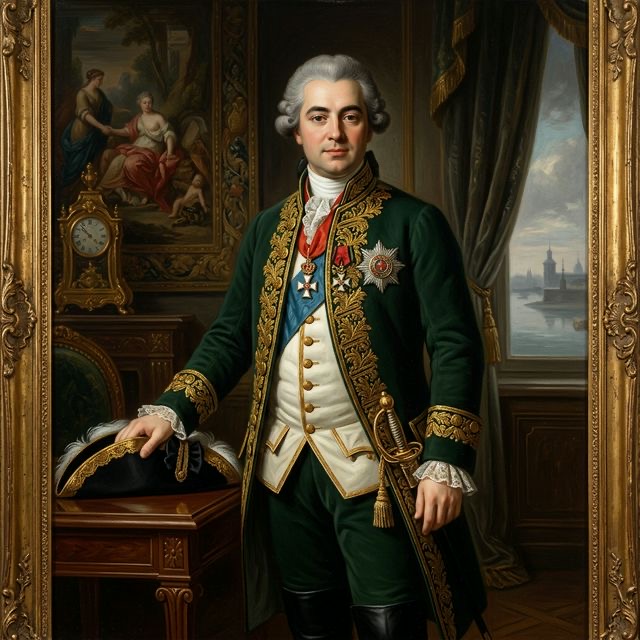
AI-assisted Portrait of Prince Nikolai Putyatin
The Soldier Who Did Not Need to Be Noticed
The Putyatin family was one of those Russian princely houses whose title stretched back before the Romanovs and whose relationship to the imperial state was accordingly complicated — proud of the antiquity, necessary to the new order, often more useful as a symbol of old Russia than as an engine of its modernization. Prince Nikolai Putyatin belonged to this world. He served, as the men of his class and generation served, in the military or at court, performing the functions the empire required without leaving the kind of detailed documentary record that administrators like his father-in-law Count Jacob Sievers routinely produced. He was, in the best sense of the phrase, a reliable officer: capable, self-contained, and uninterested in advertising his capabilities.
His marriage to Elisabeth von Sievers joined him to one of the most capable administrative families in the empire. The Sievers and Putyatin combination was a natural one — Sievers needed the legitimacy and military connection that a princely Russian family could provide; Putyatin gained access to the administrative networks and imperial favor that the Sievers family commanded. Nikolai himself likely navigated this alliance with the quiet competence that characterized his probable ISTP temperament: practical, adaptable, effective in his specific domain, and content to leave the larger political maneuvering to others.
ISTP is a type defined by an internal logical precision — Ti dominant — paired with a facility in the physical world — Se auxiliary — that makes its carriers exceptionally capable in environments that reward technical skill and situational awareness. The military world of Catherinian Russia, with its campaigns against the Turks and Poles, its regimental cultures, and its hierarchies organized around demonstrated physical courage and tactical competence, was exactly the environment in which an ISTP thrives. Nikolai Putyatin would have been most himself not in the drawing room but in the field: in the specific, concrete problems of military command, logistics, and physical endurance.
Old Title, New Empire
The old Russian princely families occupied an awkward position in Catherine's empire. Their titles predated the Romanovs, and some carried an undercurrent of resentment at the way Peter the Great had reorganized Russian nobility on meritocratic-administrative lines rather than hereditary ones. But the most pragmatic among them — and the Putyatins were pragmatic — recognized that the only viable path was service. Not the intensive, data-producing, reform-drafting kind of service that figures like Sievers exemplified, but the steady, unflashy, physically present service of the military officer who shows up, performs competently, and does not make trouble.
This was not submission; it was strategy. An ISTP in Nikolai Putyatin's position would have understood, at some unspoken level, that the way to preserve the family's position and dignity was to be genuinely useful — not in the abstract, philosophical sense that idealists sometimes mistake for usefulness, but in the immediate, practical sense that makes a commander valuable to his superiors and his men. Ti dominant personalities excel at this: they find the logical structure of whatever domain they inhabit, identify what actually needs to be done to produce results within it, and do that without wasting energy on the performance of effort or the politics of visibility.
His connection through marriage to the Sievers administrative network would have given him access to a world quite different from the military one — the world of provincial reform reports, canal surveys, and gubernatorial correspondence that his father-in-law occupied. He almost certainly did not share Count Sievers's appetite for that kind of work. The ISTP's intelligence is not the abstract, systems-mapping intelligence of the INTJ; it is a more immediate, situational intelligence, most at home when the problem has physical dimensions and the solution can be tested directly. Military service gave Nikolai Putyatin exactly that environment. Administrative reform did not.
Psychological Verdict
Nikolai Putyatin is, in the record of Catherinian Russia, one of the silences — a figure known primarily through his family connections rather than his individual deeds. This is partly the ordinary silence of any minor noble whose career produced no dramatic moments worth recording. But it is also a temperamental fact: ISTP personalities are not drawn to self-documentation. They do not produce the voluminous correspondence that Sievers produced, the public speeches that statesmen leave behind, the diaries and memoirs that survive their authors. They tend to exist in the record as names attached to deeds rather than authors of self-narration.
What we can reconstruct suggests a man who served capably in a military or court role, managed the transition between two very different noble worlds through his marriage to Elisabeth von Sievers, and embodied the old Russian princely tradition at a moment when that tradition was being slowly absorbed into the meritocratic administrative culture his in-laws represented. He was probably more comfortable in that older world than in the newer one — more at ease with the physical directness of military service than with the abstract policy discussions his father-in-law inhabited. As an ISTP, he would have found his competence and his identity in the concrete and the immediate, in doing what needed doing without requiring that the doing be particularly noticed or remembered.
Connected Figures
Further Reading
- Russia in the Age of Catherine the Great — Isabel de MadariagaThe standard account of the old princely houses, like Putyatin's, whose service left little documentary trace.
- The Romanovs: Autocrats of All the Russias — W. Bruce LincolnPlaces Putyatin among the ancient nobility more useful as symbols of old Russia than engines of reform.
- Catherine the Great and Potemkin: The Imperial Love Affair — Simon Sebag MontefioreCovers the court and administrative circles that connected Putyatin to his father-in-law, Jacob Sievers.
