 Historical Figure MBTI
5 min read
#296 · 3-25-26 · Catherinian Russia
Elisabeth von Sievers
Princess Putyatina · Sievers Daughter · Bridge Between Two Noble Houses
dates uncertain
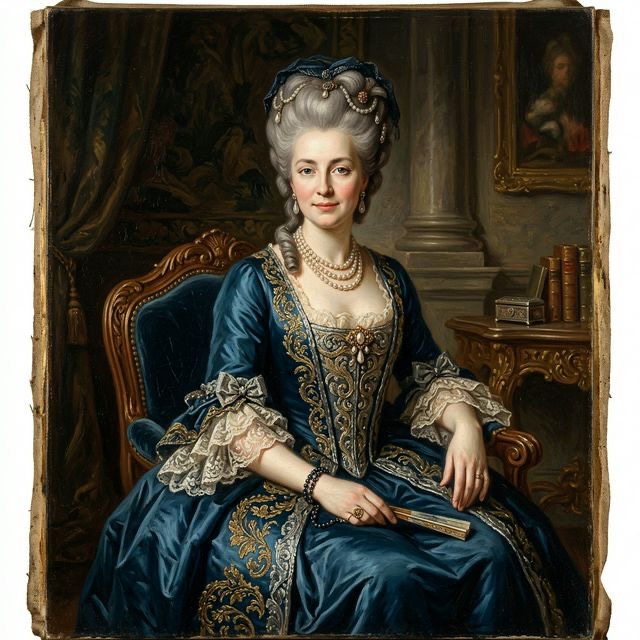
AI-assisted Portrait of Elisabeth von Sievers
The Connective Tissue of Two Empires
Baltic German noble families in Catherine II's Russia occupied a peculiar position: Lutheran by faith, German by language and culture, Russian by service and imperial loyalty. They built careers at a court that valued their efficiency and education, and they cemented those careers through a dense web of strategic marriages that linked German administrative families to Russian princely houses. Elisabeth von Sievers — daughter of the great reforming governor Count Jacob Sievers and wife of Prince Nikolai Putyatin — was one of the women who held that web together. Her marriage itself was a statement: the daughter of the empire's most capable German administrator, joining herself to one of Russia's old princely families. In her person, two traditions of service met.
The dates of her birth and death are uncertain — she exists, as many women of her class and era do, in the margins of records organized around male careers. But the world she inhabited is knowable: the sprawling Sievers household in Novgorod and St. Petersburg, where her father received correspondence from the empress and hosted the minor bureaucratic nobility that kept the empire running; the Putyatin household she married into, with its military traditions and its Russian Orthodox spirituality; and the space between them, which she would have navigated in both directions for most of her life. Baltic German women of this era were typically educated — French, German, Russian, music, the classics — and they were expected to serve as social translators as much as household managers.
Temperamentally, Elisabeth reads as ENFJ: a woman whose social intelligence was not incidental but constitutive of her role, who managed the emotional and relational work of maintaining two family networks across a cultural divide. The dominant function here is Fe — the attunement to what others need, the skill at managing group harmony, the ability to read a room and respond to its unspoken dynamics before they become explicit conflicts. This was not ornamental. In the cross-cultural noble households of Catherinian Russia, the ability to make Germans and Russians comfortable in the same drawing room was a genuine diplomatic achievement, performed daily and almost invisibly.
Diplomat of the Drawing Room
There is a particular kind of social intelligence that manifests not in grand gestures but in the management of small moments: the phrasing that doesn't give offense, the introduction that puts strangers at ease, the memory for what matters to each person in the room. Elisabeth von Sievers would have exercised this capacity constantly. Her father's administrative circle was staffed largely by men of Baltic German origin — earnest Lutherans with a preference for order and precision, not always comfortable in the Orthodox ceremonialism of the Russian court. Her husband's family carried the older Russian traditions: the icons, the patronymics, the deep identification with Russian military honor. Between these two worlds, Elisabeth moved.
The ENFJ reads social dynamics with a kind of long-range sensitivity that goes beyond mere politeness — an ability to anticipate friction before it materializes and to position people relative to each other in ways that minimize conflict. In the specific context of Catherinian noble society, this meant something practical: managing the delicate business of who sat next to whom, which conversations to encourage and which to redirect, how to honor both the German Protestant sensibility of the Sievers household and the Russian Orthodox expectations of the Putyatin one without making either side feel that their traditions had been subordinated. These are the skills that leave almost no documentary trace but determined whether households and alliances held together.
Her connection to both families also gave her a kind of information network — the natural byproduct of being a nexus between two prominent households. What was happening in the Novgorod administration; what the military men were saying about the latest campaigns; what the court gossip implied about the empress's current favorites and their prospects. The ENFJ's auxiliary Ni allows this social information to be read not just as gossip but as pattern — as an ongoing map of who is rising, who is threatened, where the relationships that matter are heading. In a society where fortune was entirely dependent on imperial favor and the networks that channeled it, this was not a trivial skill.
Psychological Verdict
Elisabeth von Sievers is one of those figures whose historical significance is almost entirely relational — she matters because of who she connected, not what she built or wrote or commanded. This is partly the limitation of the historical record, which systematically preserved the records of administrators and military men while leaving the women of their households in shadow. But it also reflects something real about her role: she was, in the ENFJ sense, a person whose primary gift was the management of human connection across difference.
An ENFJ reading of her life suggests a woman of genuine social intelligence and probably real personal warmth — not merely the polished surface of a well-trained noblewoman, but someone who cared about the people around her and found meaning in the work of holding communities together. The marriage between the Sievers and Putyatin families was, among its other functions, a social achievement, and she was its living embodiment. That she did this work largely invisibly, in the spaces that history does not record, does not diminish it. The connective tissue of any society is precisely the tissue that cannot be seen until it tears.
Connected Figures
Further Reading
- Russia in the Age of Catherine the Great — Isabel de MadariagaCovers the Baltic German administrative elite, including her father Jacob Sievers, whose world Elisabeth bridged into the Putyatin family.
- The Romanovs: Autocrats of All the Russias — W. Bruce LincolnTraces the Romanov state's reliance on Baltic German service families like the Sievers across generations.
- Catherine the Great: Portrait of a Woman — Robert K. MassieSets the cross-cultural marriages of Catherinian court society, exemplified by Elisabeth's own, within the reign's broader portrait.
