 Historical Figure MBTI
#313 · 3-26-26 · Catherinian Russia
Ekaterina Bastidon
Plenira · Derzhavin's First Muse · Radiant Young Wife
1757 — 1794
3 min read
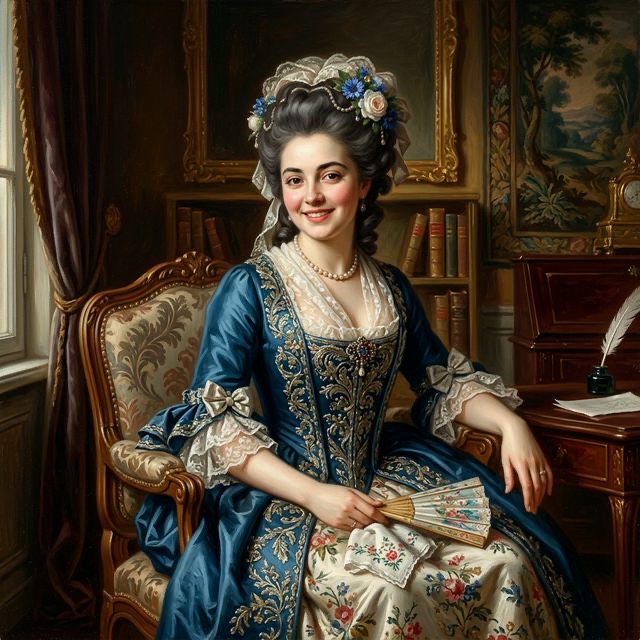
AI-assisted Portrait of Ekaterina Bastidon
Plenira: The Name He Gave Her
Ekaterina Bastidon was born in 1757 into a Portuguese musical family at the Russian imperial court — her father was one of the many European musicians Catherine II had drawn to St. Petersburg. In 1778 she married Gavrila Derzhavin, fourteen years her senior and well on his way to becoming the dominant literary voice of his generation.
Derzhavin gave her a name in his poetry: Plenira, from the Latin plenior — “fuller,” “more complete.” It became a public emblem of everything he associated with her: warmth, presence, life fully inhabited. She was known for her music, her vivacity, the quality of animation she brought into rooms. He was a bureaucrat-poet navigating the court and accumulating political consequence. She was his opposite — alive to the immediate, the sensory, the social.
She died in 1794 at thirty-six, before Derzhavin had reached the peak of his official career. He continued to write elegies for Plenira for years afterward — a private grief made public through verse. His odes to Plenira are among the most personal things he wrote, the places where the ceremonial rhetoric drops away and something more exposed appears.
The Poet's Muse and His Grief
Derzhavin's great odes — to Catherine II, to Felitsa, to God — are official performances in the high Enlightenment manner. Running alongside them, through the years of marriage, were the Plenira poems: personal, domestic, drawing on an emotional register the public odes never reached. She was not a literary collaborator; she was something that for a certain kind of poet matters just as much — the embodied presence that makes life feel worth living in the present tense.
Derzhavin remarried after her death — to Darya Dyakova, capable and steady for his remaining twenty-two years. The Plenira poems continued anyway. Darya managed his estate at Zvanka and preserved his papers; Ekaterina had given him the material for his most emotionally direct verse. Both contributions mattered, but they were not the same kind of thing.
Psychological Verdict
The portrait that emerges from the Derzhavin poems and contemporary references is of a woman characterized by warmth, musicality, and full presence in the moment — qualities that align with the ESFP profile. That Derzhavin chose the name Plenira — fullness, completeness — suggests exactly this quality: she filled things out, made them more themselves. Her musical background reinforces the reading: the court performance tradition rewarded Se-dominant types who live in the world of sound and social immediacy rather than abstraction. Her death at thirty-six is the ESFP's particular tragedy in concentrated form — a temperament built for the present moment, cut off before it had run its course. Derzhavin mourned her for twenty years, which tells you the quality of what was lost.
Connected Figures
Further Reading
- Russia in the Age of Catherine the Great — Isabel de MadariagaFrames the musical, cosmopolitan St. Petersburg court culture into which Ekaterina Bastidon's family was drawn.
- Catherine the Great: Life and Legend — John T. AlexanderProvides the era's texture for a marriage like Bastidon and Derzhavin's, forged inside Catherine's rising bureaucratic elite.
- Catherine the Great: Portrait of a Woman — Robert K. MassieSketches the imperial court's appetite for imported European talent, the milieu that brought Bastidon's musician father to Russia.
