 Historical Figure MBTI
#314 · 3-26-26 · Catherinian Russia
Darya Dyakova
Milena · Derzhavin's Second Wife · The Practical Companion
1760 — 1842
3 min read
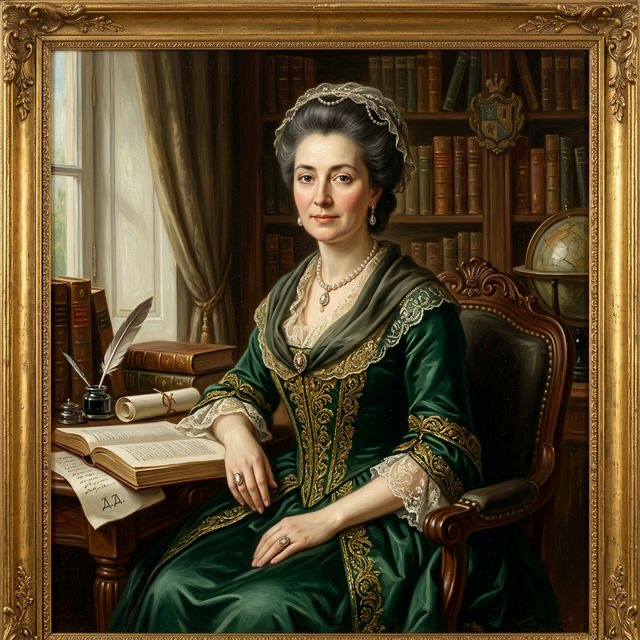
AI-assisted Portrait of Darya Dyakova
Milena: The Second Chapter
In 1794, four months after the death of Ekaterina Bastidon, Darya Dyakova married Gavrila Derzhavin — the ode-poet who had just buried his first wife and the woman he called Plenira. She was thirty-four; he was fifty-one. It was a practical union: he needed a capable domestic partner, and she brought organizational ability, social ease, and a steady temperament to a household that had just suffered a significant loss.
Derzhavin gave her a name in his poetry: Milena. He did not stop writing about Plenira — the elegies continued alongside the Milena poems — and Darya appears to have accepted this without resentment. The first wife's memory was not a rival to be displaced but a fixed feature of the emotional landscape she was now inhabiting. She got on with the practical management of a life and a household instead.
She outlived Derzhavin by twenty-six years, managing his estate at Zvanka until her own death in 1842 at eighty-two. After 1816 she organized and preserved his literary papers, corresponding with those who sought information about him, acting as the primary custodian of his posthumous reputation. She was efficient, organized, and thorough — qualities that determine whether a poet's legacy survives the chaos of an estate.
The Keeper of Zvanka
The parallel with Marie-Angélique Diderot is striking: both women devoted their later decades to preserving a famous man's literary legacy after his death. Both produced biographical memoirs — Darya wrote accounts of Derzhavin's life and work; Marie-Angélique wrote her Mémoires for Diderot. Both worked in relative obscurity, their organizational labor invisible behind the published work of the men they served.
Zvanka became a literary pilgrimage site in the early nineteenth century — poets and critics came to consult Darya on questions about Derzhavin's work, to examine the manuscripts she preserved. She was the institution's human face: calm, knowledgeable, able to provide the factual and anecdotal material that literary biography requires. Holding a legacy together across decades is the ISTJ's particular gift to the historical record.
Psychological Verdict
Darya Dyakova's life — eighty-two years, forty-eight of them as Derzhavin's wife or widow — is the ISTJ in its most characteristic form: reliable, organized, loyal to specific people and specific responsibilities over the long run. The ISTJ does not seek emotional drama; they seek to do what needs doing, consistently and well. Managing Zvanka for decades, preserving the manuscripts, remaining the primary source on Derzhavin's life until her own death: unglamorous, indispensable, durable.
Her willingness to coexist with Ekaterina Bastidon's memory without apparent resentment reflects the ISTJ's capacity for accepting practical realities without needing to reframe them emotionally. She did not need to displace Plenira; she needed to manage the household and the estate. The contrast with Ekaterina — warmth, musical vivacity, immediate presence — is the contrast between ESFP and ISTJ: two different orientations, two different gifts, both of which Derzhavin needed at different stages of his life.
Connected Figures
Further Reading
- Russia in the Age of Catherine the Great — Isabel de MadariagaProvides context for the literary and court culture Darya managed at Zvanka after marrying Derzhavin.
- Catherine the Great: Life and Legend — John T. AlexanderSets the practical remarriages common at Catherine's court against Darya's steady, capable second marriage to Derzhavin.
- Catherine the Great: Portrait of a Woman — Robert K. MassieGives the wider social backdrop for a household like Derzhavin and Darya's, run by a woman skilled at practical management.
