 Historical Figure MBTI
#315 · 3-27-26 · The Enlightenment
Voltaire
Philosophe · Satirist · Correspondent of Catherine · Patriarch of Ferney
1694 — 1778
6 min read
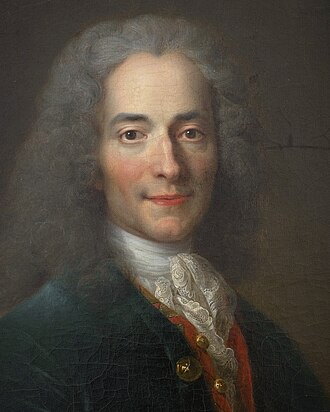
Portrait of Voltaire
The Machine That Never Stopped Thinking
No single figure so thoroughly embodies the French Enlightenment as the man born François-Marie Arouet in 1694 and known to posterity simply as Voltaire. He produced more than fifty major works and upward of twenty thousand letters—a correspondence that circled the courts of Europe and reached from Frederick the Great in Prussia to Catherine II in St. Petersburg, who called him her “divine man.” By the time he died in 1778, returning to Paris in triumph after nearly three decades of exile, he had become the most famous person in the Western world—and he had engineered that fame with something approaching scientific precision.
What powered this machine was a restless, proliferating intelligence that could not encounter an idea without immediately testing its limits or spinning it into five new directions. Imprisoned in the Bastille twice before he was thirty, exiled to England in 1726, he spent the last two decades of his life at the Château de Ferney near Geneva—close enough to the Swiss border to disappear if authorities came calling, far enough from Paris to maintain the pose of a detached patriarch. From Ferney he corresponded with half of Europe, published in a torrent, and became what no Enlightenment figure had quite managed before: a celebrity intellectual whose every provocation was news. He is the ENTP at full pitch.
Voltaire was the ENTP at full pitch—an intellect that generated ideas as naturally as breathing and then deployed them as weapons, always needing an audience, always needing an enemy, always needing the next fight.
The Proliferating Mind
Ne — dominant
Dominant Ne does not specialize; it colonizes. Voltaire wrote verse tragedy in the manner of Racine and then satirized those very conventions in the same decade. He produced a serious history of Charles XII of Sweden and then, in Candide, eviscerated Leibniz through a traveling comedy of horrors. He wrote Newtonian popularizations and the deliberately unsystematic Philosophical Dictionary—a compendium that worked by juxtaposition and provocation, not architecture. Each domain was another angle on the same underlying question: what is superstition, and how do you kill it?
The England years (1726–1729) show Ne at its most generative. Voltaire arrived as a bitter exile and left with a new mental landscape—Locke's empiricism, Newton's method, and the English practice of religious tolerance absorbed not as academic study but as intellectual ammunition. His Letters Concerning the English Nation used England as a mirror held up to French backwardness. Ne thinks comparatively, always asking what another tradition reveals about the one under examination. The Calas affair of 1762—in which he championed a Protestant merchant falsely convicted of murdering his son—showed the same instinct applied to jurisprudence, and even there he was simultaneously writing plays, corresponding with Catherine, and publishing philosophical squibs. The ENTP does not focus; it multiplies.
The Weaponized Intellect
Ti — auxiliary
If Ne supplied the ammunition, auxiliary Ti showed Voltaire how to aim. It is not interested in whether an idea is socially acceptable; it wants to know whether it is internally consistent. The ENTP's Ti is a quality-control mechanism on Ne's proliferations, stripping rhetoric to expose contradictions. In Voltaire's hands this became the defining polemical method of the French Enlightenment: find the logical structure of an opponent's position, locate where it collapses, and illuminate that collapse with enough theatrical vividness that no reader can unsee it.
Candide (1759) is Ti operating at its purest. Leibniz's optimism—this is the best of all possible worlds—is not refuted by philosophical argument but dissolved by systematic narrative demonstration. Dr. Pangloss repeats his formula through earthquake, inquisition, and slavery; each repetition makes it more grotesque. Voltaire does not rebut the principle; he follows it faithfully to reality and lets the reductio do the work. His campaign against the Church—“Écrasez l'infâme!”—was the same method applied to an institution: expose the gap between its professed values and its historical record, demolish the motivated reasoning that papers over the gap, and repeat until the audience cannot ignore the contradiction.
The Performer Who Needed an Audience
Fe — tertiary
Tertiary Fe in an ENTP produces not warmth but something more theatrical: a calibrated awareness of social atmospheres and an instinct for what an audience wants to feel. Voltaire wrote more than fifty plays, directed amateur productions at Ferney, and understood instinctively that the Enlightenment's arguments needed to be performed to reach beyond the educated elite. The pen name “Voltaire”—a more aristocratic-sounding identity than the bourgeois “Arouet”—was itself a performance decision. His correspondence with Catherine II was a carefully orchestrated exchange of flattery and intellectual sparring; when she bought his library and installed him as its paid keeper, he accepted with a performance of grateful humility that was entirely strategic.
He was not, at bottom, a deeply empathetic man. His correspondence contains anti-Semitic passages that no amount of Enlightenment enthusiasm can excuse. Tertiary Fe is social intelligence deployed in service of the self and its causes, not an end in itself. Voltaire cared about humanity in the abstract far more reliably than he cared about any particular human being who stood in his way.
The Exile Who Never Forgot
Si — inferior
Inferior Si in an ENTP expresses itself in two ways: an ambivalent relationship to tradition (which Ne dismisses while Si secretly craves), and an unusually tenacious memory for personal injury. Voltaire displayed both. He championed reason against what he saw as the dead weight of tradition, yet his Age of Louis XIV and Essay on the Customs and Spirit of Nations were genuine contributions to historiography. He needed the past even as he argued against its authority.
The grudges were more straightforward. His first Bastille imprisonment in 1717—for satirical verses aimed at the Regent—left a permanent alertness to the dangers of power. His second imprisonment in 1726 and exile to England deepened the wound. He spent the next fifty years keeping himself just far enough from Paris to be safe. The twenty years at Ferney were an inferior Si resolution: the restless ENTP finally building a fixed point. He planted trees (famously remarking that an old man who plants trees believes in the future), established watchmaking workshops, and created a small community of dependents he genuinely felt responsible for—the inferior function finding its late expression, roots in service of an endless war against everything that refused to make sense.
Why ENTP Over INTP
Why not INTP?
The INTP builds internal systems and engages the world reluctantly, on its own terms. Voltaire did the opposite: he went looking for fights, cultivated audiences, staged his own celebrity, and was constitutionally incapable of detachment from the social arena. An INTP of comparable intelligence—think Hume, or Kant—produces work of systematic depth from relative social withdrawal. Voltaire's work covers enormous terrain rapidly, sacrificing architecture for impact. He needed the stage; the INTP needs the study.
The Fe dimension is decisive. “I disapprove of what you say, but I will defend to the death your right to say it”—that is an Fe formulation. The INTP would simply note that suppressing speech is logically incoherent. Voltaire felt censorship as an affront to the shared intellectual atmosphere that makes civilization possible; the Calas campaign was driven not by abstract principle alone but by the theatrical horror of an innocent man tortured and executed, an image demanding public outrage. ENTPs use Fe to mobilize; INTPs prefer to demonstrate. Voltaire always mobilized.
Connected Figures
Further Reading
- Voltaire: A Life — Ian DavidsonThe most readable modern biography in English — authoritative on the Ferney years and the Calas affair.
- Candide — Voltaire (trans. Theo Cuffe)The essential primary text; the Penguin Classics translation preserves the satirical velocity.
- Letters Concerning the English Nation — Voltaire (ed. Nicholas Cronk)The work that introduced English empiricism and tolerance to France — and nearly landed Voltaire in the Bastille again.
- Voltaire: A Very Short Introduction — Nicholas CronkThe best compact overview of Voltaire's intellectual range and historical significance.
- The Philosophers of the Enlightenment — Peter GaySituates Voltaire within the broader Enlightenment project and its social and political consequences.
