 Historical Figure MBTI
#304 · 3-26-26 · The Enlightenment
Denis Diderot
Philosophe · Encyclopédiste · Dreamer of Systems
1713 — 1784
8 min read
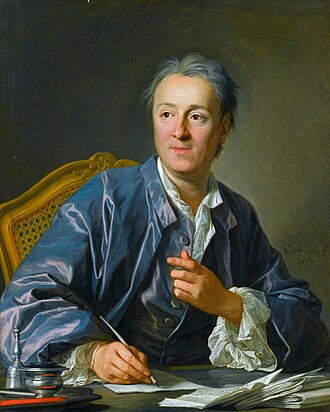
Portrait of Denis Diderot
The Man Who Could Not Stop Caring
Denis Diderot arrived in Paris from Langres in 1728, the son of a master cutler who had given him a first-rate Jesuit education and then watched him refuse a respectable career in the law. What followed was decades of cheerful poverty and one of the most ambitious cultural projects in history: the Encyclopédie (1751–1772), twenty-eight volumes mapping the whole of human knowledge to demonstrate that reason—not divine authority—was the proper ground of truth. Diderot was its chief editor, primary contributor, and most passionate defender for more than twenty years.
Yet the Encyclopédie is only part of the picture. He also wrote Rameau's Nephew, one of the strangest dialogues in French literature; Jacques the Fatalist, a novel that plays games with its own narrative machinery; and D'Alembert's Dream, a speculative dialogue about materialism and biology that anticipated science by a century. His Salons—published in Grimm's Correspondance littéraire—founded art criticism as a genre. He corresponded for decades with Sophie Volland in letters that remain among the finest in the French language. His mind moved in every direction simultaneously—and he cared, with equal intensity, about all of it.
The type that explains this is the ENFP: dominant extraverted intuition generating visions of how the world could be different, anchored by auxiliary introverted feeling that made those visions morally urgent rather than merely interesting, organized by tertiary extraverted thinking capable of managing the Encyclopédie's logistical demands, and haunted by inferior introverted sensing expressed as a lifelong complicated relationship to home. Where Voltaire used ideas as weapons, Diderot used them as acts of faith.
Diderot was the ENFP as encyclopedist—a man whose imagination was always outrunning his century, who cared too much to be merely clever, and who gave the best decades of his life to a project that mattered more to him than his own fame.
The Encyclopédiste's Imagination
Ne — dominant
The Encyclopédie was, at its core, an Ne project: the conviction that all of human knowledge could be mapped in a single structure and that exposing the connections between fields would itself be transformative. Diderot's cross-references —pointing readers from theology to philosophy to natural science and back, often with subversive intent—were Ne thinking made institutional. He was not cataloguing knowledge; he was showing how ideas undermine and illuminate one another.
His literary work displays the same quality. Rameau's Nephew, written over decades and never published in his lifetime, pits a rational philosopher against the brilliant, amoral nephew of the composer Rameau—a figure so sharp he is more compelling than the philosopher himself. The text refuses resolution; Ne finds it more interesting to map the territory of a problem than to settle it. Diderot was drawn to ideas that resisted closure—free will and determinism in Jacques the Fatalist, mind and matter in D'Alembert's Dream—because irresolvability was where the thinking lived.
His Letter on the Blind (1749), speculating about whether morality could exist without vision, got him imprisoned at Vincennes for four months—the authorities recognized its materialism as theological provocation wrapped in philosophical puzzle. Diderot kept producing these puzzles because Ne cannot stop finding them.
The Moralist Who Felt Everything
Fi — auxiliary
What distinguished Diderot from the other great ENPs of his circle was auxiliary Fi—a moral seriousness that made intellectual commitments feel like ethical obligations. He did not oppose slavery because it was inconsistent with natural law; he opposed it because it was wrong. His contributions to the abbé Raynal's Histoire des deux Indes (1780) contain some of the most passionate anti-colonial writing of the century—read not as polemic but as personal offense, quite different from Voltaire's cooler distance.
The letters to Sophie Volland are the purest window into this Fi. Diderot wrote to her thousands of times over nearly thirty years, remarkable not for philosophical content but for emotional texture: the minute registrations of mood, the way a dinner party or a piece of music could open him entirely to feeling. Fi does not perform feeling; it inhabits it—and these letters, unpublished in his lifetime, are among the most honest prose of the century.
The artisans and craftsmen who contributed to the Encyclopédie—glassmakers, weavers, locksmiths whose expertise Diderot documented with meticulous respect—were not abstractions to him. He believed their knowledge was as philosophically significant as the knowledge of scholars. Fi makes the moral case personal before it makes it general.
The Project Manager of the Enlightenment
Te — tertiary
Nothing in Diderot's biography demanded tertiary Te more urgently than the Encyclopédie. The project required coordinating over 150 contributors —scientists, philosophers, craftsmen, physicians, economists—across more than twenty years: negotiating with publishers, managing censors, replacing collaborators who dropped out (d'Alembert resigned the co-editorship in 1758), and continuing to produce his own enormous volume of entries while holding the enterprise together.
What saved the project was Diderot's willingness to make unsentimental decisions. When the publisher Le Breton secretly censored passages from the final volumes after Diderot had already corrected the proofs, Diderot's response was one of the most anguished passages he ever wrote. But he did not collapse; he completed the project. Tertiary Te operates in service of Ne and Fi: it gets the work done. His years writing the Salons for Grimm's newsletter—on demand, on schedule—showed the same pattern: Te in service of someone else's structure, which suited Diderot well.
Roots in Langres
Si — inferior
Diderot left Langres for Paris in 1728 and never returned to live there. Yet Langres never left him. His father, the cutler Didier Diderot, appears throughout his correspondence as a figure of moral seriousness—a craftsman whose practical expertise represented a value the salons could not match. The Encyclopédie's famous plates depicting artisan tools and trades were partly a tribute to that paternal world. Inferior Si works this way: anchoring the dominant intuitive in memory and origin, surfacing as a pull toward what was there before the ideas began.
His Catholic upbringing was a similar case. Diderot broke with the Church early, becoming a materialist who denied the immortality of the soul. But the moral seriousness of his Jesuit education never left; it migrated from theological to humanist grounds. You can take the man out of the Church, but you cannot always take the Church's moral architecture out of the man.
His trip to St. Petersburg in 1773–74 to visit Catherine II showed inferior Si under stress. The journey east at sixty was physically and emotionally exhausting; his daily conversations with Catherine were exhilarating, but the court environment unsettled him. He returned to Paris tired, ill, and grateful to be home in a way that surprised him—the discovery that the particular place and the particular people mattered in ways the grand project had too easily elided.
Why ENFP Over ENTP
Why not ENTP?
The ENTP argues to win, to expose, to destabilize. Diderot argued because truth mattered morally—an obligation, not a game. His auxiliary Fi gave his positions a personal weight the ENTP's Ti-driven polemics lack: where Voltaire could hold almost any position ironically, Diderot's commitments were his own in a way that cost him something to maintain. His opposition to censorship was a wound; his championship of the artisans' knowledge was love. An ENTP would have written the Encyclopédie faster. Diderot wrote it with his whole self, which is why it still reads as though something was at stake.
The comparison with Voltaire sharpens this. Voltaire managed his celebrity with strategic intelligence; Diderot was repeatedly surprised when his candor got him into trouble. Voltaire knew when to retreat; Diderot kept arguing because he could not separate the intellectual case from the moral one. The ENTP knows when to disengage. The ENFP's Fi makes disengagement feel like betrayal—and the Encyclopédie exists because Diderot never quite disengaged.
Connected Figures
Further Reading
- Diderot: A Critical Biography — P. N. FurbankThe standard English-language life — thorough, skeptical, and indispensable for understanding the man behind the project.
- The Encyclopédie of Diderot and d'Alembert: Selected Articles — John Lough (ed.)A curated English translation that shows the range and subversive ambition of the project at its best.
- Rameau's Nephew and Other Works — Denis Diderot (tr. Jacques Barzun & Ralph H. Bowen)The primary texts — Rameau's Nephew, D'Alembert's Dream, and the Supplement to Bougainville's Voyage — that show Diderot's fiction at full stretch.
- The Encyclopédistes as Individuals: A Biographical Dictionary of the Authors of the Encyclopédie — Frank A. Kafker & Serena L. KafkerMaps the network of contributors — essential context for appreciating what Diderot actually coordinated.
- Diderot and the Art of Thinking Freely — Andrew S. CurranA recent biography that emphasizes the radical materialism and its implications for Enlightenment thought.
