 Historical Figure MBTI
#307 · 3-26-26 · The Enlightenment
Friedrich Melchior Grimm
Baron · Correspondent · Cultural Diplomat of the Enlightenment
1723 — 1807
7 min read
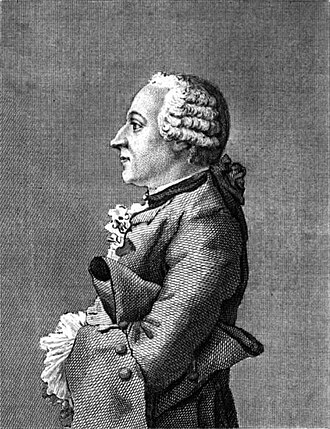
Portrait of Friedrich Melchior Grimm
The Man Who Sold the Enlightenment to Crowned Heads
Friedrich Melchior Grimm arrived in Paris from Regensburg in 1748 and within a decade had built something that had never existed before: a private intelligence service for the enlightened courts of Europe, trafficking exclusively in ideas. His Correspondance littéraire, the biweekly newsletter he edited from 1753 to 1773, was sent under seal to Catherine the Great, the King of Poland, and various German princes. It contained no news of politics or war — only reviews of new plays, assessments of Salon paintings, gossip about the philosophers. Subscribers paid handsomely for what they could not buy elsewhere: a trusted, sophisticated eye in Paris.
He was not a philosopher, though he knew all of them — his friendship with Denis Diderot was one of the defining relationships of his life, and his intimacy with Madame d'Épinay gave him a permanent foothold in the salon world. He was not a diplomat, though he acted as Catherine II's most trusted cultural agent in Paris. He occupied a position entirely of his own invention: the indispensable intermediary between two worlds that needed each other but could not reach each other without him. The ENTJ sees institutional gaps others overlook. Grimm saw that courts' appetite for French cultural prestige was enormous and structurally unmet — and built the mechanism to supply it.
An ENTJ who understood that cultural power and institutional power were different currencies and spent twenty years building the exchange rate between them, Grimm remains the most consequential cultural broker of the Enlightenment that almost no one remembers.
The Newsletter as Empire
Dominant Te organizes external reality through systems and efficient information flow. Grimm's Correspondance was a masterpiece of institutional entrepreneurship: handwritten to avoid censorship, sent under seal to carefully selected subscribers, maintained with remarkable reliability for over two decades. His reviews are crisp and confident. He did not waste subscribers' time with hedging. He assessed, ranked, and moved on. Royal courts were not paying for nuance; they were paying for the clear judgment of a trusted expert who had done the attending and assessing so they did not have to.
The information monopoly lasted because no competitor had Grimm's combination of standing in the salon world, trust in the courts, and the specific friendships that produced inside information. The network was the product, and the network was him.
The Long Game
Auxiliary Ni gives the ENTJ long-range pattern recognition — seeing not just what is useful now but what will be essential later. Grimm's relationship with Catherine II is the clearest expression of this in his life. He began corresponding with her in the 1760s, cultivated the relationship through the Correspondance, and became her most trusted Parisian agent — consulted on which paintings to buy, which French intellectuals to invite to St. Petersburg. The relationship lasted until her death in 1796, when Grimm was nearly seventy.
He understood early that Catherine was not merely a royal subscriber but a figure of enormous potential significance for the Enlightenment's self-conception. He advised on the Crozat collection, one of the great art purchases of the century; he facilitated Diderot's visit to St. Petersburg in 1773. These were moves in a strategy of positioning Catherine as the philosopher-queen the French Enlightenment needed, and Grimm as the indispensable intermediary. After the Revolution, he had built relationships across enough political regimes that no single collapse could destroy his position. This is Ni applied to career survival.
The Social Performer
Tertiary Se makes a person effective in rooms. Diderot's Rameau's Nephew contains what is widely read as a portrait of Grimm: a brilliant, socially masterful figure who has reduced human interaction to a performance, irresistible and somehow hollow. The portrait captures Diderot's genuine ambivalence — Grimm was his closest friend and also his antithesis, the man who had turned the social world into an instrument while Diderot remained constitutionally unable to. He was charming not because social performance was his deepest drive but because his Te needed access to those rooms and his Se made access easy: not the natural warmth of an Fe user, but the responsive, confident engagement of someone who understands the room as a resource.
The Costs of Calculation
Inferior Fi is the function the ENTJ cannot easily access — private moral feeling, values held for their own sake, relationships whose worth cannot be measured in strategic terms. Its most revealing expression for Grimm was his break with Jean-Jacques Rousseau. They had been close in the early 1750s; when the break came, it was bitter and lasting. Rousseau believed Grimm had managed their friendship with the same efficiency he managed everything else. He genuinely did not understand how his Te navigation read to someone operating from dominant Fi. What felt like competent social management felt to Rousseau like cold exploitation.
The deeper cost: Grimm occupied, his entire adult life, a position between worlds — German in a French cultural world, a commoner managing crowned heads, an intellectual entrepreneur before that category existed. He belonged nowhere. The intermediary is never fully of either world he connects. Whether inferior Fi ever made him feel it is not recorded.
Why ENTJ Over INTJ
Why not INTJ?
The INTJ builds a solitary, internally coherent vision that does not depend on other people to exist. Grimm built an institution that was entirely relational, dependent at every point on specific human connections — subscribers, salon hosts, artists, Catherine herself. The INTJ would have found this structurally intolerable. Grimm thrived on it. His Se-tertiary social fluency — the genuine ease in rooms, the charm Diderot both admired and mistrusted — is simply not available to the INTJ, whose Te-Si stack makes social performance effortful. Grimm's career required the external orientation of the E; he only existed fully in relation to other people and institutions.
Voltaire built a reputation on ideas; Diderot built the Encyclopédie on ideas. Grimm built a delivery mechanism for other people's ideas. This is the ENTJ move: identify what the system needs, build the mechanism to supply it. The ideas were not his; the institution was. And the institution, for twenty years, shaped the cultural self-image of half the courts in Europe.
Connected Figures
Further Reading
- Grimm: Correspondance littéraire, philosophique et critique — Friedrich Melchior Grimm, ed. Maurice TourneuxThe 16-volume 1877–1882 edition remains the primary source — the newsletter itself, covering 1753–1793.
- The Republic of Letters: A Cultural History of the French Enlightenment — Dena GoodmanSituates Grimm's salon network and correspondence enterprise within the broader social world of Enlightenment Paris.
- Diderot: A Critical Biography — P.N. FurbankThe fullest account of the Diderot–Grimm friendship and the literary world they both inhabited.
- Catherine the Great: Portrait of a Woman — Robert K. MassieCovers Grimm's decades-long correspondence with Catherine and his role as her Parisian cultural agent.
