 Historical Figure MBTI
#308 · 3-26-26 · The Enlightenment
Madame d'Épinay
Philosophe · Memoirist · Patron of the Encyclopédistes
1726 — 1783
7 min read
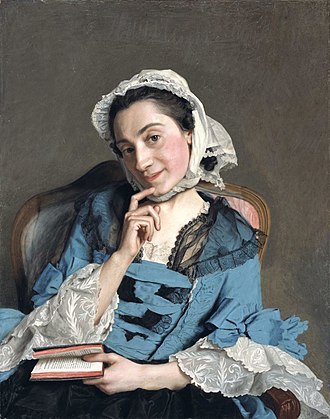
Portrait of Madame d'Épinay
The Woman Who Built the Salon
In the received story of the French Enlightenment, the philosophes argue and the salonnières pour the tea. Madame d'Épinay refused that division. Louise Florence Pétronille Tardieu d'Esclavelles — who took the name of her husband's estate and eventually transcended it — was not the backdrop against which Diderot and Grimm performed their brilliance. She housed Rousseau at L'Ermitage for two years, co-financed the networks around the Encyclopédie, and wrote a novel-memoir so penetrating that scholars still mine it for biographical detail. She won the Académie française prize for her educational dialogues in 1782, the year before her death. The Enlightenment ran partly on her resources and entirely through her relationships.
The psychological profile that emerges is unmistakably INFJ. Where Diderot was a volcano and Grimm a calculating strategist, Madame d'Épinay was a weaver — patient, purposeful, always working at the level of the whole rather than the immediate moment. Her dominant Ni gave her the long view; her auxiliary Fe gave her the warmth to act on it; her tertiary Ti gave her the analytical precision to write about it; and her inferior Se left her perpetually underequipped for the material crises that kept arriving at her door.
An INFJ who understood that a human network, carefully tended, is itself a kind of argument — Madame d'Épinay turned her salon into the Enlightenment's social infrastructure.
The Long Horizon
Dominant Ni is patience in the service of vision. Madame d'Épinay's cultivation of the philosophes' circle was never opportunistic. She identified the Encyclopédie project as a civilizational undertaking and organized her resources around it for decades. The hosting of Rousseau at L'Ermitage from 1756 to 1757 — an act of considerable generosity to a notoriously difficult man — was characteristic: she saw what Rousseau could contribute even when his behavior tested every limit of her hospitality. When the relationship collapsed, she processed it with analysis rather than bitterness; her memoir depicts him with a precision that suggests years of careful observation.
Les Conversations d'Émilie, written for her granddaughter, reveals the Ni at its most systematic — a structured argument about how girls should be educated to develop reason, moral sense, and independent judgment. The work won the Académie prize in 1782, composed during years of severe illness. That she deployed her diminishing energy on a project she might not live to see recognized tells us something essential: the long horizon was not an abstraction but a governing orientation. Her memoir, Histoire de Madame de Montbrillant — written across decades, revised repeatedly, never fully published in her lifetime — operates on the same principle. An opportunist would have written something more flattering. Madame d'Épinay wrote something true.
The Keeper of the Circle
Auxiliary Fe reads and manages the emotional temperature of a room. Madame d'Épinay's salon was a carefully maintained environment in which difficult, egotistical, brilliant men could collaborate. She managed Diderot's enthusiasms and Grimm's coldness and Rousseau's paranoia, often simultaneously — not through social performance but through genuine attention to what each person needed. Her letters reveal a woman who tracked others' emotional states with precision, noticing when a friendship was straining, when someone needed reassurance, when a quarrel could still be averted.
The Grimm relationship is the most revealing case. He was calculating, sometimes cold, frequently absent on diplomatic missions. Madame d'Épinay sustained three decades of partnership through letters of remarkable emotional intelligence, calibrating her responses to what he could receive. Her Fe did not idealize him; it worked with him as he was. The Rousseau rupture clarifies the function by negation: after two years of accommodating his hostility toward her friends, she finally registered that nothing could satisfy a need that had no object. This is Fe operating clearly — recognizing when the social fabric is genuinely beyond repair.
The Analyst Behind the Hostess
Tertiary Ti in an INFJ shows up as precise, evidence-based analysis coexisting with the Fe's emotional intelligence. Madame d'Épinay was not a philosopher in the systematic sense, but her writing dissects a person or situation with considerable clarity. The memoir's portrait of Rousseau does not simply narrate his behavior but reconstructs the logic of his paranoia — the internal consistency of his errors. This is not gossip; it is psychological analysis.
Les Conversations d'Émilie is equally analytical: she separates reason from rote memorization, moral feeling from mere obedience, genuine curiosity from performed enthusiasm. These are analytical distinctions, not rhetorical ones. When Diderot revised her memoir and she pushed back against his revisions, she was not asserting pride of authorship but protecting the analytical integrity of what she had observed — Ti in its tertiary position: useful, precise, subordinate to larger purposes.
The Material World She Managed
Inferior Se in the INFJ manifests as a chronic mismatch with the immediate physical world. For Madame d'Épinay, the material world arrived primarily as crises to be managed: her husband's financial dissipation left her estate perpetually encumbered, her health was precarious for much of her adult life, and the salon at La Chevrette required constant management she was never quite temperamentally suited for. The memoir is full of moments where the practical suddenly intrudes — where she must turn from an argument about truth to haggling with a creditor or managing a leaky roof. She handled it by sheer force of character rather than natural facility.
Her relationship with Grimm served a partially compensatory function. He was a diplomat, a social operator, a person who understood institutions and money. In practical matters she relied on his judgment in ways she did not rely on Diderot's. The INFJ's inferior Se often finds expression through trusted companions more at home in the immediate world, and Grimm was that person — the partnership endured partly because each supplied what the other lacked.
Why INFJ Over INTJ
Why not INTJ?
The INTJ is a systems builder who treats human relationships as instrumental to larger goals. Madame d'Épinay built a human web that was itself the system — the salon, the correspondence, the financial support were not scaffolding for some other project; they were the project. An INTJ would have been far more selective, far less patient with difficult personalities, and far more likely to withdraw from social friction than navigate it. The warmth in her letters — even to people who had disappointed her — is not a strategist's warmth; it belongs to someone for whom human connection is a primary value. That orientation belongs to Fe, not Te.
The deeper distinction: the INTJ thinks best alone; Madame d'Épinay thought best in correspondence and conversation. Her letters to Grimm are not reports from a solitary mind but the mind itself, working through ideas in dialogue. She needed the response — needed to know the other mind was engaging back. That reciprocal orientation is the mark of Fe, and it places her firmly in the INFJ camp.
Connected Figures
Further Reading
- Madame d'Épinay: Une femme philosophe — Ruth Plaut WeinrebThe most thorough English-language scholarly study of d'Épinay's life and thought.
- Les Conversations d'Émilie — Louise d'ÉpinayHer prize-winning educational dialogues (1782), now available in modern critical editions — the best entry into her own voice.
- The Salonnières and the Philosophes in Old Regime France — Dena GoodmanPlaces d'Épinay within the broader social history of Enlightenment salons and the intellectual roles women occupied.
- The Republic of Letters: A Cultural History of the French Enlightenment — Dena GoodmanEssential background on the networks of correspondence and salon culture in which d'Épinay was a central operator.
