#300 · 3-26-26 · Catherinian Russia
Peter III
Emperor · Husband of Catherine · Victim of a Palace Coup
1728 — 1762

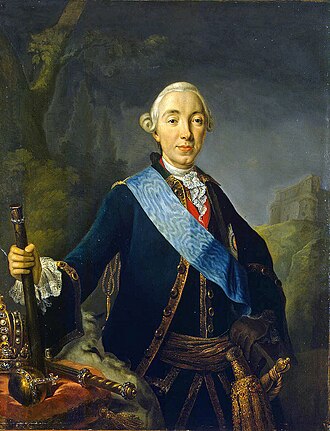
Portrait of Peter III
The Wrong Tsar in the Wrong Country
Karl Peter Ulrich of Holstein-Gottorp arrived in Russia at age fourteen and never really arrived at all. He came as the designated heir of Empress Elizabeth, his maternal aunt, a grand-ducal German prince who was to be Russified, educated in Orthodoxy, married into Russian dynastic interests, and eventually crowned. He accomplished none of this except the last, and the last — his six months on the Russian throne in 1761 and 1762 — ended in a palace coup organized by his wife, who became Catherine the Great. He was dead within weeks, his historical reputation destroyed by the woman who replaced him, and his actual legislative record buried under the more interesting story of how badly wrong he had gone.
The standard account of Peter III portrays him as a buffoon — a man who played with toy soldiers in his chambers, worshipped Frederick the Great like a schoolboy idolizing a general, humiliated his wife publicly, and alienated the Russian nobility, the Russian Orthodox Church, and the Russian guards regiments all within the same six months of reign. This account is not false, but it is incomplete. Peter III was not stupid. He issued significant legislation, including the Manifesto on the Freedom of the Nobility that emancipated the Russian gentry from mandatory state service — a reform that his more celebrated successors did not reverse. He abolished the Secret Chancellery, the political police apparatus that had terrorized Russian public life for decades. He understood something about Frederick II's Prussian system that many of his Russian contemporaries preferred not to acknowledge.
What he could not do — what his psychology made essentially impossible — was adapt. He was an ISFJ who had arrived at the center of power of a world to which he did not belong, whose loyalties ran to Holstein rather than to Russia, whose inner world was organized around a set of attachments formed in childhood and never substantially revised. The Si that governed him stored what it knew: Germany, Lutheranism, Frederick's army, the customs of a small German duchy. Russia remained, after decades of residence, essentially external — a place he administered rather than a world he inhabited.
An ISFJ who could not update his internal world to match his external position — Peter III governed Russia with the loyalties of a Holstein duke, and Russia did not forgive him for it.
The Man Who Could Not Change
Dominant Si is memory and loyalty — the function that preserves the inner world formed through early experience and maintains it with a fidelity that can persist even when circumstances have fundamentally changed. For Peter III, the inner world was Holstein: the small German duchy where he had been born and raised, whose customs, religion, and loyalties he had absorbed before being transplanted to St. Petersburg. He never let Russia replace Holstein in his psychic architecture. After decades at the Russian court, he still ate German food when he could manage it, still preferred Lutheran services, still kept Holstein officers in his personal retinue, and still regarded Frederick II of Prussia with an admiration that bordered on devotion. These were not affectations; they were the expressions of a dominant Si that could not update its fundamental attachments.
His refusal to attend Russian Orthodox services was more than a religious preference; it was a statement — probably an unconscious one — about the limits of his adaptation. The Russian court expected a tsar who had internalized Orthodoxy as a political and spiritual commitment. Peter III attended services intermittently, made faces at the priests, and reportedly laughed during solemn moments. Contemporary observers read this as contempt or stupidity. It was more likely the involuntary expression of a Si-dominant who had stored the Lutheran liturgy as the real one and could not feel the Orthodox version as anything but theater. The inner world does not easily revise its records.
The toy soldiers — the subject of so much mockery in both contemporary accounts and subsequent historiography — belong to the same picture. Peter III was known to play elaborate war games in his apartments with toy Prussian regiments, staging miniature battles according to Frederick's tactical principles. This has been taken as evidence of immaturity. It is better understood as the Si dominant's characteristic mode of engagement: the preservation and rehearsal, in controlled internal form, of something that cannot be fully realized in the external world. He could not actually command Prussian armies. He could organize his inner version of them, in careful detail, as a form of devotion to what he loved most.
The Emperor Who Needed Approval
Auxiliary Fe in the ISFJ produces a person who is deeply oriented toward the approval and warmth of their immediate social circle, and who experiences social rejection or cold indifference as acutely painful. Peter III's emotional life was organized around a desperate need for the approval of those he admired — above all, Frederick the Great of Prussia, a man he had never met before becoming emperor and whom he worshipped from a distance with an intensity that contemporary observers found baffling and embarrassing. When he became Emperor in December 1761, one of his first acts was to withdraw Russia from the Seven Years War — not merely ending hostilities but effectively handing Frederick a strategic gift that saved the Prussian state from what had seemed like certain defeat. This is sometimes called the “Miracle of the House of Brandenburg.” It was also, at least in part, an act of Fe-driven devotion: the new Emperor demonstrating his admiration for the King of Prussia at the expense of his own country's strategic position.
With his actual circle — the Holstein officers and German companions he kept close — Peter III's Fe operated more successfully. He was apparently warm and informal with people he trusted, given to crude jokes and genuine camaraderie, uncomfortable with the formal hierarchies and ceremonies of the Russian court. His relationship with his mistress Elizaveta Vorontsova, whom he kept openly during his reign, was characterized by observers as genuinely affectionate — she was described as loyal to him in a way that the rest of his court was not. The Fe sought reciprocal warmth; it found it where it could, not necessarily where it was politically appropriate to find it.
His attempts to win the loyalty of the Russian guards regiments were where the auxiliary Fe most visibly failed. He made efforts — visiting the regiments, attempting the kind of jovial, man-to-man bonhomie that Russian military culture expected from a tsar. But the Fe could not manufacture the warm reception it craved from an audience that had already decided he was not theirs. The guards were loyal to the idea of a Russian tsar and to the woman who was about to become one. Peter III's Fe worked best with people who already loved him; it could not create that love where it did not exist, and it was too transparent in its need to persuade people who were looking for a reason not to trust him.
The Legislator
Peter III's legislative record is substantially better than his historical reputation. In six months of reign, he issued the Manifesto on the Freedom of the Nobility, which freed the Russian gentry from the obligation of mandatory state service that had been imposed by Peter the Great — a reform of considerable social significance that represented the most significant legal change in gentry status since the early eighteenth century. He abolished the Secret Chancellery, the feared political police apparatus that had been used to prosecute thousands. He issued measures relaxing the persecution of religious dissenters, and he moved toward secularizing church lands. None of these were the random acts of an incompetent. They have a certain logical coherence: they were reducing the coercive apparatus of the Russian state in ways that reflected Enlightenment ideas about governance.
Tertiary Ti in the ISFJ provides a capacity for systematic logical analysis that operates in service of the dominant Si values. Peter III had absorbed Frederick II's Prussian system as the model of well-organized governance — a state that was rational, efficient, and capable of military excellence — and his legislative instincts reflected his attempt to bring Russian governance into alignment with that model. He could see the logical case for these reforms clearly enough; the Ti tertiary gave him the analytical capacity to identify what the state needed. What he could not do was read the political system he was operating within well enough to implement the reforms without destroying his own position. The logic of the reforms was sound; the political timing and execution were catastrophic.
The peace with Frederick II is the best example of this pattern. Withdrawing Russia from the Seven Years War was defensible on rational grounds — Russia had gained little from the war and had suffered considerably — but the manner of withdrawal, which made no attempt to extract concessions from Prussia and which was accompanied by an enthusiastic admiration for Frederick that the Russian court found humiliating, combined legislative logic with political incompetence in a way that was characteristic. The Ti could identify what made sense in the abstract; it was the political judgment — the reading of how actions would land in the specific social and emotional field of the Russian court — that was missing.
The Future He Could Not Imagine
Inferior Ne is the ISFJ's most profound blind spot: the inability to model possibilities, to generate multiple scenarios for how a situation might unfold, to anticipate the unintended consequences of one's actions. Peter III's political career is a textbook case of this failing. He acted, repeatedly and with apparent confidence, in ways that a more Ne-capable person would have immediately recognized as politically suicidal. He insulted his wife publicly at state dinners while simultaneously making it known that he intended to replace her with Elizaveta Vorontsova. He wore Prussian uniforms and displayed Prussian decorations in a country that had just spent years at war with Prussia. He announced plans to redirect the Russian military from its current deployments to a Holstein border dispute that no one in Russia considered important. He did all of this while the guards regiments — his most immediate military support — watched and drew their conclusions.
The coup of June 1762 is sometimes presented as a complicated political conspiracy that could not have been anticipated. But the immediate historical record suggests that nearly everyone in the Russian court could see it coming except Peter III himself. He was genuinely shocked when Catherine moved. That shock — the disbelief of a man who had not modeled the possibility that his wife would organize a military coup in the time between breakfast and noon — is the inferior Ne in its most legible form. The Si-dominant mind assumes that what has been will continue to be; the inferior Ne cannot easily generate the scenarios in which it does not.
His decision to not contest the coup by fleeing to the army rather than rallying his forces was the final expression of this failure. He had loyal troops — or at least troops whose loyalty had not yet been transferred — at Kronstadt and elsewhere. He did not attempt to reach them. He negotiated, he appealed to Catherine personally, he signed the abdication document she presented him. The inferior Ne could not generate a scenario in which resistance might succeed; it could not see past the immediate reality of the situation to the contingent possibilities that still existed. He accepted what was in front of him as though it were inevitable, which is perhaps the clearest sign of all that the future remained, to him, essentially unimaginable.
Why ISFJ Over ESTJ
Why not ESTJ?
The ESTJ is an institution-builder — a person who dominates organizational systems, enforces hierarchies, and takes natural command of the procedural apparatus of governance. Peter III was dominated by his attachments, not the other way around. An ESTJ placed on the Russian throne would have rapidly assessed the power landscape, identified the key constituencies that needed management, and deployed considerable executive energy to secure his position. Peter III assessed nothing of the kind. He organized his personal world around his existing loyalties — to Holstein, to Frederick, to his German circle — and remained oriented toward those loyalties even when the Russian political world was visibly collapsing around him. That is not an ESTJ pattern; it is the ISFJ's pattern of Si-driven attachment overriding strategic judgment.
The legislative reforms are the one area where an ESTJ misread might seem plausible, because they show a person attempting to reorganize institutions in a systematic way. But the ESTJ reforms from within the system — managing the politics of institutional change with the Te fluency that makes executive types effective. Peter III reformed without managing: he issued the Manifesto on the Freedom of the Nobility without building the political coalition that would have protected him from the backlash. He abolished the Secret Chancellery without considering whether its elimination would cost him a tool he might need. These are the reforms of a Ti-tertiary who could see the logical case for change but could not execute the political management that change required. The ESTJ would have managed both simultaneously, because the Te is primary. For Peter III, the logic was clear and the politics invisible — which is what happens when Te is absent from the dominant position.
Historical Figure MBTI