LogoHistorical Figure MBTI

#302 · 3-26-26 · Catherinian Russia

Sophie Volland

Diderot's Companion · Keeper of His Letters · Voice Behind the Text

1716 — 1784

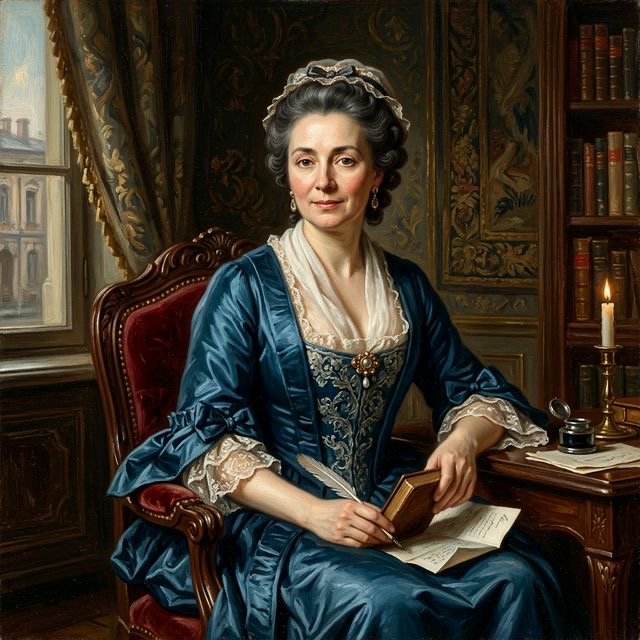
AI-assisted Portrait of Sophie Volland

AI-assisted Portrait of Sophie Volland

The Mind Behind the Letters

We know Sophie Volland almost entirely through the man who loved her. Of the letters she wrote to Denis Diderot across nearly thirty years, almost none survive — possibly destroyed by her family after her death, possibly by her own design. What remains is approximately 553 letters he wrote to her, a correspondence so extraordinary in its range and intellectual intimacy that scholars have used it as a primary source for everything from the social history of the Enlightenment to the inner life of the Encyclopédie's editor. The paradox of Sophie Volland is that she is known through an absence: we reconstruct her from the shape of the conversation she was half of, from the questions she must have asked to produce the answers he gave, from the challenges she must have issued to produce the self-examination he performed.

Born Louise-Henriette Volland in 1716, she was about thirty-nine when the relationship with Diderot began around 1755 — older than the stereotypical muse, a woman of the provincial bourgeoisie who lived much of her life with her widowed mother and sister in circumstances that constrained her mobility and her public life. The name Sophie was given to her by Diderot, a name he associated with wisdom, and there is nothing condescending in the choice; his letters make clear that he regarded her as among the most intellectually serious people he knew. He discussed everything with her: the philosophy of materialism and the existence of the soul, the latest play at the Comédie-Française, the feuds and alliances of the philosophes' circle, the state of his daughter's education, his own working methods and uncertainties. He was not performing for her; he was thinking with her.

That thinking-with is the key to her psychological profile. Sophie Volland was an INTP — a woman whose dominant Ti organized her intellectual life around precision, internal consistency, and a skepticism toward easy sentiment. The evidence is necessarily indirect, read from the mirror of Diderot's responses: but a man as sensitive to his interlocutors as Diderot would not have written to her with that particular combination of intellectual sharpness and occasional self-questioning vulnerability if he had not been receiving something that demanded it. She pushed back. She questioned. She was, by every indication available in the surviving record, a thinking partner rather than an admiring audience.

An INTP whose intellectual substance shaped the greatest correspondence of the French Enlightenment — Sophie Volland exists in the negative space of Diderot's letters, and the shape of that space is unmistakably precise.
Ti

The Thinking Partner

Dominant Ti produces a mind organized around precision and internal coherence — a mind that does not accept conclusions without examining their foundations, that is suspicious of sentiment where it substitutes for thought, and that finds its deepest satisfaction in working through a problem until it actually makes sense. The evidence that Sophie Volland possessed this kind of mind comes primarily from what Diderot's letters reveal about the demands she placed on his thinking. His letters to her are notably different from his philosophical works and his letters to other correspondents: they are more self-questioning, more likely to qualify a confident assertion and then interrogate the qualification, more attentive to the places where his own reasoning fails. These are not the letters of a man performing for an admiring audience. They are the letters of a man who knows his interlocutor will notice the gaps.

Several letters contain explicit evidence of her intellectual challenges. In at least one, Diderot responds to what is clearly a rigorous objection to one of his materialist arguments, acknowledging that she has identified a genuine problem. In others, he returns to positions he had stated in earlier letters and revises them — the revision occasioned by something she had apparently said in response. The pattern is consistent: he makes a claim, she questions it, he refines it. This is the structure of genuine intellectual partnership, and it requires that both parties be capable of the same kind of analytical rigor. A woman who could identify weaknesses in Diderot's arguments was not operating from sentiment or impressionism. She was operating from Ti.

The disappearance of her letters — whether by deliberate family destruction or by her own design — fits a Ti profile. The INTP is private about intellectual work in a way that differs from the INFP's emotional privacy. Sophie Volland's letters contained her thinking: her arguments, her objections, her analyses. These are precisely the things a Ti-dominant might be most reluctant to have circulate in the world without her own capacity to contextualize or revise them. If the destruction was deliberate, it was an act of intellectual control — a refusal to let the record of her thought exist separately from her ability to stand behind it. That kind of control is more Ti than any other function.

Ne

The Curious Mind

Auxiliary Ne in the INTP provides the intellectual appetite that Ti alone cannot generate. Ti is a refining function — it takes what it has and makes it more precise. Ne is an expanding function — it keeps generating new questions, new connections, new areas of interest. Together they produce the characteristic INTP intellectual style: wide-ranging curiosity organized and disciplined by analytical rigor. Diderot's letters to Sophie Volland cover an extraordinary range of subjects — philosophy, natural science, theater, literary criticism, gossip, family affairs, the mechanics of translation, the ethics of deception, the question of whether animals have souls — and they presuppose an interlocutor who can engage with all of it. He did not compartmentalize his correspondence with her to the topics he thought she could handle. He wrote to her about everything, which tells us something about the range she actually brought.

Her willingness to engage with philosophical materialism — Diderot's most contested intellectual commitment, the view that matter and its properties explain everything including mind and consciousness — is particularly revealing. This was not a comfortable position in mid-eighteenth-century France, where it was not only philosophically controversial but politically dangerous. The letters suggest that she was not a passive recipient of his materialism but an active interlocutor — raising the problems with it, noting the places where it struggled to account for experience, pushing him to sharpen his arguments. An intellectually incurious person would not have pressed these questions; a person without Ne would not have ranged across so many of them simultaneously.

The breadth of interest also extended to the social world she and Diderot shared. His letters to her contain some of the most vivid social portraiture of the Enlightenment: characters sketched in a few details, conversations reconstructed from memory, the textures of dinner parties and salon debates captured with the precision of someone who has been paying close attention. He wrote these to her because she would appreciate them — because she was curious about the same world, interested in the same characters, attentive to the same kinds of social and intellectual dynamics. Her curiosity was, by all indication, as wide as his; it simply left fewer traces.

Si

The Constrained Life

Tertiary Si in the INTP produces a deep attachment to particular relationships, places, and routines — an attachment that can coexist with, and sometimes limit, the Ne's expansive intellectual range. Sophie Volland's domestic situation was one of genuine constraint: she lived for much of her adult life with her widowed mother and her sister, first in Paris and then at the family property in Vitry-sur-Seine. Her mobility was limited by family obligation, social convention, and financial circumstance. Diderot's letters are full of references to the difficulty of seeing her — she was not always in Paris, her mother's surveillance was a recurring theme — and of the particular frustration of sustaining a relationship at the distance that her circumstances imposed.

What is striking is that she apparently accepted these constraints without audible rebellion. The INTP's tertiary Si produces a person who is, in some ways, more comfortable with domestic stability and established routine than the type stereotype might suggest. She did not leave her mother, did not relocate to be closer to Diderot, did not organize her life around the relationship in ways that would have required disrupting the structures she inhabited. This is not passivity; it is the Si tertiary's deep attachment to the relational and physical world it knows, even when that world is limiting.

Her relationship with Diderot itself has the character of Si constancy: it lasted approximately thirty years, from around 1755 until his death in 1784. She died the same year, within months of him — a detail that, while possibly coincidental, has the quality of a final loyalty. The Si tertiary's attachments are deep and long-lasting; they do not easily redirect. Whatever the formal status of the relationship — it was not a marriage, it was conducted partly at a distance, it coexisted with his family life — it was clearly the defining personal relationship of her adult life, and she sustained it with a fidelity that the surviving evidence makes unmistakable.

Fe

The Love She Could Not Perform

Inferior Fe is the INTP's most vulnerable point: the function that manages the performance of care, warmth, and emotional reciprocity in social contexts. The INTP cares deeply — this is not in question — but the expression of that care is often less fluent than the caring itself, and the social scripts for emotional performance can feel alien or forced. Diderot's letters to Sophie Volland contain, interspersed with the philosophy and the gossip and the literary criticism, moments of naked emotional need: demands for reassurance that she loves him, complaints about the length of time between her letters, expressions of jealousy, requests that she write more and more warmly. The picture that emerges is of a man who needed more emotional performance from the relationship than it naturally produced.

This is not evidence that she did not love him. It is evidence that her love expressed itself differently from the way he wanted it to. The INTP's care is most naturally expressed through attention, through the precision of engagement, through the quality of intellectual presence — through the fact of the thirty-year correspondence itself. It is less naturally expressed through the kind of warm, demonstrative reassurance that Diderot periodically craved. Her letters, when they came, were apparently too sparse and too reserved; he wanted more, both in quantity and in emotional temperature. This tension runs through the correspondence as a minor but persistent strain.

The inferior Fe also suggests why the disappearance of her letters might have been partly her own doing. The INTP is private about emotional expression in a particular way: the inner emotional life is real and intense, but its display in writing — especially writing that might be read by others — feels like an exposure that the function cannot comfortably authorize. If Sophie Volland's letters contained anything like the emotional candor that Diderot's letters to her contain, they would have been deeply personal documents that she might well have preferred not to leave in the world. The inferior Fe protects itself by limiting the evidence of its presence. The absence of her voice may be, in part, an expression of it.

Why INTP Over INFP

Why not INFP?

An INFP correspondent would have left emotional traces — would have written letters whose warmth and feeling Diderot found satisfying rather than periodically insufficient. The INFP's dominant Fi expresses itself through emotional candor; it tends to leave behind documents of personal feeling, creative writing marked by lyrical subjectivity, relationships characterized by emotional generosity. Nothing in the indirect evidence of Diderot's letters suggests that Sophie Volland operated this way. The intellectual precision of his responses to her, the specific pattern of his self-revision when challenged, and the repeated complaints about her emotional restraint all point toward a woman whose primary register was analytical rather than emotional. The INFP would have written back with feeling; Sophie Volland apparently wrote back with questions.

The deeper distinction is in what each type leaves behind, even in silence. An INFP whose letters were destroyed would leave a gap that felt emotionally warm at its edges — the surviving context would suggest expressiveness, feeling, the particular quality of someone for whom personal experience is the primary material of thought. The gap that Sophie Volland's absence creates in Diderot's letters is cooler and more precise: it is the gap of an interlocutor who engaged ideas carefully, who challenged claims rather than affirming them, who was present in the quality of thinking she produced rather than in the emotional temperature she maintained. That is not the absence an INFP leaves. It is the absence of an INTP — and recognizing that difference is, in the end, the only portrait of Sophie Volland we have.

Sophie Volland is known only through the mind that loved her, but the shape of that mind's engagement with her tells us everything we need to know about what she brought to the conversation.

The Conversation That Made the Letters

The letters Diderot wrote to Sophie Volland are among the most important documents of the French Enlightenment, and they are important partly because of what she brought to the exchange. Scholars who have studied the correspondence in detail note that Diderot's letters written during periods of separation from her — when he was at the country house of the Baron d'Holbach, for instance — have a particular quality of self-examination and intellectual honesty that is less consistently present in his published works. He was thinking out loud for an audience that would hold him to what he said. That audience shaped the thinking.

Her relationship to Diderot's broader circle was not merely peripheral. She knew Grimm, who appears in the letters; she was aware of the salon world centered on figures like Madame d'Épinay, whose estate hosted many of the gatherings that Diderot described to her. She existed within the network of the Encyclopédistes without being of it in the way the male philosophes were — constrained by her circumstances and her gender from the public intellectual role that the network provided to Diderot and Grimm. The letters were, among other things, the form through which she participated in the intellectual life that her circumstances otherwise kept at a distance.

The fact that she died the same year as Diderot — 1784 — has struck readers as significant since the correspondence was first published. Whether it represents coincidence, the physical toll of grief, or the simple convergence of two lives bound for half a century, it has the quality of a conclusion. She had been his thinking partner for thirty years; when the thinking stopped on his end, hers apparently stopped too. It is the most emotional fact in the record of a relationship that expressed itself primarily through intellectual engagement — which is, perhaps, exactly the kind of last word an INTP would leave.

Logo

Sign up for monthly insights

Monthly insights into history's most influential figures — examined through psychology, context, and cognitive pattern. Less stereotype, more structure. History, but with a mind map.

Powered by Buttondown

||Share