 Historical Figure MBTI
#708 · 5-27-26 · The Age of Exploration
John Cabot
Italian Navigator for England · Discoverer of Newfoundland · Vanished at Sea
c. 1450 — 1498
6 min read
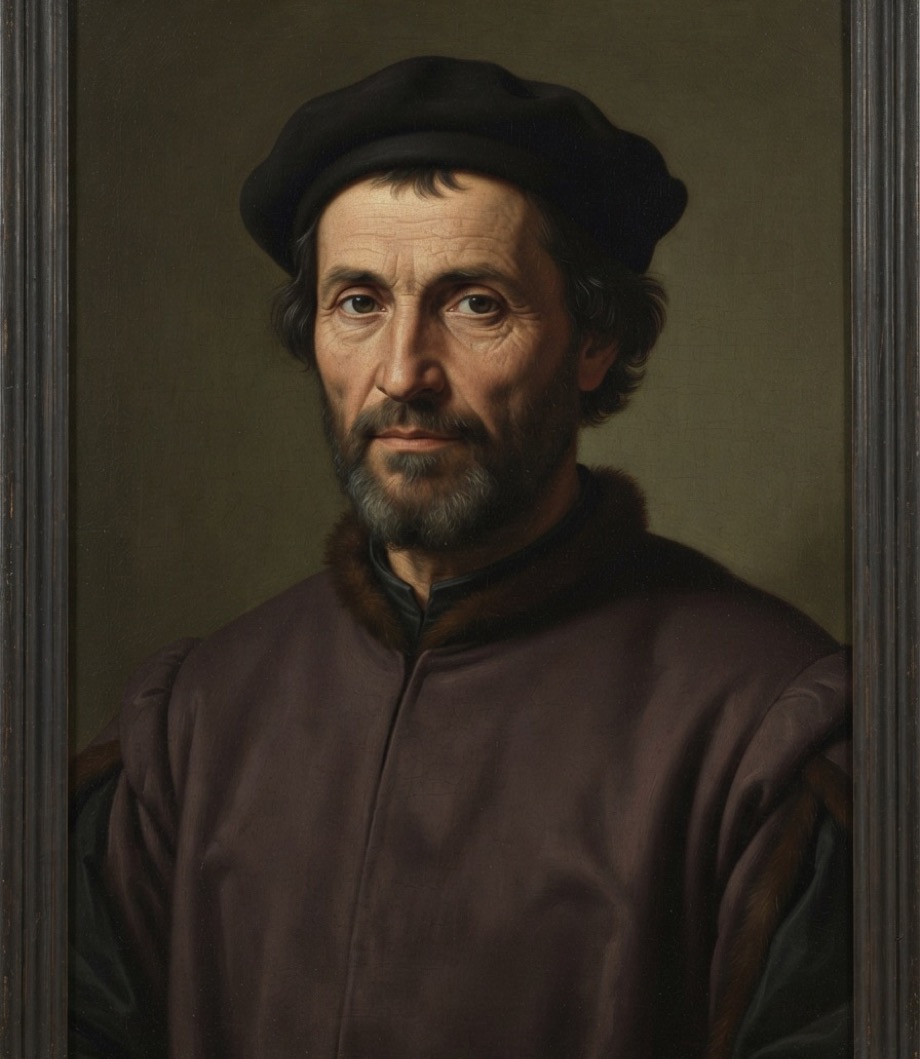
AI-assisted Portrait of John Cabot
The Salesman Who Sold the Same Pitch Three Times
He had already been turned down twice before England ever heard his name. A navigator of uncertain origin — Genoese by most accounts, naturalized Venetian — Giovanni Caboto had shopped his westward-passage scheme to Portugal and Spain and watched both crowns hand the contract to someone else. Most men would have folded the plan away. Cabot instead crossed to Bristol, found a court hungry to catch up to its rivals, and made the same audacious bet a third time. In 1496 Henry VII granted him letters patent. By May 1497 he was gone from port in a single small ship, the Matthew, with a crew barely twenty strong.
This was the temperament of a man who read a room, sized up an opportunity, and moved on it before anyone else could — a ESTP whose entire biography is a sequence of decisive physical acts taken on incomplete information, each a wager with his own body as the stake. He found Newfoundland — or thereabouts — in thirty-five days, planted a banner on a coastline he was certain was Asia, and sailed home to a hero's welcome. Within a year he did the boldest version of the same thing again — a larger follow-up fleet, launched with even less caution — and vanished so completely that history cannot even agree how many ships went down with him.
Cabot was an ESTP built almost entirely for the leap — a dominant Extraverted Sensing that read opportunity in the moment and acted on it before doubt could catch up.
A Small Ship and a Foreign Crown
Extraverted Sensing lives in the immediate and the physical, and nothing fits that better than Cabot's choice of vessel. The Matthew was tiny — smaller than the ships Columbus had commanded — crewed by perhaps eighteen men, provisioned for a voyage whose length no one could predict. A more cautious temperament would have insisted on redundancy, on preparation that hedges against the sea's indifference. Cabot went with what he could get funded fast, because what mattered was not the perfect expedition but the next one — the one leaving now, before a rival beat him to the patent.
The same instinct explains his choice of sponsor. Spain and Portugal were the obvious backers for an Italian navigator, and both had shown him the door. Rather than wait for a change of fortune, he read the wider field — England, ambitious and unpitched — and moved his plan to a court that had never funded an Atlantic crossing. That is Se doing what it does best: scanning the live terrain rather than the theoretical one. It shows again in the aftermath of 1497, when he spent his royal reward not on caution but on a second, larger voyage almost immediately. It was the boldest possible next action. It was also the one that killed him.
The Argument He Actually Believed
Underneath the improvisation sat real private reasoning. His plan rested on a geometric conviction: that the globe was small enough, and the northern latitudes narrow enough, that a shorter westward crossing than Columbus's more equatorial route would reach Asia faster. This was Introverted Thinking working quietly in the background — a self-contained model, built against his own logic rather than borrowed wholesale, that told him a strip of ocean this small could be crossed profitably by a country with no Caribbean foothold to compete for.
It was also, notably, wrong — Newfoundland is not Asia — but its internal consistency is what let him act with such speed once the field cleared at the English court. He did not need a committee of cosmographers; he needed a plan coherent enough to convince a king, and himself, to stake a life on it. That is Ti in service of Se — a fast private calculation that clears the way for action, visible too in the letters patent themselves: precise about what he was authorized to claim, narrow in scope, a system built just solid enough to get the ship out of harbor.
Playing to the Room in Bristol and at Court
Tertiary Extraverted Feeling gave Cabot the social read that made the whole enterprise possible — the ability to sense what skeptical merchants or a cautious king needed to hear before he could get their backing. Bristol was already a city of Atlantic fishermen with half-formed rumors of land to the west; Cabot arrived and gave their scattered hunches a name, a plan, and a leader to rally behind.
The same instinct shows in how quickly he turned a single voyage into public triumph. On returning in 1497 he paraded through Bristol and London, drew a royal pension, "dressed himself in silk," and was addressed as "the Great Admiral." He understood how to perform a discovery for an audience — turning one modest landfall into a narrative big enough to fund a much riskier second voyage almost immediately. That same Fe, though, made him vulnerable to his own momentum: the applause of 1497 fed directly into the overreach of 1498, a fleet raised on borrowed confidence rather than proof the method was safe to repeat.
The Long View He Never Took
Inferior Introverted Intuition is the function that asks what happens next, what pattern this fits into — and it is precisely the function Cabot's biography shows starving. He never seems to have paused to ask what a second crossing with several unproven ships might risk that the first single-ship voyage hadn't. He read the immediate opportunity brilliantly and never built the patient model of consequence that might have counseled restraint.
It surfaces too in his unshakeable, un-revisited conviction that Newfoundland was the edge of Asia — a stronger Ni would have held that theory more loosely. Instead he built an entire second, larger expedition on the unexamined assumption of his first guess, as if one success had to be answered with a far larger claim on destiny. The ship and its companions disappeared somewhere in the Atlantic and never reappeared in any port. The instinct that made him unstoppable in the moment gave him no way to see the moment the luck would end.
Why ESTP Over ISTP
Why not ISTP?
Both types read the physical moment and act on it, but an ISTP's dominant function is Introverted Thinking, not Extraverted Sensing — a private mechanical model tested quietly before committing. Cabot did the opposite: he moved first, reasoned second, and needed an audience of investors and a crown to validate the plan at every stage. An ISTP does not shop the same pitch to three separate courts and stage a public homecoming parade in silk; that is Fe seeking social confirmation, not Ti working in isolation.
What separates Cabot from the more careful ISTP tinkerer is exactly what makes him a compelling ESTP case study: the willingness to bet everything on the read of a single moment, sell it convincingly to whoever holds the money, and move again before the first bet has finished paying out. It won him Newfoundland. It also cost him the fleet, the crew, and his own life, unrecorded and unrecovered.
Connected Figures
Further Reading
- Alwyn Ruddock: John Cabot and the Discovery of America — Evan T. JonesReassesses the lost primary evidence behind Ruddock's suppressed research on Cabot's voyages.
- The Voyage of the Matthew: John Cabot and the Discovery of North America — Peter FirstbrookA narrative account of the 1497 crossing, drawn from Bristol's surviving records.
- The European Discovery of America: The Northern Voyages — Samuel Eliot MorisonThe standard scholarly survey placing Cabot's voyages within the wider Atlantic exploration record.
