 Historical Figure MBTI
3 min read
#175 · 3-19-26 · Ancient Athens
Lysicles
The Orator of the Moment
† 428 BCE
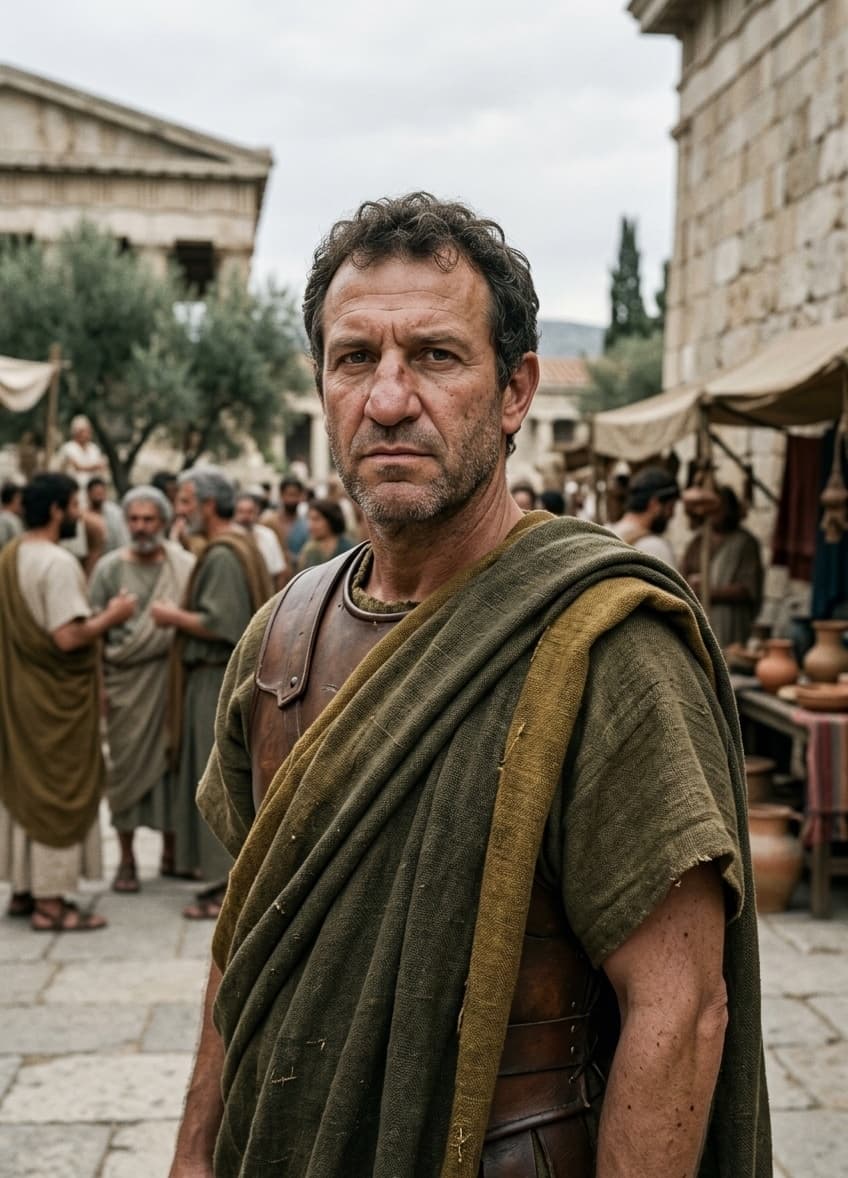
AI-assisted portrait of Lysicles
The Architecture of Impact
Lysicles did not begin as a philosopher, nor as a statesman shaped by lineage or tradition. He rose from something far less formal—a sheep dealer, a man of trade, embedded in the rhythms of the marketplace rather than the academy.
And yet, in the volatile atmosphere of Athens during the Peloponnesian War, that background became its own kind of training.
After the death of Pericles, Lysicles emerged not through doctrine, but through presence—through speech, persuasion, and the ability to move a crowd in real time. Ancient sources, especially Aristophanes, portray him not as refined, but as forceful. Not philosophical, but effective.
He was not shaping ideas for posterity. He was shaping outcomes—right now.
The Psychological Verdict
Lysicles is often dismissed as merely opportunistic or demagogic, but a closer look suggests something more specific: a man operating through immediate perception, social responsiveness, and action-oriented persuasion.
He reads most clearly as ESTP.
Se — Dominant
Lysicles’ rise is inseparable from his attunement to the present moment. He was not working from inherited ideology or long-term philosophical frameworks. Instead, he responded to what was happening—the mood of the Assembly, the urgency of war, the shifting emotional currents of the Athenian public.
This is Se at its core: not abstract modeling, but real-time engagement. He didn’t need theory to act. He needed a situation.
Ti — Auxiliary
Despite his reputation, his rhetoric was not purely chaotic or emotional. To persuade effectively in Athens required structure—arguments that could hold under scrutiny, even if they were delivered with force. Lysicles’ success suggests a functional internal logic: quick, adaptive, and sharpened for debate.
Not system-building for its own sake, but precision in the moment. This is Ti in service of action—not detached analysis, but tactical reasoning.
Fe — Tertiary
His power depended on people. Lysicles did not withdraw from the crowd; he leaned into it. He understood how to provoke, rally, and align with collective emotion—not with the careful harmony of dominant Fe, but with a more opportunistic, situational use of it.
He could read a room. And then move it.
Ni — Inferior
What’s notably absent is long-range vision. Unlike Pericles, whose leadership carried a clear strategic arc, Lysicles appears far more reactive—anchored in immediate advantage rather than overarching direction.
This suggests inferior Ni: difficulty sustaining a singular, long-term narrative, leading instead to decisions shaped by the present rather than the future.
The Athenian Shift
Lysicles’ rise marks something broader within Athens itself—a shift from the measured, vision-driven leadership of Pericles to something more immediate, more reactive, more grounded in the volatility of the moment.
In that sense, he is less an anomaly and more a reflection. When stability breaks, presence takes over. And Lysicles was, above all, present.
Not a philosopher of the city. But a man who moved it.
Connected Figures
Further Reading
- Greek Lives — PlutarchPlutarch's Life of Pericles frames the political vacuum Lysicles stepped into after Pericles's death.
- Goddesses, Whores, Wives, and Slaves: Women in Classical Antiquity — Sarah B. PomeroyCovers Aspasia's household and influence, the circle Lysicles entered as her companion after Pericles.
- Lives of the Eminent Philosophers — Diogenes LaertiusPreserves the intellectual milieu of Aristophanes-era Athens against which Lysicles's rise as a demagogue stood out.
