 Historical Figure MBTI
4 min read
#176 · 3-19-26 · Ancient Athens
Speusippus
The Successor Who Redefined the System
† 339 BCE
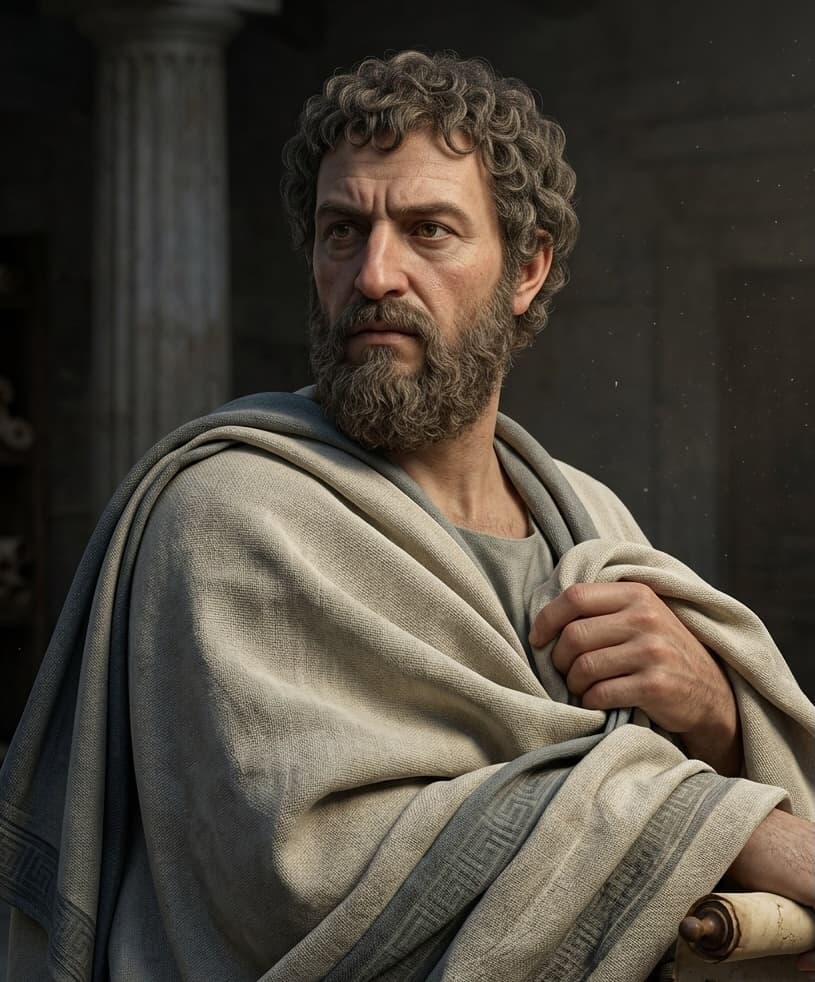
AI-assisted portrait of Speusippus
The Architecture of Revision
Speusippus did not found a philosophy—he inherited one.
As the nephew and eventual successor of Plato, he stepped into leadership of the Platonic Academy at a moment when its intellectual foundation had already been laid. But rather than preserving that system intact, Speusippus did something quieter, and in some ways more revealing.
He altered it.
Where Plato had pursued unity—the Form of the Good, the idea that reality could be traced back to a singular, ultimate principle—Speusippus fragmented that vision. He rejected the centrality of the Good as a first principle and instead proposed a more pluralistic structure of reality, one that did not collapse into a single explanatory source.
This was not rebellion for its own sake. It was revision—precise, internal, and conceptual.
The Psychological Verdict
Speusippus is often overshadowed by Plato, and because of that, he is sometimes flattened into a derivative figure. But his philosophical moves suggest something more distinct: a mind less concerned with vision, and more concerned with internal coherence.
He reads most clearly as INTP.
Ti — Dominant
Speusippus’ defining trait is his willingness to rework an inherited system from the inside. Rather than preserving Plato’s framework out of loyalty or extending it through vision, he interrogated its internal logic—questioning whether the “Good” truly functioned as a foundational principle. His philosophy reflects a concern with structural validity, not symbolic meaning.
This is Ti at its core: not “what is the grand vision?” but “does this system actually hold?” He was not building outward. He was refining inward.
Ne — Auxiliary
His rejection of a singular principle in favor of multiple starting points suggests a shift toward possibility rather than convergence. Where Plato compresses reality into unity, Speusippus expands it—allowing for a plurality of principles rather than a single explanatory axis. This openness to alternative structures, to different ways reality might be organized, reflects auxiliary Ne. Not chaotic ideation, but conceptual flexibility.
Si — Tertiary
As the head of the Academy, Speusippus still operated within an inherited intellectual tradition. He did not discard Plato entirely—he worked within the established language, categories, and institutional structure of the Academy. His thought shows continuity even as it introduces change, suggesting a reliance on prior frameworks as a grounding reference. This is Si in a tertiary position: not rigid preservation, but contextual anchoring.
Fe — Inferior
What is notably absent is any strong emphasis on persuasion, moral framing, or social harmony. Speusippus does not appear concerned with how his revisions would be received emotionally or culturally. His work lacks the rhetorical warmth or ethical centrality that defines more Fe-oriented philosophers. The priority is not alignment with others. It is alignment with the system itself.
Analysis
Why not INTJ?
Given his position as Plato’s successor, it might be tempting to see Speusippus as another vision-driven thinker—someone extending a unified philosophical arc. But his work moves in the opposite direction.
INTJs tend to compress reality into singular frameworks—to identify the underlying principle that organizes everything. Plato exemplifies this with the Form of the Good. Speusippus, by contrast, resists that compression. He does not seek one unifying vision, but multiple coexisting structures. His approach is not “what is the ultimate truth behind all things?” but “how should this system be internally constructed so that it remains consistent?”
This is not Ni-driven synthesis. It is Ti-driven restructuring.
The Academy After Plato
Speusippus’ leadership marks a subtle but meaningful shift in the Academy itself. Under Plato, the school was oriented toward vision—toward the pursuit of a unifying philosophical truth. Under Speusippus, it becomes more analytical, more fragmented, more concerned with the internal mechanics of ideas than with their ultimate convergence.
In that sense, he represents not a continuation, but a divergence. Not the architect of the original structure. But the one who took it apart—and rebuilt it on different terms. Not the vision that founded the school. But the mind that questioned it.
Connected Figures
Further Reading
- Speusippus of Athens: A Critical Study — Leonardo Tarán (1981)The definitive scholarly monograph on Speusippus — covers his metaphysics, his break from Plato, and the fragments that survive.
- Plato's Academy — David Sedley (ed.), The Cambridge Companion to Plato (1992)Places Speusippus within the broader intellectual life and succession of the Academy.
- From Plato to Platonism — Lloyd P. Gerson (2013)Traces how Speusippus and Xenocrates transformed Plato's metaphysics into early Platonism.
