 Historical Figure MBTI
4 min read
#177 · 3-19-26 · Ancient Athens
Perictione
The Woman Behind the Lineage
5th Century BCE
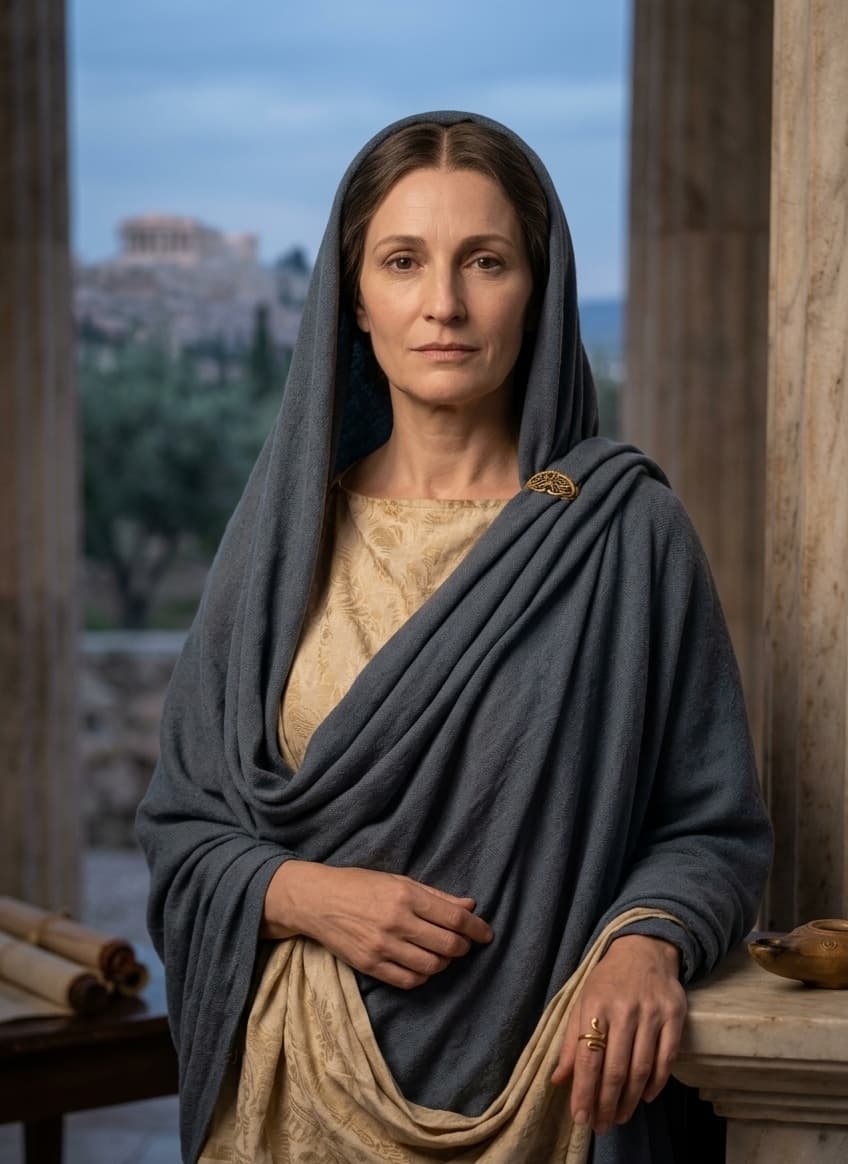
AI-assisted portrait of Perictione
The Architecture of Preservation
Perictione is not remembered for speeches, nor for philosophical treatises.
She is remembered through proximity—as the mother of Plato, and as a woman born into one of the most distinguished aristocratic families of Athens. Her lineage traced back to Solon, placing her within a tradition of order, structure, and civic responsibility long before Plato would articulate those values philosophically.
But what remains most telling is not what she said. It is what she sustained.
In a world shaped by instability—war, political upheaval, and shifting power—Perictione’s role was not to redefine Athens, but to preserve continuity within it. Through family, through upbringing, through the quiet transmission of values, she became part of the unseen architecture that made figures like Plato possible.
The Psychological Verdict
Perictione is a figure reconstructed through fragments—lineage, context, and the character of what she helped produce. But even within those limits, a pattern emerges: one of steadiness, preservation, and relational responsibility.
She reads most clearly as ISFJ.
Si — Dominant
Perictione’s identity is deeply rooted in continuity. Her aristocratic background was not merely status—it was inheritance, tradition, and the maintenance of an established order. As the link between Solon’s legacy and Plato’s upbringing, she represents a living bridge between past and future.
This is Si at its core: not innovation, but preservation. Not creating something new, but ensuring something enduring is carried forward.
Fe — Auxiliary
Her role within the family structure suggests attentiveness to relational harmony and responsibility. Though we lack direct writings, the environment in which Plato was raised—one shaped by discipline, education, and social awareness—implies a maternal presence attuned to both expectation and care.
Fe here is not public or performative, but embedded in the rhythms of family life: guidance, emotional calibration, and social integration. She does not appear as a figure asserting identity, but as one sustaining connection.
Ti — Tertiary
There are later writings attributed to a “Perictione” that engage with philosophical themes, particularly around harmony and order. Whether authentically hers or not, their association reflects a perception of her as someone capable of structured thought—not as a public philosopher, but as someone with an internal sense of balance and reasoning.
This aligns with tertiary Ti: present, but not dominant. A quiet internal framework rather than an outward intellectual project.
Ne — Inferior
What is notably absent is any strong push toward novelty or conceptual expansion. Perictione does not appear as someone driven to explore possibilities or challenge existing structures. Instead, her life reflects stability, continuity, and adherence to inherited frameworks. This suggests inferior Ne: not a rejection of possibility, but a lack of orientation toward it.
Analysis
Why not INFJ?
Given her proximity to Plato, it might be tempting to project a similar depth of vision or philosophical orientation onto Perictione. But the available evidence does not support a Ni-driven profile.
INFJs are typically characterized by a strong internal vision—a tendency to interpret reality through symbolic, future-oriented insight. Plato embodies this through his construction of ideal forms and ultimate truths.
Perictione, by contrast, does not appear as a visionary. She appears as a stabilizer. Her influence is not in redefining the world, but in maintaining the conditions in which others can do so. This is not Ni shaping the future—it is Si preserving the past and present.
The Line That Continues
Perictione’s significance is easy to overlook precisely because it is not overt. She did not leave behind a system. She left behind a foundation. And from that foundation, one of the most influential philosophical minds in history emerged.
Not the voice that shaped the ideas. But the presence that made them possible.
Connected Figures
Further Reading
- The People of Plato: A Prosopography of Plato and Other Socratics — Debra NailsThe standard reference for reconstructing Perictione's aristocratic lineage and her place in Plato's family circle.
- Plato: Complete Works — John M. Cooper (ed.)Contains the dialogues shaped by the household Perictione maintained for her son Plato.
- Lives of the Eminent Philosophers — Diogenes LaertiusPreserves the biographical tradition surrounding Plato's birth and family, including Perictione's Solonic ancestry.
