 Historical Figure MBTI
3 min read
#142 · 3-16-26 · The Founding Generation of USA
Abigail Brown Brooks Adams
The Moral Center of the Line and shaping presence within the Adams family.
1808 — 1889
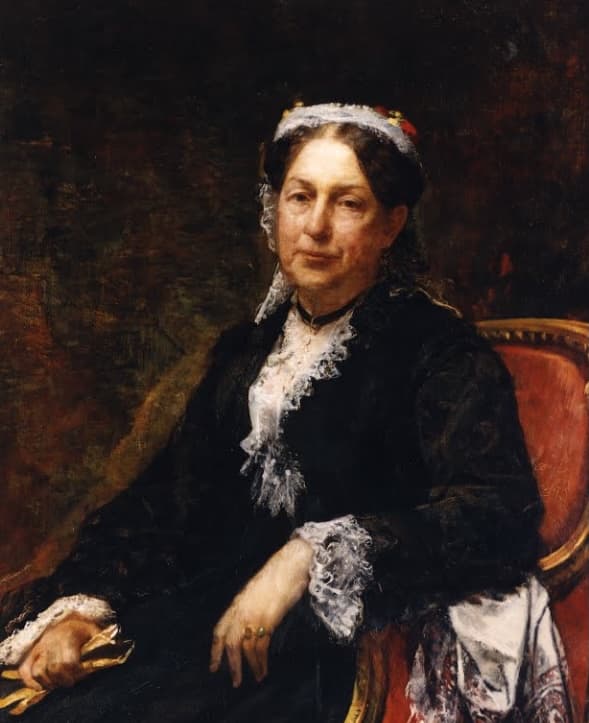
Portrait of Abigail Brown Brooks Adams
The Moral Center of the Line
Abigail Brown Brooks Adams does not dominate the historical stage in the way her husband, Charles Francis Adams Sr., or her grandparents-in-law once did. But she exists within a lineage where character, restraint, and moral clarity were not incidental traits — they were expectations.
Born into the Brooks family and married into the Adams line, Abigail lived at the intersection of two deeply structured, intellectually serious worlds. Yet what distinguishes her is not political ambition or public authorship, but a quieter, more internal orientation — one that reveals itself through tone, judgment, and presence rather than position.
She does not appear as a force of system or execution. She appears as a center of gravity.
The Psychological Verdict
Abigail Adams is best understood as an INFJ — a type defined by internal vision, moral coherence, and a quiet but persistent influence on the emotional and ethical direction of those around them.
While the historical record on her is not as extensive as more prominent figures, what does emerge — particularly through correspondence and relational accounts — suggests a personality oriented toward meaning, principle, and depth rather than structure or external achievement.
This is not a loud presence. It is a shaping one.
Ni — Dominant
Abigail’s cognition appears inwardly organized and meaning-driven. Rather than engaging with the world through external systems or immediate action, she seems to interpret it through an internal lens — drawing conclusions about people, relationships, and moral direction.
This is characteristic of dominant Ni: a focus on underlying patterns, long-term implications, and the essence of situations rather than their surface details.
Her presence suggests someone less concerned with what is happening, and more with what it means.
Fe — Auxiliary
Alongside this internal vision is a clear relational awareness. Abigail does not come across as detached or purely introspective; her influence appears to operate through connection, empathy, and a sensitivity to the emotional dynamics around her.
This reflects auxiliary Fe: an ability to engage others, not through overt social dominance, but through attunement and quiet guidance. Not performative, but responsive.
She does not impose. She aligns.
Ti — Tertiary
There is a subtle structure to her thinking — an internal consistency that shapes how she evaluates situations. While not overtly analytical in a detached or system-building way, her perspective carries a sense of coherence and quiet reasoning.
This aligns with tertiary Ti: present, but secondary to her intuitive and relational orientation.
Se — Inferior
There is little indication of strong engagement with the immediate, sensory world. Abigail does not appear driven by action, novelty, or physical experience, but by reflection and internal clarity.
This aligns with inferior Se: a distance from the present moment in favor of internal synthesis.
Why not ISFJ?
Ni over Si
Given her role within a structured, tradition-oriented environment, ISFJ is a natural alternative. However, ISFJs tend to anchor themselves in continuity, routine, and the preservation of what is known. Abigail’s presence feels less rooted in maintaining tradition and more oriented toward interpreting and refining it — engaging with the moral and emotional direction of her world rather than simply sustaining it.
Not preservation-first. Meaning-first.
Connected Figures
Further Reading
- Adams Family Correspondence — L. H. Butterfield (ed.)The letters that trace the Adams household Abigail Brown Brooks Adams married into and the moral tone she inherited.
- John Adams — David McCulloughEstablishes the dynastic weight of the Adams name that shaped her role as Charles Francis Adams Sr.'s wife.
- What Hath God Wrought: The Transformation of America, 1815-1848 — Daniel Walker HoweCovers the nineteenth-century world she lived through, well past the Revolutionary generation of her in-laws.
