 Historical Figure MBTI
#1048 · 8-5-26 · The New Kingdom
Ahhotep I
The Queen Who Held the Army Together
fl. c. 1560 – 1530 BCE
6 min read
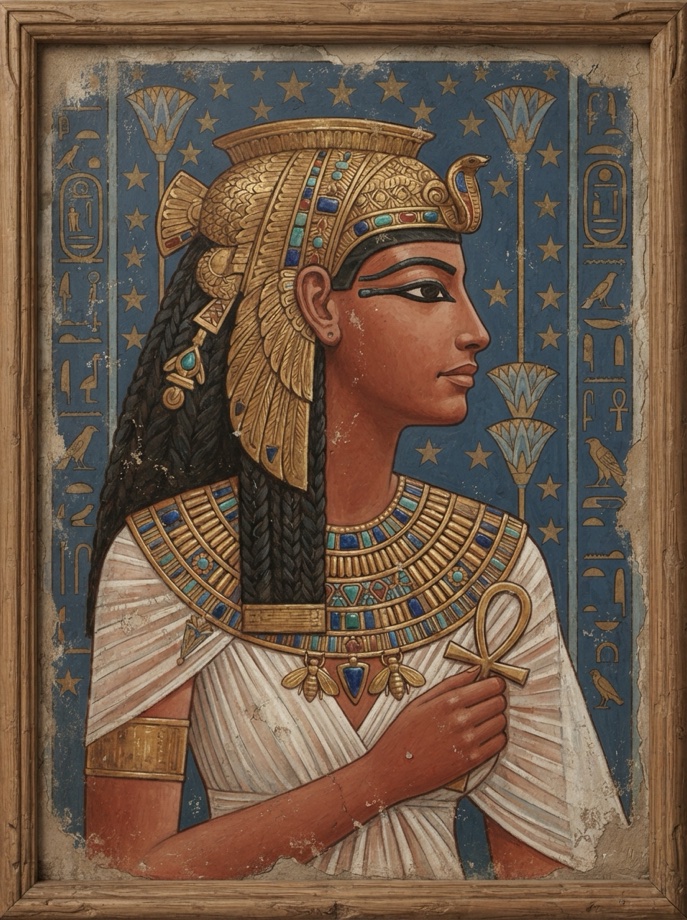
AI-assisted Portrait of Ahhotep I
The Widow Who Became the Army’s Spine
When Seqenenre Tao’s body came back from the front — skull staved in by axe and spear, the wounds still legible three and a half millennia later on the mummy itself — Egypt did not have the luxury of mourning slowly. The Theban war against the Hyksos was unfinished, the heir was a child, and the kingdom’s fragile coalition of soldiers, priests, and provincial loyalists had every reason to fracture. It did not. What held instead was Ahhotep I, and what she held it with was not an army she personally led into battle but a household, a court, and a fighting force she kept loyal to a throne that, for a few years, existed mostly in her keeping.
A stela raised later by her son Ahmose I gives the plainest evidence historians have for what she actually did: it credits her with “pacifying Upper Egypt” and rallying its fighters back to the royal cause after they had scattered or wavered. She was buried, extraordinarily for a woman, with the Order of the Golden Flies — a military decoration for valor, not a ceremonial trinket. Regalia and ritual can be inherited; that award has to be earned, or at least witnessed as earned by the men who gave it. Between those two facts sits a portrait of a queen who did not administer a crisis from a distance but stood inside it, keeping people bound to a common cause by force of presence rather than force of arms.
Ahhotep I was an ENFJ, and her Fe was not warmth deployed for its own sake — it was the mechanism by which a kingdom without a functioning king kept its soldiers from walking away.
Pacifying Upper Egypt
The verb the stela uses is telling: pacify, not conquer. This was not a military campaign of maneuver and terrain but a campaign of persuasion, aimed at soldiers and officials who had every practical reason to hedge their loyalty once their king was dead and his heir still a boy. Ahhotep’s task was to make the Theban cause feel worth staying loyal to — to hold a coalition together through sheer force of relational will at exactly the moment institutional authority had gone soft. That is Fe under pressure: reading a room full of wavering allegiances and closing the gap between them and the throne before it widened into open defection.
The Golden Flies make the same point from a different angle. It was a battlefield honor, awarded by soldiers or on their behalf, and soldiers do not hand that kind of recognition to a figurehead they merely tolerate. Something in how she moved among them — visible, present, invested in their survival and their cause — earned it. Fe dominants build their authority by making the collective feel like it is being held together on purpose, by someone who is paying attention to it; Ahhotep’s decoration is the army’s own testimony that this is exactly what happened.
Her later reburial with weapons and military regalia beside her — grave goods more typical of a warrior than a queen mother — reads less as evidence she fought personally than as evidence of how completely the army absorbed her into its own identity. A dominant Fe function does not need to swing an axe to be recognized as one of the reasons a fighting force held its shape.
Holding the Line Until the Boy Could Reign
What separates Ahhotep from a merely charismatic caretaker is that her mobilizing of loyalty was not aimless comfort — it was aimed, with evident patience, at a single fixed point years off: the moment Ahmose I would be old enough to rule and finish what his father had started against the Hyksos. Everything the sources credit her with — pacifying the restive, holding the household, keeping the war effort intact — reads as service to that one future outcome rather than a reaction to whichever crisis was loudest that week.
That is Ni in an auxiliary seat behind Fe: a private, unwavering read of where this all had to end, translated outward into the relentless day-to-day work of keeping people loyal long enough to get there. She was not improvising a regency out of nothing so much as protecting a single inevitable conclusion from every distraction that could have derailed it — factional grabs for the throne, a fracturing army, a Hyksos opportunity to strike while Thebes was leaderless. Ahmose I did grow up to finish the reunification of Egypt; the stela that honors his mother is, among other things, an admission that his victory had her years of quiet, forward-fixed insistence built into its foundation.
Why ENFJ Over ENTJ
Why not ENTJ?
An ENTJ regent facing this crisis would have consolidated power through structure — chains of command, appointments, a visible reorganization of the war effort. What the sources describe instead is relational: soldiers who had drifted brought back into the fold, an army that voted her its highest honor for valor rather than for competent administration. Ahhotep’s achievement was making people want to stay loyal to a fragile throne, not out-maneuvering rivals with strategic logic. That is Fe’s signature, not Te’s.
It is tempting to read a queen mother of this era purely as a nurturing domestic figure holding the palace together while the men fought — an ESFJ reading, in effect. But nothing about the evidence is domestic. She is credited with pacifying a province and decorated for battlefield valor; the loyalty she mobilized was a soldier’s loyalty, aimed at war, not a household’s comfort aimed at peace. The scale and the stakes point to a dominant, outward-facing Fe operating across an entire kingdom's morale, not a supporting Fe tending hearth and court.
Connected Figures
Further Reading
- The Rise and Fall of Ancient Egypt — Toby WilkinsonA sweeping political narrative that situates Ahhotep's regency within the chaos of the Hyksos wars.
- When Women Ruled the World — Kara CooneyPlaces Ahhotep among Egypt's exceptional female power-holders and reads her military honors in that context.
- Women in Ancient Egypt — Gay RobinsThe essential study of royal women's real authority, including the unusual case of Ahhotep's battlefield decoration.
- The Oxford History of Ancient Egypt — Ian Shaw (ed.)A reference chapter on the Second Intermediate Period and the Theban war of liberation.
