 Historical Figure MBTI
#1049 · 8-5-26 · The New Kingdom
Ahmose I
The King Who Finished the War
r. c. 1550 – 1525 BCE
8 min read
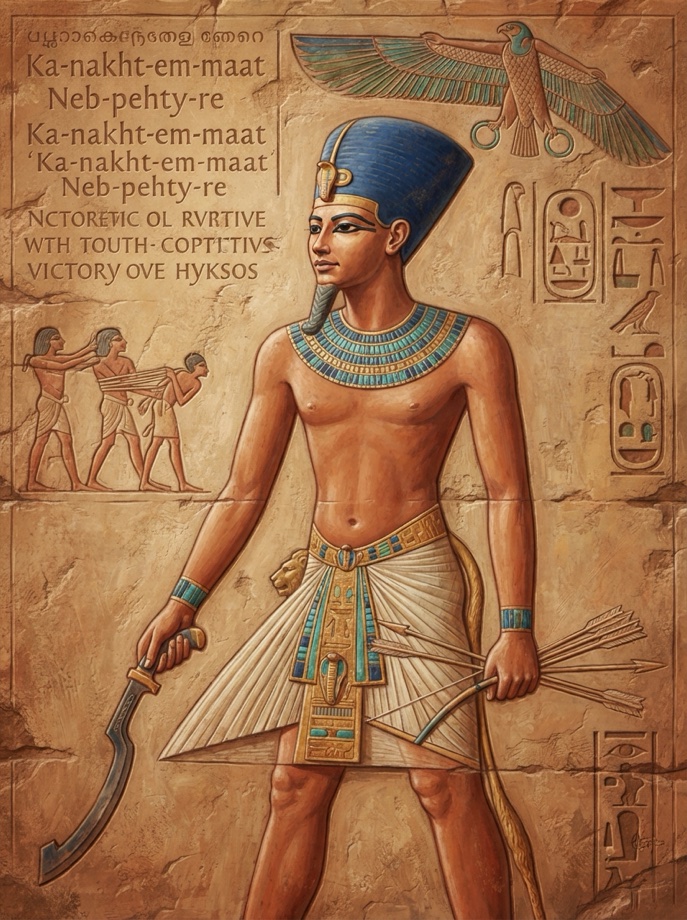
AI-assisted Portrait of Ahmose I
A Boy Handed a War
The mummy of Ahmose’s father is in Cairo, and it is not a restful object. Seqenenre Tao’s skull carries at least five wounds — an axe blow above the eye, a dagger thrust behind the ear, a crushing strike to the cheek — delivered by weapons of the kind the Hyksos used, and there is no sign that anyone embalmed him carefully afterward. The Theban king had picked a fight with the foreign dynasty ruling the Delta and lost it in the field. His elder son Kamose took up the war and was dead within three years. Then the crown passed to a child, and Egypt’s survival depended for a decade on the boy’s mother holding the south together.
Ahmose I inherited the least appealing project in the ancient world: an unfinished war of national liberation, against a militarily superior enemy, with two of his immediate predecessors already killed pursuing it. What he did with it is the reason the next five hundred years of Egyptian history look the way they do. He took Avaris. He pursued the Hyksos across Sinai and besieged them at Sharuhen in southern Canaan until the possibility of return was gone. He turned around, went a thousand kilometres south, and reasserted Egyptian control over Nubia. Then he spent the rest of his reign building the state that would hold what he had taken.
The record of it comes largely from a marine. Ahmose son of Ibana, a naval officer from El-Kab, had his career carved on the wall of his own tomb: the fighting at Avaris, the hands taken, the gold of valour awarded, the slaves granted, the pursuit to Sharuhen, the campaigns south. It is the closest thing to a war diary that survives from the period, and it reads like the account of a campaign run by someone who knew exactly what came next.
An ENTJ whose dominant Te converted an inherited catastrophe into a sequence — expel, pursue, secure, institutionalize — and left behind not a victory but an empire-state.
Te — The Campaign as a Checklist
What separates Ahmose from his father and brother is not courage; they had plenty and it killed them. It is sequencing. The war against Avaris was fought in stages, with the Nile used as a supply and assault corridor and the fleet doing the heavy work — Ahmose son of Ibana describes fighting on the water at Avaris repeatedly before the city fell. The Theban army did not attempt a single decisive battle in open ground, which is precisely the engagement the Hyksos chariotry would have won. It ground the enemy’s capital down until it was untenable.
Then came the part most conquerors skip. With the Delta cleared, Ahmose did not declare the war over and go home to build a temple. He crossed into Canaan and laid siege to Sharuhen — the Hyksos fallback position — reportedly for three years. The point was not territory. It was the elimination of a base from which the expelled dynasty could reconstitute itself. Only when that was finished did he turn south, running campaigns into Nubia to re-secure the gold routes and the frontier the Middle Kingdom had held and lost.
Every step of that programme is Te: a defined end state, an ordered set of operations to reach it, and no appetite for stopping partway because the visible objective has been achieved. He also cleaned up domestically — putting down at least two internal rebellions once the foreign war was won, reopening the Tura limestone quarries, restarting temple construction at Karnak and Abydos, and distributing conquered land and captives to the officers who had earned them, which bound the new military class to the throne by property rather than by sentiment.
Ni — The Buffer That Became an Empire
Underneath the campaign logic sits a single strategic insight, and it defined Egyptian foreign policy for half a millennium: a country that waits behind its border to be invaded will eventually be invaded. The Hyksos had entered a Delta that Egypt held passively. Ahmose’s answer was to push the line of contact out beyond Egypt itself — into Canaan in the north, deep past the cataracts in the south — so that the fighting would always happen somewhere else. Sharuhen was the first application of that doctrine. Thutmose I and Thutmose III would ride it to the Euphrates.
He also grasped that the war had permanently changed the shape of the state. The Hyksos had brought the composite bow, the horse-drawn chariot, bronze weaponry, and improved fortification, and Ahmose absorbed all of it rather than repudiating it — the liberating dynasty adopted the invader’s technology wholesale and made it the core of a permanent professional army. Egypt would never again be a kingdom that raised militias when trouble came. It would be a kingdom with standing forces, garrisons, and a viceroy governing Nubia as an administered province.
None of this had a precedent to copy. The Old and Middle Kingdoms had built frontier walls and forts; Ahmose built a foreign policy of forward presence and the institutions to sustain it. That is Ni in the auxiliary position, supplying Te with an endpoint worth all the sequencing — not a restored Egypt, but a different kind of Egypt entirely.
Se — Ships, Axes, Weather
Ahmose fought at the front. His officer’s tomb biography places the king personally on the water at Avaris and describes the rewards handed out in his presence, and the ceremonial axe found in the burial of his mother Ahhotep I — gold, with the king shown striking down an enemy — belongs to a court that treated hand-to-hand violence as the family business. Weapons found with her, including golden flies of valour, suggest a woman who had been honoured for military service in her own right. Ahmose grew up inside that.
The Tempest Stela, set up at Karnak, shows the same physical alertness in peacetime. It describes a catastrophic storm — days of darkness, rain, collapsed monuments, corpses floating on the water, tombs flooded — and then describes the king going out to inspect the damage and ordering the repairs. Whatever natural event lies behind the text, the royal posture is unmistakable: go look at it, then fix it.
Tertiary Se in an ENTJ typically shows up as this — immediate, competent engagement with physical reality, deployed in service of the plan rather than for its own sake. He was not a warrior-king in the mould of a Ramesses composing epics about his own valour. He was a commander who happened to be in the boat.
Fi — The Debts He Acknowledged
For a conqueror, Ahmose was unusually explicit about who else deserved credit. On a stela at Karnak he instructs Egypt to honour his mother, listing her as the one who cared for the soldiers, held the country together, brought back its fugitives and pacified Upper Egypt during the interregnum. Kings do not normally publish that a woman ran the kingdom while they were too young to. He did.
He did the same for his wife. Ahmose-Nefertari was granted the office of God’s Wife of Amun with an endowment recorded on the Donation Stela, an institution that gave royal women independent economic and religious power for centuries afterward, and she was deified alongside him at Deir el-Medina, where the workmen of the royal tombs worshipped them both as patrons for the next four hundred years. He also built a cenotaph pyramid complex at Abydos for his grandmother Tetisheri, and left an inscription about wanting to honour her.
Inferior Fi is often described as a blind spot, and in Ahmose it appears in the form of loyalty that is deep, narrow, and dynastic. Family and the officers who fought for him received extraordinary recognition. Everyone else — the inhabitants of Avaris, the defenders of Sharuhen, the Nubians whose gold routes he took — appears in the record only as counted hands and enumerated captives.
Why ENTJ Over ESTJ
Why not ESTJ?
The execution is so orderly — siege, pursuit, garrison, quarry, temple — that an ESTJ reading is defensible, and the Te is undeniably in the driver’s seat. What rules it out is that Ahmose was not restoring the Egypt he inherited. An Si-led king expels the invader, re-establishes the old Middle Kingdom order, and rebuilds the frontier forts. Ahmose kept the enemy’s chariots, built a standing professional army Egypt had never had, administered Nubia through a viceroy as conquered territory, and made forward presence in Canaan permanent policy. The founding conception is his.
Sharuhen is the decisive detail. The war aim he was handed — the one his father and brother died for — was the expulsion of the Hyksos from Egypt, and taking Avaris accomplished it. An executor optimizing the inherited objective stops there. Ahmose treated the stated goal as insufficient, crossed into territory no Egyptian king had held in centuries, and spent years reducing a foreign fortress to close a possibility that existed only in the future. That is Te executing an Ni objective, and it is the moment the New Kingdom begins.
Connected Figures
Further Reading
- The Oxford History of Ancient Egypt — Ian Shaw (ed.)The standard narrative of the Second Intermediate Period and the founding of the Eighteenth Dynasty.
- Ancient Egyptian Warfare — Ian ShawOn the military technology Egypt absorbed from the Hyksos and the standing army that followed.
- The Rise and Fall of Ancient Egypt — Toby WilkinsonVivid account of Seqenenre's death, the Theban war effort, and the imperial turn under Ahmose.
- The Egyptian Kingdom and the Hyksos: studies on the Second Intermediate Period — Ian Shaw & Robert MorkotFocused treatment of Hyksos rule in the Delta and the archaeology of Avaris and the expulsion.
- The Art of Ancient Egypt — Gay RobinsOn the early Eighteenth Dynasty's revival of monumental building at Karnak and Abydos.
