 Historical Figure MBTI
#1046 · 8-5-26 · The New Kingdom
Apepi
The Hyksos King's Taunt
r. c. 1600 – 1560 BCE
6 min read
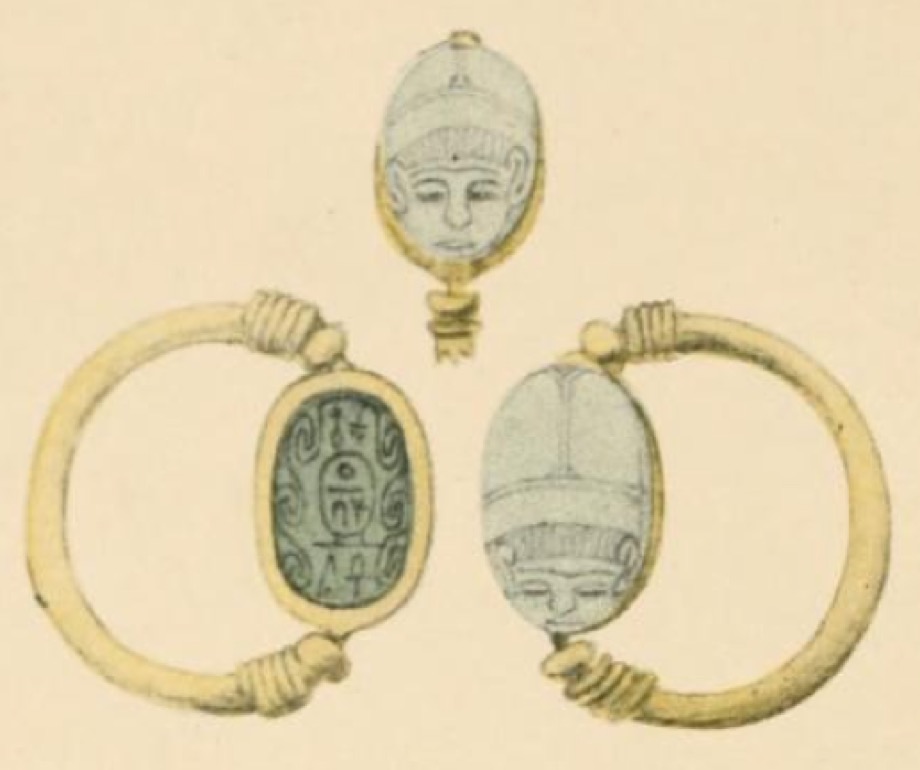
Seal ring of Apepi
The Hippopotamuses of Avaris
Apepi ruled the Delta from Avaris as the last great king of the Hyksos Fifteenth Dynasty, a foreign dynasty that had held Lower Egypt for generations while a rival Theban court clung to the south. What survives of him is thin — a handful of scarabs, a few royal titles, a literary papyrus copied out long after his death. But that papyrus preserves something rare in the historical record of the ancient world: a documented act of pure rhetorical provocation.
In the "Quarrel of Apophis and Seqenenre" — a New Kingdom story that survives only as a fragment of Papyrus Sallier I, and which most Egyptologists now read as a moralizing tale composed generations after the fact rather than a court transcript — Apepi sends an envoy nearly five hundred miles south to Thebes with an absurd demand: that Seqenenre Tao silence the hippopotamus pool beneath his palace windows, because its bellowing keeps the king of Avaris awake at night. The distance alone makes the literal complaint nonsense. What it was not nonsense about was the message underneath it.
Whether or not the exchange happened in these exact words, the story was preserved and retold because it captured something true about how a Hyksos-Theban confrontation might plausibly open — not with an army at the border, but with a joke engineered to be impossible to answer safely. Comply, and you have accepted an insult as reasonable. Object, and you have confirmed you take a hippopotamus complaint seriously enough to fight over it. That is not the move of a king reaching for a sword. It is the move of a mind that reaches, first and instinctively, for the angle nobody else has considered.
Apepi is an ENTP, and the hippo letter is dominant Ne in its purest form — not a threat, but a probe, floated to see what shape the world bends into when you push on it sideways.
A Complaint Shaped Like a Trap
Ne dominant reads the world as a field of possible meanings rather than a fixed set of facts, and Apepi's letter is engineered to keep multiple meanings alive at once. It is a joke. It is an insult. It is a loyalty test. It is, depending on how Seqenenre responds, potentially a pretext for war he can later claim he did not start. A sensing-led ruler making a real territorial threat says so plainly and backs it with troops massed at a border. Apepi instead sends words about an animal, and lets the ambiguity itself do the coercive work — nobody can be blamed for starting a war over a comment about hippos, and yet everyone downriver understood exactly what had been said.
That is Ne's signature move: refusing to commit to one literal reading when an unstable, multivalent one accomplishes more. The story specifies an absurd distance — Avaris to Thebes is nowhere near close enough for a hippo pool's noise to reach anyone — and the gap between the stated grievance and the physical impossibility of it is exactly where the message lives. A direct thinker closes that gap with plain speech. Apepi widens it on purpose, because the widening is the point: it forces Seqenenre to do the interpretive work himself, and however he answers, he reveals something.
Even allowing that the tale as we have it is likely later Theban propaganda, shaped to cast the Hyksos king as capriciously belligerent, the portrait it draws is a specific and coherent one rather than a generic villain. It imagines a ruler who tests, needles, and postures through indirection before ever reaching for force — which is itself a recognizable cognitive signature, and probably why the story stuck.
The Logic Under the Insult
Beneath the playfulness sits a cold structural calculation, and that is Ti. The complaint is not chosen at random — it is built to be logically unassailable on its own absurd terms while remaining strategically loaded underneath. Apepi does not simply mock Seqenenre; he constructs a grievance with an internal logic of kingly prerogative (a king may object to noise disturbing his sleep) stretched over a physical impossibility, and the seam between the two is where the real argument sits: I can say anything to you and dress it as reasonable, and you cannot refuse me without conceding the frame.
That is Ti auxiliary in service of Ne's opening move — a private, internally consistent system for testing where the limits of another ruler's tolerance actually lie, built and tested quietly rather than announced. The Hyksos administration Apepi is known to have overseen, with Egyptian scribal titles absorbed into a foreign court and Delta bureaucracy kept running on largely native lines, points the same way: a ruler comfortable working within an inherited logical structure and bending it to his own ends rather than replacing it wholesale.
Why ENTP Over ESTP
Why not ESTP?
An ESTP looking to provoke Thebes had a simpler tool available — a raid, a border seizure, a physical show of force landing where its effect could be seen and felt immediately. Apepi instead reaches for words about an animal a king cannot even hear from where he sits, a message that only works if its target does the interpretive labor of decoding it. That is not sensing-led opportunism responding to the terrain in front of it; it is an idea, deliberately abstracted from any real stimulus, sent out to see what it provokes at a distance.
The hippo complaint only makes sense as an Ne move: an intentionally unstable, indirect signal launched to generate a reaction rather than to solve an immediate physical problem. Whatever the story's exact provenance, the reasoning it dramatizes is unmistakably that of a mind more interested in the possibilities an ambiguous provocation opens up than in the direct application of force it could have used instead.
Connected Figures
Further Reading
- The Quarrel of Apophis and Seqenenre (Papyrus Sallier I) — trans. Miriam Lichtheim, in Ancient Egyptian Literature, Vol. 2The sole surviving source for the hippopotamus complaint, copied out long after the events it describes.
- The Rise and Fall of Ancient Egypt — Toby WilkinsonSituates the Hyksos Fifteenth Dynasty and the Theban war of liberation within the broader collapse of the Second Intermediate Period.
- The Oxford History of Ancient Egypt — Ian Shaw (ed.)Reference chapters on the Hyksos period and the political fragmentation that set Avaris against Thebes.
