 Historical Figure MBTI
#1045 · 8-4-26 · The Middle Kingdom
Sobekneferu
The First Certain Female Pharaoh
r. c. 1806 – 1802 BCE
6 min read
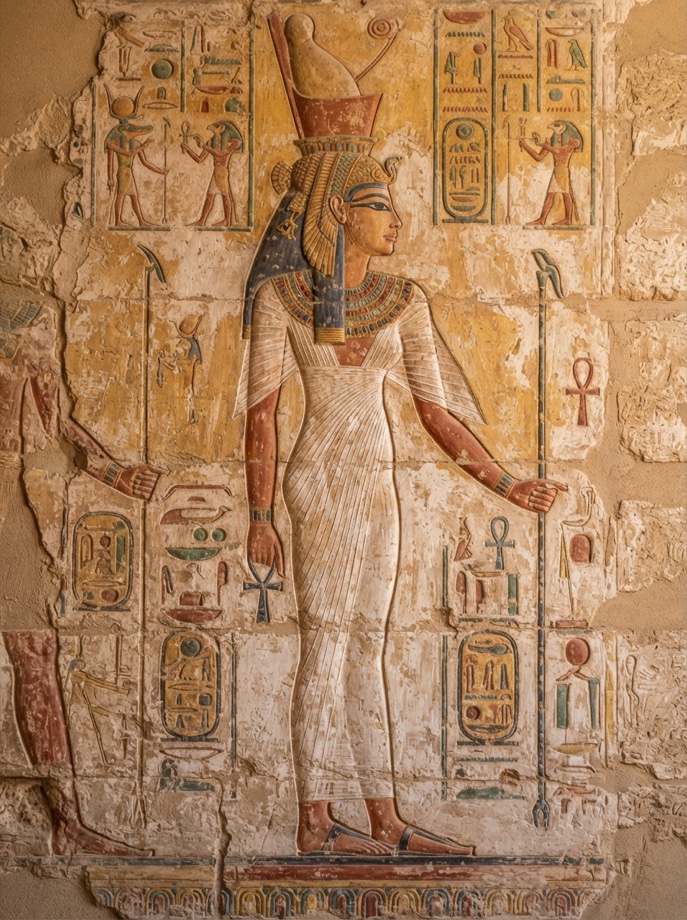
AI-assisted Portrait of Sobekneferu
A Throne With No Precedent
Sobekneferu did not inherit a throne so much as construct one, out of the wreckage of a collapsing lineage. When her father, Amenemhat III, died without a surviving son to carry the Twelfth Dynasty forward, Egypt faced a problem its theology had never modeled: a female claimant to an office defined, in every hieroglyph and every ritual gesture, as male. She did not campaign for the crown, did not marry into it, did not wait for a council to invent a workaround. She took the full pharaonic titulary — Horus name, Golden Horus name, prenomen and nomen, the whole five-part apparatus of legitimacy — and simply occupied it, becoming, so far as the record shows, the first woman in Egyptian history to rule in her own name as king rather than as regent or consort.
The reign lasted under four years and closed the dynasty rather than saving it. That fact alone invites a reading of Sobekneferu as improvisation under duress, a stopgap. But the surviving statuary argues otherwise: images that graft the nemes headdress and kilt of kingship onto a female body without disguising either, a hybrid visual language invented, as far as anyone can tell, on the spot. Three centuries before Hatshepsut faced the identical problem and solved it by performing maleness outright, Sobekneferu chose synthesis over disguise — the signature of a mind that does not borrow solutions from precedent but builds them, alone, from first principles.
Sobekneferu reads as INTJ: dominant Ni confronting a succession crisis with no cultural template and answering it with a single, internally-constructed design — a titulary and an image no one had ever assembled before.
The Architecture of a Solution Nobody Had Drawn
Nowhere in Egyptian precedent was there a form for a ruling woman to fill. Every prior queen who touched real power — Merneith, centuries earlier — had done so as regent, a placeholder explicitly understood to end when a son came of age. Sobekneferu had no son to hand the throne back to and made no gesture toward finding one. Instead she assembled, seemingly from nothing, a complete royal identity: a Horus name, a Two Ladies name, a throne name built on Ra, each element lifted from the existing kingly toolkit and reassembled around a body the toolkit had never accounted for. That is not adaptation of a known model. It is a structure generated whole, internally, then presented to the world as already finished.
The statuary makes the same case in stone. Surviving fragments show her in a garment that merges the shendyt kilt of a king with the fitted dress of a queen, cutting across a symbolic boundary that Egyptian art had never blurred before. This was not confusion about how to present herself — it was a considered visual argument, worked out once and held to, that kingship and womanhood were not in fact incompatible categories. A dominant Ni does not survey the field of existing options and pick the least-bad one; it collapses a genuinely unprecedented problem into a single coherent form and trusts that form over the absence of any tradition to lean on.
Running the State the Crisis Left Behind
Vision alone does not keep a kingdom fed and administered, and Sobekneferu's brief reign shows a ruler executing, not merely symbolizing. She is attested completing work at her father's vast mortuary complex at Hawara and continuing building at Mazghuna, projects that needed real labor, real materials, and real oversight to move forward rather than stall with the dynasty. A Nile flood-level inscription at Kumma, recorded in her name, is a small but telling detail: the machinery of state measurement and record-keeping kept running under her, unbroken, exactly as it had under her father.
None of this was ceremonial. An internally generated claim to kingship means nothing if the irrigation records stop, the building sites go idle, and the bureaucracy loses its nerve. Te, in service to a Ni-built design, is the discipline that turns "this is now how things are" into administrative fact — decrees issued, monuments finished, the ordinary business of Egypt proceeding under a name the system had no precedent for honoring.
A Reign With No Second Act
What is most visible by its absence is exactly what an inferior Se would predict: no campaign to consolidate power through spectacle, no visible push to marry, produce or adopt an heir, no improvised move to physically extend the dynasty once the structural argument for her own kingship had been made. The solution was conceptual and administrative, not dynastic in the ordinary, body-and-blood sense — and when Sobekneferu died after roughly four years, the Twelfth Dynasty simply had nothing left to hand forward. The design solved the immediate crisis completely and did nothing at all to solve the next one.
Why INTJ Over ENTJ
Why not ENTJ?
An ENTJ facing the same succession vacuum would more plausibly have asserted the claim outwardly — through campaign, coalition, or a public contest of authority against rival claimants — leading with Te and treating legitimacy as something won in the open. Nothing in Sobekneferu's record shows that kind of extraverted power struggle: no rival faction put down, no military assertion, no court she had to out-argue. What survives instead is a finished design, presented as already settled — titulary, iconography, ritual role, arriving as a single completed synthesis rather than a campaign fought and won in public. That is Ni leading, Te executing what Ni had already decided, not the reverse.
The distinction matters because so little of Sobekneferu survives beyond monuments and inscriptions — there is no court chronicle recording persuasion, rivalry, or debate. What the stone shows is a solution arrived at, not a solution argued for. An ENTJ leaves a paper trail of contest; Sobekneferu leaves only the finished artifact of a mind that had already resolved the question before anyone else was consulted.
Connected Figures
Further Reading
- The Middle Kingdom of Ancient Egypt — Wolfram GrajetzkiThe standard political history of the period, covering the Twelfth Dynasty's collapse in detail.
- Women in Ancient Egypt — Gay RobinsPlaces Sobekneferu's titulary and iconography in the broader context of Egyptian women's access to formal power.
- When Women Ruled the World — Kara CooneyTreats Sobekneferu as the opening case in a longer argument about female pharaohs and how Egypt made room for them.
- The Rise and Fall of Ancient Egypt — Toby WilkinsonA readable narrative history situating her brief reign within the end of the Middle Kingdom.
