 Historical Figure MBTI
#1044 · 8-4-26 · The Middle Kingdom
Amenemhat III
The Engineer King
r. c. 1860 – 1814 BCE
5 min read
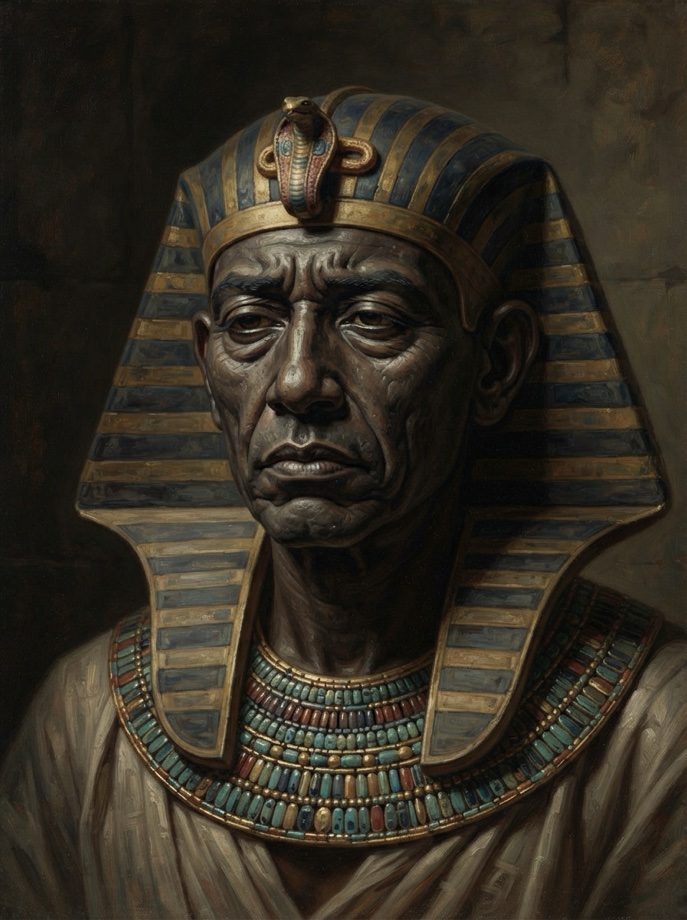
AI-assisted Portrait of Amenemhat III
The Longest Reign Built the Longest Canal
Amenemhat III inherited a kingdom already at peace and made it richer without firing a single arrow that history bothered to record. Forty-five years on the throne — one of the longest reigns of the Middle Kingdom — produced no famous battle, no dramatic conquest, no legend of personal heroism. What it produced instead was the Faiyum: a natural depression west of the Nile that Amenemhat and his engineers turned, through decades of dikes, canals, and a regulated inlet at Lahun, into the most productive farmland in Egypt. He did not discover the Faiyum's potential — his predecessors had already begun draining it — he simply finished the job more thoroughly than anyone before or after him, and kept finishing it for four and a half decades.
Alongside the reclaimed farmland rose his mortuary complex at Hawara, a structure so vast and so maze-like in its chambers and corridors that Herodotus and Strabo, visiting more than a thousand years later, called it the Labyrinth and rated it more impressive than the pyramids. It was not built to awe with a single soaring gesture. It was built to overwhelm through sheer accumulated complexity — room after room, wall after wall — the same instinct that drained a swamp one canal at a time.
Amenemhat III was an ISTJ, and dominant introverted sensing (Si) is the only function patient enough to spend a reign turning a marsh into a granary.
A Reign Measured in Cubits and Flood Marks
Si is the function that trusts what has already been tested and wants to run it to its fullest extent rather than replace it with something new. Amenemhat's Faiyum project is Si as statecraft: Nilometers at Semna and Kumma recorded flood heights with a precision his officials maintained for generations, and the numbers fed directly into decisions about how much of the Faiyum basin to open to irrigation in a given year. He was not improvising a response to each flood — he was operating a system, refined year over year, that let a known input (the river's height) produce a known output (arable acreage). That is a mind that wants precedent, calibration, and repetition, not novelty.
The same instinct shows in how long he kept doing the same things. Most Middle Kingdom pharaohs built one major monument program; Amenemhat maintained building projects at Hawara, at Dahshur where he had already built one pyramid before abandoning it for structural flaws and starting a second, and across the turquoise mines of Sinai, where his name appears on inscriptions dated across nearly the entire length of his reign. He did not chase a single triumph. He kept returning to the same worksites, the same quarries, the same irrigation channels, deepening and extending what already existed until the returns compounded past anything a shorter, flashier reign could produce.
The Administration That Outlasted Him
Where Si supplied the patience, extraverted thinking (Te) supplied the machinery to organize thousands of laborers, surveyors, and officials into projects that ran for decades without collapsing into waste. The Faiyum reclamation was not one canal but a coordinated system of dikes, sluices, and drainage channels that had to be planned, staffed, and maintained across a bureaucracy — a logistics problem as much as an engineering one. Amenemhat's government left behind an unusually dense record of provincial administration, taxation, and labor organization for exactly this reason: the work required it, and Si-Te temperaments are the ones that build the paperwork trail because they build the systems that generate it in the first place.
He also used Te's efficiency instinct to consolidate power at the center rather than seeking new territory to justify it. The great provincial governors — the nomarchs — who had held semi- independent authority for generations effectively vanish from the record under his reign, their offices folded into a more centralized royal administration. That is not the mark of a conqueror extending a border. It is the mark of an administrator tightening a system he already controlled, squeezing inefficiency out of a structure rather than building a new one from scratch.
Why ISTJ Over ESTJ
Why not ESTJ?
An ESTJ pharaoh would have led with Te — issuing decrees, reorganizing the bureaucracy first, and treating the Faiyum as a problem to be delegated and solved on schedule. Amenemhat's record shows the opposite order of operations: forty-five years of incremental, hands-on deepening of an existing project, with administrative consolidation arriving as a byproduct rather than the headline. The sheer duration and evenness of the effort — no burst of reorganizing energy, just steady extension year after year — reads as Si in the driver's seat, with Te doing supporting work rather than leading it.
The Labyrinth settles it further. An ESTJ builds a monument to declare an achievement finished; Amenemhat built a structure whose entire character was cumulative complexity, corridor added to corridor, chamber to chamber, over years of continuous construction. That is a Si signature — a mind that finds security in accumulation, not a Te one that finds satisfaction in closing a project out.
Connected Figures
Further Reading
- The Middle Kingdom of Ancient Egypt — Wolfram GrajetzkiThe standard modern study of the era's administration, economy, and the Faiyum reclamation.
- The Rise and Fall of Ancient Egypt — Toby WilkinsonA readable narrative history situating Amenemhat III's reign within the Middle Kingdom's arc.
- The Oxford History of Ancient Egypt — Ian Shaw (ed.)Scholarly overview chapters covering 12th Dynasty kingship, building programs, and succession.
