 Historical Figure MBTI
#1043 · 8-4-26 · The Middle Kingdom
Senusret III
The Realist King
r. c. 1878 – 1839 BCE
8 min read
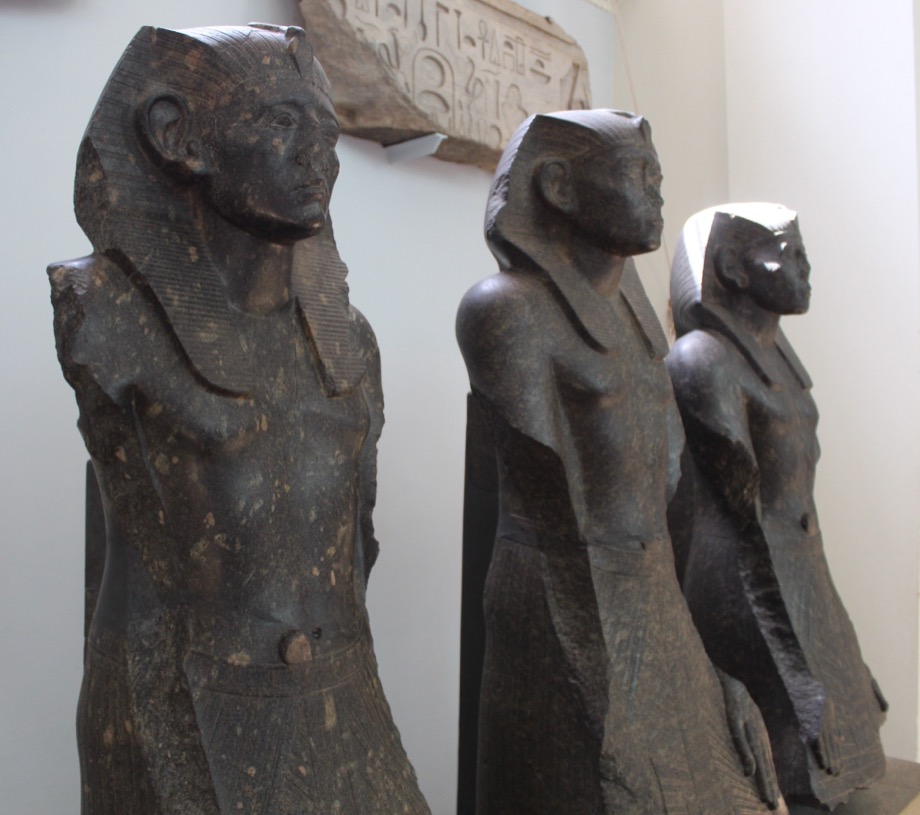
Statue of Senusret III
The King Who Let Himself Look Tired
For roughly a thousand years, Egyptian kings had been shown the same way: smooth-cheeked, wide-eyed, perpetually about thirty, serene. Then, somewhere around 1870 BCE, the royal workshops began producing something else entirely. The face of Senusret III has hooded, heavy lids and pouched skin beneath them. Deep diagonal furrows run from the nose past a compressed, downturned mouth. The ears are enormous. The expression is not sad and it is not cruel; it is the expression of a man in the middle of a long meeting he intends to win. Nothing like it had been carved before, and after his dynasty ended nothing like it would be carved again for centuries.
It is tempting to read those faces as confession — the burden of kingship, a private melancholy. The reign itself suggests something harder. This was the pharaoh who ended the semi-independence of Egypt’s provincial dynasts, pushed the southern frontier deep into Nubia at spearpoint, and ringed it with a chain of mud-brick fortresses so large that their ruins remained the most imposing military architecture in the Nile Valley until they were drowned by Lake Nasser. The careworn face is not an apology. It is an assertion: this is what running a country actually looks like, and I am the one doing it.
Later Egyptians remembered him better than they remembered almost anyone. In Nubia he was worshipped as a god for the next five hundred years. The Greeks collapsed him and his ancestors into the legendary conqueror “Sesostris,” who supposedly subdued the world. The exaggeration was earned by something unglamorous: he made the machinery of the Egyptian state answer directly to the throne, and he made the border hold.
An ESTJ whose dominant Te treated Egypt as a system with faults to be closed — hereditary power abolished, a frontier drawn on a map and then built in brick, and a royal face that reported the cost.
Te — Abolishing the Middlemen
Egypt’s Twelfth Dynasty had a structural defect it had inherited from the collapse of the Old Kingdom: the nomarchs. These provincial governors held their offices by inheritance, kept their own courts and militias, dated events by their own years of rule, and cut themselves rock-tombs at places like Beni Hasan and Deir el-Bersha that were, in scale and ambition, small royal monuments. Successive kings had managed them, married into them, and bought them off. Senusret III simply stopped the practice. After his reign the great provincial tomb series go quiet — no more grand nomarch burials, no more independent dating, no more hereditary succession in the provinces.
What replaced them was administration. The evidence points to a reorganization of the country into three great departments — north, south, and the Nubian territory — each run by a council of officials reporting into the vizier and the royal residence rather than into a local dynasty. Career bureaucrats appointed from the centre displaced landowning families whose claim was ancestry. It is the single most consequential act of internal restructuring in Middle Kingdom Egypt, and it was done without a civil war.
This is Te at its most characteristic: identify the part of the org chart where authority leaks, delete it, and replace it with something that can be measured and reassigned. He was not attacking the nomarchs out of grievance. He was closing a gap between where decisions were made and where they were executed, and the gap happened to be occupied by the most powerful families in the country.
Si — The Border Built in Brick
Senusret III campaigned into Nubia at least four times — his own inscriptions record expeditions in regnal years 8, 10, 16, and 19 — and had the Nile cataract channel at Sehel cleared and widened so that warships could pass upstream on schedule. The campaigns were deliberately brutal, and he said so: one text boasts of seizing the enemy’s women, cutting off their water supply, and burning their grain. He was not describing glory. He was describing a method for making a population unable to return.
Then came the fortresses. Buhen, Mirgissa, Semna, Kumma, Uronarti, Askut and their neighbours formed a fortified chain around the Second Cataract — massive mud-brick enclosures with bastioned walls, dry ditches, glacis slopes, covered stairways down to the river, granaries, barracks, and permanent garrisons in correspondence with the capital. The Semna Dispatches, recovered on papyrus, show the system in operation: routine written reports of every group of Nubians approaching the frontier, logged and forwarded. A border was not a line on a map; it was a paperwork regime with walls attached.
At Semna he set up a boundary stela stating the doctrine outright — that no Nubian was to pass this point going north, by boat or by land, with herds, except to trade at the designated place, and nothing else. Si supplies the conviction beneath all of this: precedent matters, borders are real things, systems that worked before should be built to last and staffed forever. He was not improvising a frontier policy. He was institutionalizing one and expecting it to outlive him — which it did, garrisoned for the better part of two centuries.
Ne — The Break in the Royal Face
The tertiary function is where an ESTJ occasionally does something nobody predicted, and Senusret’s is the royal portrait. Deciding to be depicted aged, strained, and unbeautiful — in a culture whose entire visual theology held that the king was a perfected, ageless being — was a genuinely radical move. It spread through the workshops of his reign and his son’s and became, briefly, the house style of Egyptian sculpture. Then it vanished. It was a one-family experiment in what a king was allowed to look like.
The same lateral instinct shows in his monuments. He built a pyramid at Dahshur and also cut an enormous subterranean tomb complex at Abydos, in the shadow of the Osiris cult centre — hedging between the northern royal tradition and the older southern one, and possibly leaving open which was the real burial. He cleared a cataract channel to make warships fast. He put his frontier doctrine on a stela in plain, almost commercial language.
But Ne here stays subordinate. Every departure serves an argument Te has already made: that rule is work, that the border is a fact, that the throne needs no flattery to be obeyed. The innovations are instruments, never explorations.
Fi — Contempt, Plainly Stated
The Semna stela does something Egyptian royal texts almost never do: it gets personal. The king declares that he has taken the frontier further than his fathers did, that a son of his who maintains it is his true son and one who lets it slip is not, and that the Nubian retreats when pressed because he is not a man of courage. That last line is not policy. It is scorn, carved in granite at the edge of the world, by a man who evidently could not resist saying what he actually thought.
Inferior Fi tends to surface exactly like that — rarely, bluntly, and with a moral edge disproportionate to the occasion. The same voice appears in his insistence that a king who is soft on the border has forfeited the relationship. Value, for Senusret III, was measured by whether you held what you were handed.
And there is the face again. Whatever else those portraits are doing, they are the work of a man who preferred an accurate account to a flattering one, even when the subject was himself, and even when the medium was eternity.
Why ESTJ Over ENTJ
Why not ENTJ?
The scale of the reorganization invites an ENTJ reading — a visionary restructuring the state. But look at what he actually built: not a new kind of Egypt, but the existing pharaonic order pushed to full compliance. He did not reimagine kingship, invent institutions, or open a new strategic horizon; he removed the intermediaries between the throne and the country, and fortified a frontier along a line the Twelfth Dynasty had already been probing for three reigns. That is Si-backed executive command — precedent enforced harder — not Ni-driven reimagining.
The Nubian policy is the clearest test. An Ni-led conqueror looks past the cataract and asks what an empire to the south could become; that is what the Eighteenth Dynasty would eventually do. Senusret III did the opposite. He drew a line, wrote down exactly who could cross it and for what, and spent four campaigns and a fortune in brick making that line permanent. His ambition was depth of control, not breadth of possibility — the difference between an ESTJ and an ENTJ stated as clearly as any king has ever stated it.
Connected Figures
Further Reading
- The Middle Kingdom of Ancient Egypt — Wolfram GrajetzkiThe standard survey of the period, with the clearest account of the nomarchs' disappearance and the administrative reform.
- The Oxford History of Ancient Egypt — Ian Shaw (ed.)Chronology, sources, and the current reading of the Twelfth Dynasty's Nubian policy.
- Ancient Egyptian Warfare — Ian ShawOn the Second Cataract fortress system, its garrisons, and the Semna Dispatches as a working border regime.
- Egyptian Fortresses (articles on Semna and Buhen) — Bill ManleyAccessible treatment of the individual Nubian forts and the boundary stelae erected at Semna.
- The Art of Ancient Egypt — Gay RobinsBest discussion of the careworn royal portrait style and how far it broke with a thousand years of idealization.
- The Rise and Fall of Ancient Egypt — Toby WilkinsonReads Senusret III's reign as the high point of Egyptian state coercion rather than benevolent kingship.
