 Historical Figure MBTI
#1041 · 8-4-26 · The Middle Kingdom
Mentuhotep II
The King Who Reunified Egypt
r. c. 2055 – 2004 BCE
5 min read
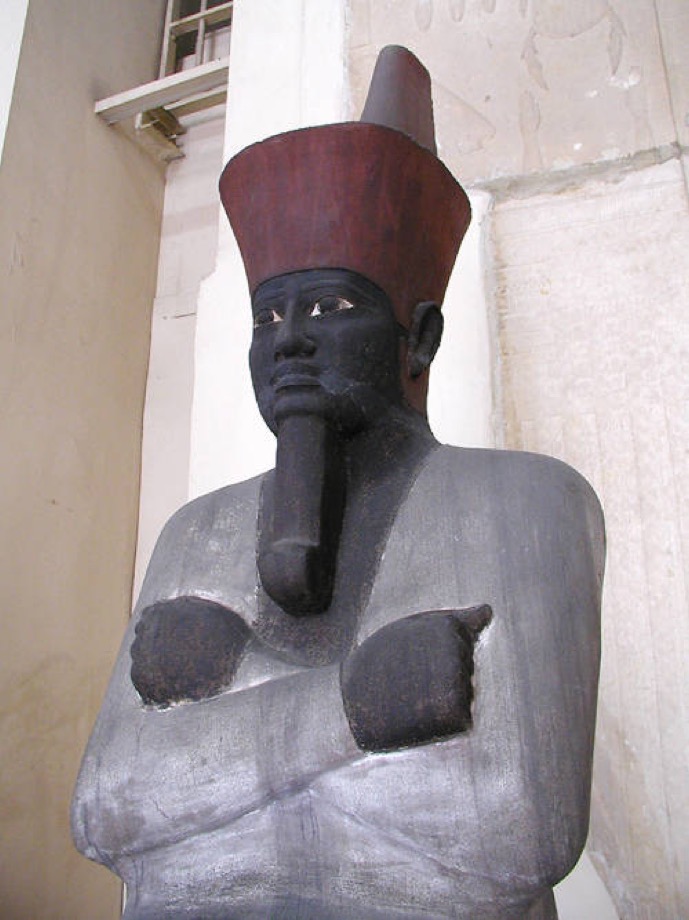
Statue of Mentuhotep II
A Kingdom Stitched Back Together by Force
Egypt had been broken for a century when Mentuhotep II inherited the throne of Thebes, a provincial seat commanding a fraction of the Nile. To the north, a rival dynasty ruled from Herakleopolis; nomarchs elsewhere governed as petty kings in all but name. Most rulers in his position would have negotiated, waited, consolidated what they had. Mentuhotep II campaigned. Across a reign of roughly fifty years he pushed his armies north, broke the Herakleopolitan line, and by his thirty-ninth regnal year stood as the first king in generations to call all of Egypt his own.
What follows the conquest is the more telling part. He did not simply hold the ground he had taken; he rebuilt the machinery of the state around Thebes, installed loyal officials in place of the old provincial lords, and commissioned a mortuary temple at Deir el-Bahari unlike anything built before it — a terraced, colonnaded statement of a new order, later echoed almost exactly by Hatshepsut's temple next door. Reunification was not a single victory to him; it was a design problem, and he solved it methodically, on his own terms, in his own name.
Mentuhotep II is an ENTJ, and his dominant function is Te — the drive to impose an efficient, working order on whatever chaos he inherits, and to do it visibly, in stone.
The Reorganizer of Thebes
Te is the will to make the external world function correctly, and Mentuhotep II applied it first to the most obvious inefficiency in front of him: a country split against itself, its resources wasted on internecine war instead of production. His campaigns against Herakleopolis were not undertaken for glory in the abstract — inscriptions from his reign describe the fighting in blunt, administrative terms, as the necessary clearing of an obstacle. Once the north fell, he moved immediately to institutional cleanup, stripping the nomarchs of the near-autonomous power they had accumulated during the First Intermediate Period and replacing regional loyalty with a chain of command that answered to Thebes.
The same instinct shows in how he restyled his own kingship mid-reign, adopting titulary that explicitly proclaimed the reunification — a Te move if there ever was one, converting a military outcome into a durable, legible claim on legitimacy. And it shows again at Deir el-Bahari, where the mortuary temple functions as propaganda in the most literal sense: a permanent, physical argument that order has been restored and a single king now governs the whole of the Two Lands. Every piece of it, from the war to the wall inscriptions, is aimed outward at producing a measurable result.
A Single Vision of a Reunited Nile
What separates Mentuhotep II from a mere warlord is the coherence of the endpoint he seems to have held from early on. A fragmented Egypt was, to him, not simply an inconvenience to be managed piecemeal but a wrong shape — a deviation from an underlying pattern of what the state was supposed to look like, one king ruling one Egypt from the Delta to the First Cataract. His decades-long campaign reads less like opportunistic expansion and more like the patient execution of a single, long-held picture of the whole, pursued through multiple phases of war and administration until reality matched the image.
That same long-range pattern sense appears in his choice of Deir el-Bahari itself — a site he read correctly as symbolically central, tucked into the cliffs facing Thebes, positioned to dominate the western horizon the way Karnak would come to dominate the eastern one. He was, in effect, laying architectural groundwork for a Theban-centered religious and political geography that would outlast him by centuries.
Why ENTJ Over INTJ
Why not INTJ?
An INTJ reunifier would have planned the campaign in private and let subordinates execute it, surfacing mainly through decree and design. Mentuhotep II did the opposite: he restyled his own titulary mid-reign to broadcast the reunification, built a temple explicitly meant to be seen and read as a public claim on legitimacy, and staked his authority on visible, external results rather than a quietly held strategic vision. That is Te reaching outward for validation in the world, not Ni content to be right in private.
The distinction matters because both types can produce the same outcome — a unified state — by very different roads. An introverted Ni-dominant would have treated the fifty-year reign as the unfolding of an internal model, judged by its own coherence. Mentuhotep II treated it as a project measured by conquered territory, functioning bureaucracy, and stone that still stood a thousand years later. That is the signature of Te in the driver's seat.
Connected Figures
Further Reading
- The Middle Kingdom of Ancient Egypt — Wolfram GrajetzkiThe standard account of Mentuhotep II's reunification and the administrative reforms that followed it.
- The Rise and Fall of Ancient Egypt — Toby WilkinsonSets the First Intermediate Period collapse and Mentuhotep II's reconquest in the sweep of Egyptian political history.
- The Oxford History of Ancient Egypt — Ian Shaw (ed.)Scholarly overview of the Deir el-Bahari temple and the 11th Dynasty's Theban power base.
