 Historical Figure MBTI
#1047 · 8-5-26 · The New Kingdom
Seqenenre Tao
Died Facing Forward
r. c. 1558 – 1554 BCE
3 min read
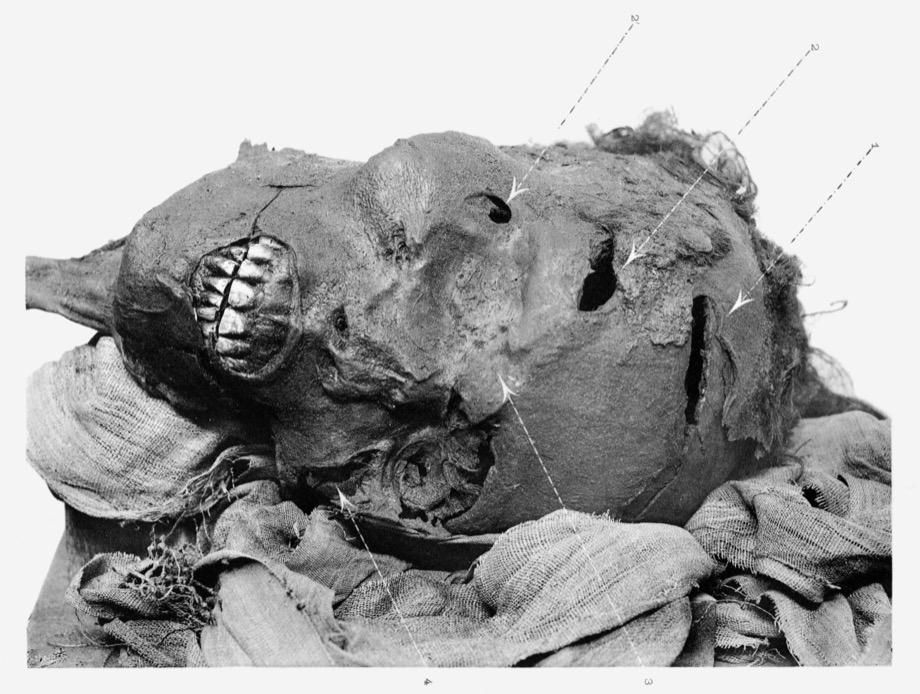
Mummy of Seqenenre Tao
A King Who Answered With His Body
Seqenenre Tao ruled Thebes as a vassal of the Hyksos kings who controlled the Nile Delta — a client kingship that Apepi, the Hyksos king in Avaris, tested with an absurd, deliberately provoking complaint: that the hippopotamuses in Seqenenre's sacred pool, hundreds of miles south, were keeping him awake at night. Whether or not the surviving account is literal, Seqenenre answered the provocation the only way an ESTP ruler could — not with a treatise, but with war.
He did not live to see it won. His mummy shows catastrophic wounds — an axe blow through the forehead, further gashes to the face and skull — inflicted, forensic study suggests, at close range, possibly even after he had already fallen. Whatever the exact circumstance, Seqenenre died where the fighting was, not behind it.
Seqenenre Tao did not out-think the Hyksos. He confronted them, physically and immediately, and let his body carry the argument his kingdom could not yet win.
The Body in the Field
Every trace of Seqenenre that survives is physical rather than administrative: no lengthy inscriptions, no philosophical instructions to an heir, just a body carrying the direct evidence of close combat. That absence is itself informative — this was a king whose engagement with the Hyksos crisis was immediate and bodily, not mediated through scribes and policy.
Se rulers act in the world as it presents itself, moment to moment. Seqenenre's decision to press a fight against a materially stronger occupying power, rather than continue his predecessors' uneasy accommodation, reads as exactly that kind of direct, present-tense engagement — for better or for fatal worse.
Reading the Insult Correctly
Apepi's hippopotamus complaint was, on its face, ridiculous — but Seqenenre appears to have understood exactly what it was actually testing: whether Thebes would keep accepting Hyksos authority over increasingly petty and pointed demands, or draw a line. That is a private, internally-reasoned read on a deliberately ambiguous provocation, not a reflexively emotional one.
Ti works quietly beneath a dominant Se, sorting out what a situation actually requires before the body commits to it. Seqenenre's war was not blind reaction; it was a considered judgment, acted on directly once made.
Why ESTP Over ISTP
Why not ISTP?
An ISTP might reach the same tactical read on Apepi's provocation, but would more likely stay in the analytical background rather than personally leading the charge that got him killed. Seqenenre's dominant function was outward and physical — Se, not introverted Ti — and it was that Se that put him at the front of the fighting rather than directing it from behind.
The evidence for Seqenenre is thin and almost entirely forensic, but what it shows — a body absorbing the war rather than a mind narrating it — points to Se leading, Ti quietly confirming the call was right.
Connected Figures
Further Reading
- The Rise and Fall of Ancient Egypt — Toby WilkinsonCovers the Hyksos period and the war of liberation in full context.
- Ancient Egyptian Warfare — Ian ShawIncludes forensic analysis of Seqenenre's wounds and the tactics of the era.
- The Quarrel of Apophis and Seqenenre (Papyrus Sallier I) — trans. Miriam Lichtheim, Ancient Egyptian Literature vol. 2The surviving literary account of the hippopotamus provocation.
