 Historical Figure MBTI
#1050 · 8-5-26 · The New Kingdom
Ahmose-Nefertari
The Queen Worshipped for 400 Years
fl. c. 1550 – 1505 BCE
5 min read
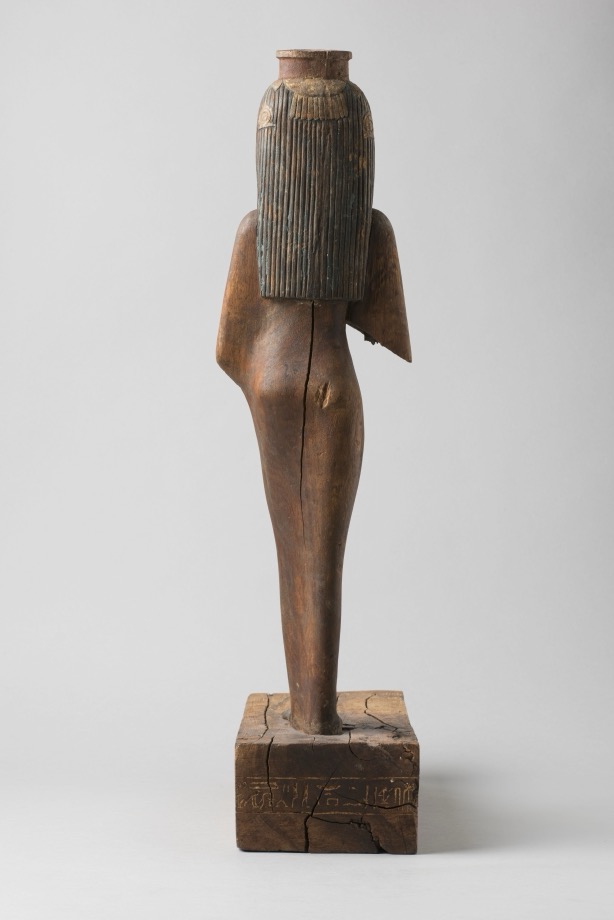
Statuette of Ahmose-Nefertari
A Queen Who Outlived Every Reign She Touched
Most royal wives of ancient Egypt vanish into a husband’s shadow within a generation. Ahmose-Nefertari did not. She married Ahmose I as he finished expelling the Hyksos and refounded a unified Egypt, and she carried the title God’s Wife of Amun — an office that came with its own land grants, its own staff, its own income, independent of the crown. She was not a symbolic consort; she administered a religious estate in her own name, and she went on doing so through the reign of her son, Amenhotep I, after Ahmose died.
What makes her unusual is not the title but what happened after she died. Centuries later, the workmen of Deir el-Medina — the village that built the royal tombs of the Valley of the Kings — still kept her shrine, still poured offerings to her, still painted her, black-skinned, as a symbol of fertility and rebirth rather than any ethnic marker, on tomb walls generation after generation. No decree kept that cult alive for nearly four hundred years. Only affection did.
Ahmose-Nefertari is an ESFJ, and the four centuries of popular devotion that outlasted her are the clearest signature of dominant Fe on record in this era — an authority built entirely from being loved.
The Authority of Being Remembered Kindly
Dominant Fe reads a community’s emotional needs and answers them, and nowhere is that clearer than in the cult that grew around Ahmose-Nefertari at Deir el-Medina. She was adopted as a patron and protector of the necropolis workmen — an unusually intimate, working-class devotion for a queen, closer to a village’s household god than a state monument. Workmen invoked her alongside their own dead relatives in personal prayers, a register of closeness that state religion rarely produced for royalty.
As God’s Wife of Amun, she used the office’s wealth and staff to fund cult activity that bound the temple community together rather than simply enrich it — the hallmark of Fe wielding institutional power in service of relational cohesion, not personal accumulation. Her son inherited a mother whose religious authority had already knit the priesthood and the crown into a working partnership; that partnership outlasted her by centuries because it had been built on genuine reciprocal care, not fear.
Even her iconography argues for Fe. Later artists chose to paint her skin black — a color coded to the fertile Nile silt and to Osiris, god of rebirth — a symbolic decision made by others, long after her death, to keep casting her as a life-giving, nurturing presence. A dominant Ti or Te figure leaves behind systems and edicts; Ahmose-Nefertari left behind a feeling people kept choosing to preserve.
Guardian of an Office Still Being Invented
The title God’s Wife of Amun existed before Ahmose-Nefertari, but she is the queen who made it a durable, well-resourced institution rather than an honorific — establishing precedents for its endowments and its ritual duties that her successors, including Hatshepsut, would inherit and build on. That is auxiliary Si’s work: taking a loosely defined role and grounding it in concrete, repeatable, well-documented practice.
Her steady administration through two reigns — her husband’s and her son’s — reads as continuity management rather than reinvention. She did not remake Egyptian religion; she made sure an already-precious inheritance, a newly reunified kingdom emerging from foreign occupation, was carefully tended and handed on intact. That is Si in service of Fe: preserving the concrete institutions that let a community’s emotional bonds actually function generation after generation.
A Cult That Kept Finding New Forms
Tertiary Ne shows up not in Ahmose-Nefertari’s own choices — the record is too thin for that — but in how flexible and generative her posthumous cult proved to be. Over four centuries, artists and priests kept reinterpreting her image: black-skinned fertility goddess in one generation, protector of craftsmen in another, ancestral matriarch paired with Amenhotep I in a third. A cult that rigid would have calcified into a single fixed icon; hers kept absorbing new symbolic meaning without losing its emotional center.
That openness to reinterpretation, sustained by a community rather than a bureaucracy, suggests the kind of personality whose warmth invites elaboration rather than demanding uniformity — the difference between an office people merely staff and one people keep wanting to reimagine.
Why ESFJ Over ISFJ
Why not ISFJ?
An ISFJ’s Si-Fe stack tends toward quiet, private duty rather than a public devotional following — protecting a small circle rather than becoming a communal object of affection for an entire workmen’s village. Ahmose-Nefertari’s cult was extroverted in its very nature: shared shrines, communal offerings, a figure invoked publicly and repeatedly across generations, not a private household loyalty. That pattern points to Fe leading, with Se-adjacent Si supporting it, rather than Si leading with Fe in reserve.
The distinction matters because it changes what kind of authority she held. An ISFJ queen would have been remembered as faithful; Ahmose-Nefertari was remembered as beloved, actively invoked by name for centuries by people with no obligation to her at all. That is Fe’s signature, not Si’s.
Connected Figures
Further Reading
- A History of Ancient Egypt — Nicolas GrimalStandard dynastic overview covering the reunification under Ahmose I.
- Ancient Egyptian Literature — Miriam LichtheimTranslated votive and devotional texts from Deir el-Medina's cult of Ahmose-Nefertari.
- Pharaoh Triumphant — Kenneth KitchenBroader New Kingdom political context that the God's Wife of Amun office grew within.
