 Historical Figure MBTI
#1051 · 8-6-26 · The New Kingdom
Hatshepsut
The Queen Who Took the Throne
r. c. 1479 – 1458 BCE
10 min read
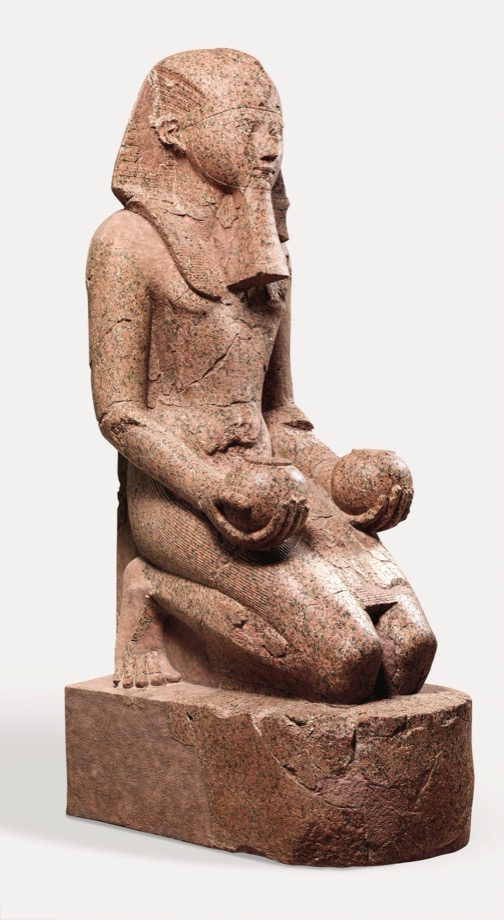
Statue of Hatshepsut
The Regent Who Did Not Give It Back
Egypt had a word for what she was supposed to be. A king's daughter, a king's sister, a king's great wife, a god's wife of Amun — the titles stacked up around Hatshepsut like scaffolding around a building that would never be finished. When her husband Thutmose II died around 1479 BCE, the machinery did what it was designed to do: the throne passed to his infant son by a secondary wife, and the widow stepped forward to hold the country steady until the boy could hold it himself. Regency was an honorable, temporary, well-understood office. Egypt had seen it before. What Egypt had not seen was a regent who looked at the scaffolding and decided to become the building.
Within about seven years she had stopped being a regent in anything but arithmetic. She took the full fivefold titulary of a pharaoh — Horus name, throne name, the whole royal apparatus — and had herself crowned as Maatkare, "Truth is the Soul of Re." In relief and statuary she appears in the kilt and the nemes headcloth, the bull's tail and the ceremonial false beard, her body carved in the conventional male idiom of kingship even as the texts beside her sometimes kept feminine grammar. This was not a disguise; nobody in Thebes was fooled about her sex. It was a claim, made in the only visual vocabulary Egypt had for legitimate rule, and she made it everywhere, at scale, in stone.
And then — this is the part that keeps historians up at night — nothing collapsed. There was no purge, no civil war, no coup against her. Thutmose III grew up alongside her as a junior king, learning the army; her officials prospered; the treasury filled; the quarries and the trade routes ran. She held the throne for roughly two decades of prosperity and peace and gave it up only by dying. A woman had seized the most rigidly gendered office in the ancient world and then governed so competently that the seizure came to look like continuity.
Hatshepsut is the archive's cleanest ancient case of ENTJ dominant Te: a ruler who did not wait to be granted authority, but built it in public, out of monuments, expeditions and results, until refusing it was unthinkable.
Te — Legitimacy Manufactured in Limestone
Extraverted Thinking does not argue for authority; it organizes the world until authority is the obvious description of what is already happening. Hatshepsut's entire reign is that operation run at state scale. She did not petition the priesthood for permission to be king and she did not rule from behind a curtain. She commissioned. Djeser-Djeseru at Deir el-Bahari — the terraced mortuary temple rising against the cliff opposite Karnak, still the most architecturally confident building to survive from the second millennium BCE — is a policy document in stone, and every visitor to the west bank of Thebes was made to read it. At Karnak she raised a pair of granite obelisks, one of which still stands, and had the record inscribed with the flat administrative pride of a woman itemizing a delivery: quarried at Aswan, hauled, erected, sheathed in electrum, the whole job done in seven months.
Te judges by output, and Hatshepsut chose outputs that could not be argued with. The expedition to Punt — a seaborne trading mission down the Red Sea for incense trees, ebony, ivory, gold and myrrh — was not a war, and that was the point. It was an achievement in the register of logistics, and she had it carved in exhaustive narrative relief along the temple's middle colonnade: the ships, the cargo nets, the Puntite village on stilts, the famously unflattering depiction of the queen of Punt, the living myrrh saplings potted for transplanting into the temple garden. Most rulers commemorate battles. She commemorated a supply chain, because a supply chain proved the thing she needed proved — that under her the country got richer.
Even her theology was engineered as infrastructure. The divine birth cycle at Deir el-Bahari stages her conception as the direct work of Amun, who visits her mother Ahmose in the god's own person; a companion sequence shows her father Thutmose I presenting her to the court as his chosen heir. Neither event is likely to have happened as depicted. Both are load-bearing. A Te dominant confronted with a rule that excludes her does not brood about the injustice of the rule — she builds a public, documented, ritually endorsed structure in which the rule no longer applies to her, staffs it with loyal administrators like Senenmut, and then gets on with the work.
Ni — The Twenty-Year Approach
What kept the Te from being mere noise was a long, singular vision of where it was all going. Hatshepsut did not lunge at the crown. The transition from "great royal wife acting for the child king" to "king" was staged across years, in increments each of which was individually deniable: first the regent's titles, then royal epithets, then the throne name, then the regalia, then the full iconography of kingship in monumental relief. Introverted Intuition supplies exactly this — a fixed image of the end state, and the patience to let the intermediate steps look like something else.
She also understood that the dangerous part of a usurpation is not the taking but the aftermath, and she solved for it decades in advance. Rather than eliminating Thutmose III, she kept him beside her as co-regent, dated her monuments by his regnal years as well as her own, and let him grow into the army that would become the greatest fighting instrument of the age. It is a strange, cool-headed decision — the standing threat to your reign, trained in warfare, kept close — and it reads as a bet that a legitimate co-king who owes his education to you is safer than a martyred one. Through her own daughter Neferure, groomed with the god's-wife titles and given Senenmut as tutor, she hedged the succession on a second front.
The Ni also shows in what she declined to do. The New Kingdom was built on conquest, and the expected way for a new ruler to prove worth was a campaign in Syria-Palestine. Hatshepsut ran modest military operations — Nubia among them — but she deliberately did not stake her legitimacy on the battlefield, where a single reverse would have been read as the gods' verdict on a woman in the double crown. She staked it instead on trade, building and restoration, arenas where success accumulates and rarely reverses. That is not timidity. That is seeing the shape of the whole reign before it happens and choosing the terrain on which she cannot lose.
Se — The Beard, the Obelisk, the Myrrh Tree
Tertiary Extraverted Sensing gives the ENTJ an instinct for the physical gesture that lands — the object, the image, the staged appearance that does the persuading before a word is spoken. Hatshepsut had an almost modern grasp of this. The false beard is the obvious case: a piece of ceremonial costume that converted a contested fact about her body into an uncontested statement about her office, repeated in granite until it became the background of Egyptian life. Her sculptors developed a whole visual program around her, sliding across her reign from feminine forms in queenly dress toward the idealized male royal body, letting the eye be trained gradually rather than shocked.
The Punt reliefs are Se as reportage. They are crowded with the sensory particulars a purely abstract ruler would have left out — the fish in the Red Sea rendered accurately enough that modern zoologists can name species, the sailors' rigging, the piles of aromatic resin, the trees carried in baskets by teams of men. She wanted the wealth seen, weighed, smelled. And she followed through physically: the myrrh trees were planted on the temple terraces, and the pits dug for them are still there in front of Djeser-Djeseru, empty for thirty-five centuries.
Se also explains her taste for scale and spectacle — the transport and erection of hundred-ton obelisks, the electrum-tipped shafts catching first light over Karnak, the processional festivals in which the barque of Amun moved through crowds who could see, with their own eyes, that the god traveled at her invitation. She governed a largely illiterate country and understood that in such a country an argument is a thing you can walk up to and touch.
Fi — The Private Self Left Out of the Record
Inferior Introverted Feeling is the hardest thing to see in any ancient subject, and in Hatshepsut it is nearly invisible by design — which is itself the evidence. Across acres of inscribed surface she says almost nothing about what she wanted, feared or loved. The one recurring note of something like personal feeling is her insistence on her father. Again and again she returns to Thutmose I: his choice of her, his presentation of her to the court, the restoration of his memory, the plan to have him reburied so that they would lie together. A dominant-Te ruler does not usually spend that much monumental real estate on a filial bond unless the bond is load-bearing in some interior way as well as a dynastic one.
The other place the inferior function shows is in the intensity of her attachments to a small circle. Senenmut's rise is extraordinary — a man of unremarkable birth who accumulated some eighty titles, oversaw the Deir el-Bahari works, tutored her daughter, and was permitted to carve small images of himself hidden behind doors in her own temple, an intimacy with the sacred that no steward should have had. Whether the relationship was romantic is unknowable and probably beside the point; what it demonstrates is the classic ENTJ pattern of giving almost nothing away emotionally in public while binding a very few people to herself with total, unexplained trust.
And when Fi is inferior, the wound it registers is the sense of being personally unrecognized despite everything achieved. Hatshepsut's texts return compulsively to the theme of justification — she was chosen, she was foretold, the god himself fathered her, the land flourished under her. There is a defensive edge under all that stone. She had done more for Egypt than most kings and still had to keep saying so. It is the note of a person whose competence was never the question and who could never quite stop answering the question anyway.
Why ENTJ Over INTJ
Why not INTJ?
INTJ is the serious alternative, and the case for it is real: the incremental approach to the throne, the twenty-year horizon, the refusal to be baited onto the battlefield all look like dominant Ni running a private long game. But an INTJ's instinct under an illegitimate claim is to keep the formal title in someone else's hands and hold the actual power — to rule as the indispensable regent, the architect behind a compliant boy king. Hatshepsut did the opposite. She reached for the title itself, in public, in the most conspicuous idiom available, and spent the rest of her life advertising it in stone. That is Te leading and Ni serving, not the reverse.
The distinction is between strategy conducted in private and strategy conducted as performance. An introverted strategist minimizes surface area; Hatshepsut maximized it, covering Thebes with her name, staging festivals, sending fleets whose cargo could be counted by anyone standing on a quay. She organized people and materials by direct command and measured herself by visible, external results — obelisks raised, temples finished, trade restored, the Two Lands prosperous. Her Ni is genuine and it is doing real work, but it is in the service of an outward campaign rather than a hidden one. Where the INTJ waits for the world to come around to a conclusion already reached, Hatshepsut built the conclusion at full scale and invited the world to walk through it.
Connected Figures
Further Reading
- The Woman Who Would Be King — Kara CooneyA narrative biography arguing that Hatshepsut's power was built incrementally and legitimated through religion and image.
- Hatshepsut: From Queen to Pharaoh — Catharine H. Roehrig (ed.)The Metropolitan Museum exhibition catalog — the standard illustrated reference on her statuary, monuments and court.
- Hatchepsut: The Female Pharaoh — Joyce TyldesleyA readable scholarly life that reassesses the erasure campaign as dynastic housekeeping rather than personal revenge.
- The Monuments of Senenmut — Peter F. DormanThe detailed study of her steward's career and tombs, and the best window onto how her building program was actually run.
- Silent Images: Women in Pharaonic Egypt — Zahi HawassBroad survey of women's roles and representation in ancient Egypt, useful for placing her reign in context.
