 Historical Figure MBTI
#1052 · 8-6-26 · The New Kingdom
Senenmut
The Steward Who Smuggled Himself In
fl. c. 1473 – 1458 BCE
10 min read
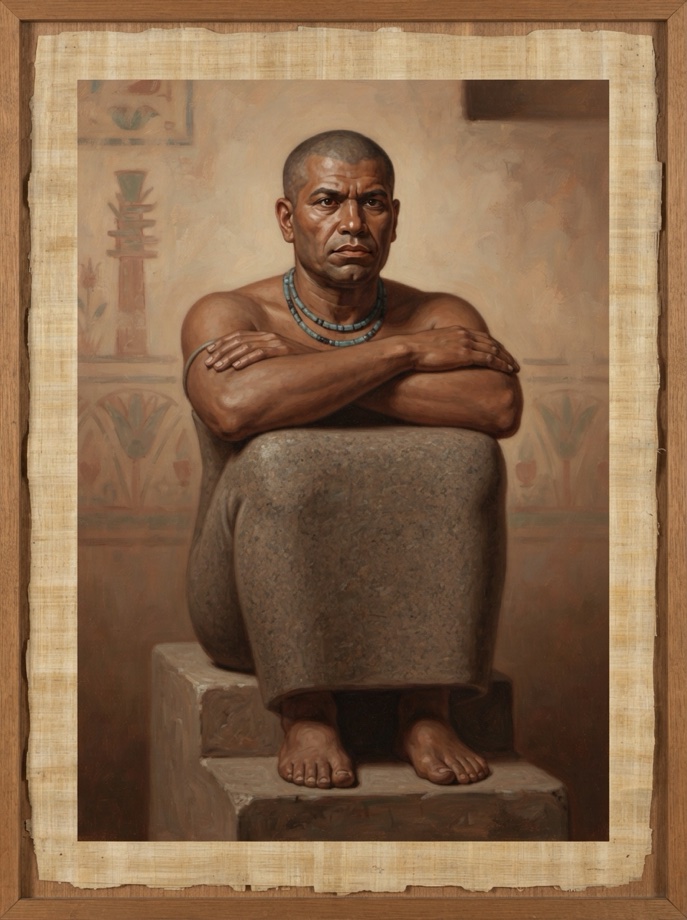
AI-assisted Portrait of Senenmut
Ninety Titles and No Ancestry
Egypt was a civilization that liked its categories fixed. A man was a scribe or a priest or a steward, and his father had usually been the same thing before him. Senenmut arrived from provincial Armant with parents so obscure that their titles amount to nothing at all — and then accumulated, over roughly two decades, somewhere north of ninety official designations, held simultaneously. Steward of Amun. Overseer of the granaries, the fields, the cattle, the gardens of the god. Chief of the king's works. Tutor to the royal daughter. Controller of works at Karnak. The sheer inventory is the point: no one else in the New Kingdom collected offices the way Senenmut did, and no one else so plainly treated the entire administrative apparatus of Egypt as a set of adjacent doors, all of which could be opened by the same restless man if he was quick enough about it.
What he did with that access was more startling than the collecting. Under Hatshepsut he built Djeser-Djeseru at Deir el-Bahari, a mortuary temple that abandons the pyramid template entirely — three ascending colonnaded terraces cut into a bay of limestone cliffs, ramped along a single axis, so that the mountain behind it reads as the building's fourth and largest storey. Nothing in Egyptian architecture had done that before. The temple does not sit on the landscape; it argues with it, and wins. Its porticoes carry the Punt expedition reliefs and the divine-birth cycle that legitimized a female king. It is simultaneously a structure, a propaganda campaign, and a solution to a political problem that had no precedent.
And then there is the detail that gives him away. In more than sixty places inside that temple, hidden behind door leaves and in niches that would be invisible once the doors were opened, Senenmut had small images of himself carved, kneeling in prayer toward the sanctuary. Not displayed — tucked. Positioned exactly where a worshipper would not see them but where the god, in principle, would. It was an unauthorized insertion of a commoner into a royal monument, and it was engineered to survive precisely because nobody was meant to look there.
Senenmut was an ENTP: dominant Ne, forever finding the unnoticed opening — in a career, in a cliff face, in the shadow behind a temple door.
The Man Who Saw the Gap in the Cliff
Extraverted intuition is the function that looks at a settled arrangement and immediately sees the versions of it that nobody has tried. Deir el-Bahari is that habit rendered in limestone. Senenmut had a partial model available — Mentuhotep II's terraced complex stood next door, eight centuries old — and instead of copying it he extracted its one radical idea, the terrace, and pushed it far past where its designer had stopped: longer colonnades, a shallower and more theatrical ramp, a processional axis that runs from the valley temple through the causeway and does not resolve until it reaches rock. He also read the site itself as raw material. The cliff is not a backdrop he tolerated; it is the element he built the composition around.
The same restlessness shows in his portfolio. He quarried and erected Hatshepsut's obelisks at Karnak, and left a relief showing them transported on a single enormous barge towed by a flotilla — a logistical scheme audacious enough that Egyptologists still argue about whether it worked as depicted. He held granary and cattle offices, temple works, and the education of a princess at the same time, in an administration that normally rewarded specialization. Ne does not experience that as overextension; it experiences it as leverage. Every office is a new vantage point, and the vantage points multiply into possibilities other officials could not see because they were only ever standing in one place.
And the hidden portraits are the purest expression of it. Egyptian mortuary practice was obsessed with the durability of a name; the standard route to permanence was a granted tomb, a granted statue, a formally sanctioned inscription. Senenmut took all of those too — he had two tombs, including one whose ceiling carries the oldest known Egyptian astronomical chart. But he also noticed that a door, when opened, creates a permanent invisible pocket of wall, and that a carving placed there enjoys the temple's protection without ever attracting its scrutiny. That is not piety and it is not vanity. It is an improvised exploit found in the seams of a system, which is what Ne does when it goes hunting.
Geometry as a Private Language
Ne on its own produces schemes; introverted thinking is what makes them stand up. Senenmut's terraces are not a gesture at symmetry, they are symmetry solved — a ramp on a strict central axis, colonnades of uniform square-and-polygonal piers whose rhythm holds across the whole width of the bay, proportions tuned so that a building perhaps a hundred feet high does not look small against a cliff several times that. Getting a structure to hold its own against a mountain is an engineering problem before it is an aesthetic one, and it was solved with the internal precision that Ti supplies.
The ceiling of his unfinished tomb beneath the temple forecourt makes the same case in a different medium. It carries a star chart: the decanal stars in ordered columns, the northern constellations with their planetary deities, the lunar months laid out in twelve circles each divided into twenty-four segments. Nobody had put a systematic map of the sky on a tomb ceiling before. It is a working diagram of celestial order rather than a decorative sky, and its author was a man who wanted the mechanism drawn correctly, not merely invoked.
His statuary shows the analytic streak turned inward. Senenmut had himself carved in poses that had barely existed before: the block statue enveloping the small figure of Neferure, so that tutor and pupil form one compact geometric mass; the cryptographic statue in which the hieroglyphs spelling Hatshepsut's name are composed out of a rearing cobra, sun disc and upraised arms. These are puzzles — a private system of signs offered to anyone clever enough to unpick it. Ti likes a solution that is also a demonstration of its own cleverness, and Senenmut left several dozen of them in stone.
Building Someone Else's Legitimacy
Whatever Senenmut wanted for himself, almost all of it was earned by making another person's case persuasive to an audience. Hatshepsut ruled as king in a tradition with no comfortable slot for a female king, and the temple Senenmut built is, among other things, the argument that solved the problem. Its reliefs stage the god Amun fathering her in the palace of her mother; they narrate the Punt expedition as proof of divine favour delivered in myrrh trees and exotic cargo; they place her coronation among the gods as an accomplished fact. That is public sentiment engineered at architectural scale — tertiary Fe put to work not on charm but on the management of what a whole kingdom would find believable.
His tutorship of Neferure runs on the same current. He is shown again and again holding the child, wrapped around her, in a posture of protective closeness that Egyptian sculpture had rarely offered to anyone outside the royal family. The statues are political — proximity to the heir was proximity to power — but they also read as sincere, and they cost him nothing but visibility. A man who understood exactly how images make people feel chose to be seen for two decades as the one adult holding the princess.
Fe in the tertiary slot rarely produces a smooth courtier, and Senenmut was not one. The stack of offices, the self-insertions, the statues distributed through temples that were not his to fill — none of that endeared him to an establishment nobility watching a provincial nobody accumulate the treasury, the granaries, the works, and the ear of the king. He could read a public brilliantly when the public was Egypt. The court immediately around him was a harder audience, and there is no sign he ever managed it as well.
The Precedent He Could Not Invent
Inferior introverted sensing shows up as a nagging awareness of the thing the improviser cannot improvise: continuity. Senenmut had no ancestry to fall back on. Every other great official of the Eighteenth Dynasty could point at a father in office and a family tomb; Senenmut's parents, Ramose and Hatnefer, were nobodies until he reburied them in a shaft near his own tomb, upgrading their coffins and grave goods to a standard their lives had never earned. It is a revealing act — the man with no past constructing one retroactively, in the proper form, with the correct objects.
The two tombs point the same way. He began one high up at Sheikh abd el-Qurna and another driven beneath the forecourt of Hatshepsut's temple, as if a single provision for eternity were not sufficient insurance. Neither was finished; the underground chambers were abandoned partly cut, the sarcophagus damaged. For all the ingenuity spent on hidden portraits, the ordinary business of getting himself properly and durably buried — the most conventional obligation an Egyptian official had — was the part he never closed out.
He disappears from the record around Hatshepsut's regnal year 16, still years before her death, with no explanation and no successor to his heap of titles. Later, in the erasures that struck Hatshepsut's monuments during Thutmose III's sole reign, Senenmut's name and images were attacked too — smashed in his tomb, chiselled at Karnak. But the small figures behind the doors at Deir el-Bahari mostly survived. The hedge worked. The improviser's trick outlasted every formal provision he made.
Why ENTP Over ENTJ
Why not ENTJ?
An ENTJ accumulating ninety offices would be consolidating a power base toward an end of his own — and Senenmut never states one. Every project he ran served a vision that was Hatshepsut's: her legitimacy, her temple, her obelisks, her daughter's education. He was an inventor operating inside someone else's programme, not a commander imposing his own, and his most personal act was not a seizure but a smuggled carving behind a door. ENTJs build hierarchies and put themselves at the top; Senenmut built openings and slipped through them.
The distinction matters because the two types can look identical from a distance — both hyper-capable, both drawn to scale, both prone to alarming the people they outrun. But the texture of Senenmut's career is improvisational all the way down. The offices were taken because they were reachable, not because they added up to a plan. The temple's radicalism is a design insight, not a policy. Even the hidden self-portraits are a workaround, the move of a man who could not command permanence and so engineered it sideways. That is dominant Ne with Ti sharpening it — brilliant at the unauthorized angle, indifferent to the org chart, and ultimately dependent on a patron whose favour was the one variable he could not design around.
Connected Figures
Further Reading
- The Monuments of Senenmut: Problems in Historical Methodology — Peter F. DormanThe standard scholarly treatment — titles, tombs, hidden images, and the vanishing.
- The Woman Who Would Be King — Kara CooneyHatshepsut's reign from the inside, with Senenmut as the indispensable and suspect favourite.
- A History of Ancient Egypt — Nicolas GrimalReliable narrative context for the early Eighteenth Dynasty and the Theban building programme.
- Hatshepsut: From Queen to Pharaoh — Catharine H. Roehrig (ed.)The Metropolitan Museum catalogue — the best illustrated record of Senenmut's statuary and Deir el-Bahari.
