 Historical Figure MBTI
#1053 · 8-6-26 · The New Kingdom
Thutmose III
The Napoleon of Egypt
r. c. 1479 – 1425 BCE
8 min read
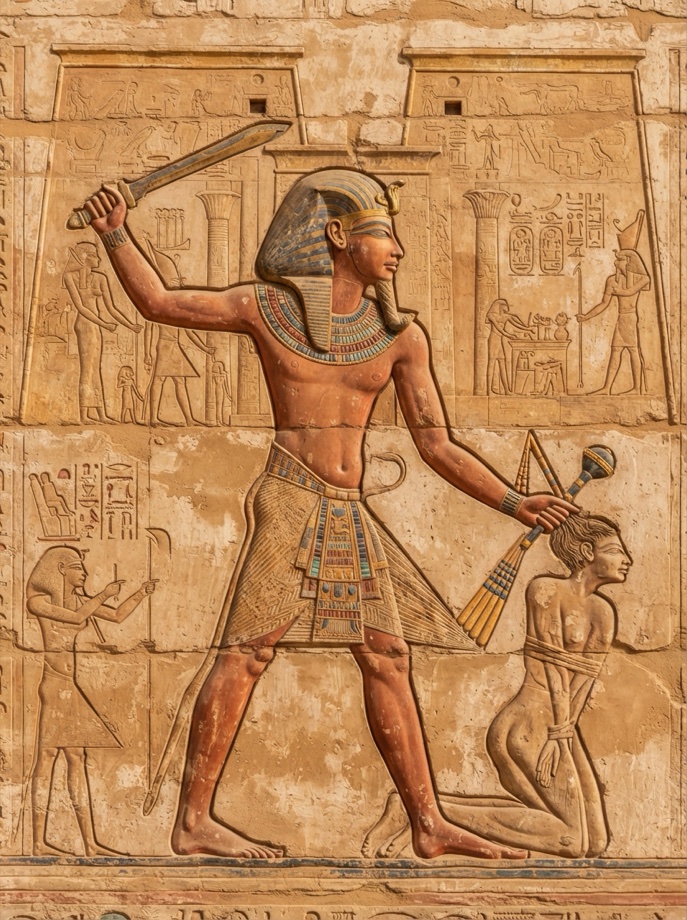
AI-assisted Portrait of Thutmose III
Twenty-Two Years of Waiting
He was crowned as a small child and then, for more than two decades, allowed to be almost nothing. His stepmother and aunt took the throne titulary, the regnal years, the divine-birth narrative, the temples, the obelisks; on the monuments of that long co-reign Thutmose III appears where he appears at all as the junior figure, a name behind a name. Whatever he thought about this during the years it was happening, he never said. There is no surviving complaint, no abortive coup, no faction of his own that the record can identify. He simply persisted through the reign of Hatshepsut and, at some point in that silence, seems to have acquired an army's worth of technical competence and a completely formed idea of what Egypt should be.
Because when she died, the waiting ended at speed. Within months he was in the field. Over the following twenty years he led seventeen campaigns into the Levant and Syria, took Megiddo, broke the Mitannian coalition, crossed the Euphrates and set a stela beyond it, brought Nubia under firmer control than any predecessor, and enlarged Egypt's sphere of influence to the widest extent it would ever reach. The nineteenth-century habit of calling him the Napoleon of Egypt was crude but caught something real: this was a man with a strategic conception, executed campaign by campaign, year on year, without deviation.
And he had all of it written down. The Annals carved on the walls surrounding the sanctuary at Karnak record the campaigns from the army scribe's daybooks — marching dates, the council of war, the numbers of prisoners, horses, chariots, the tribute lists, the harvest seized. The Megiddo account preserves the moment his commanders begged him not to take the narrow Aruna pass and his flat refusal. No Egyptian king before had turned his wars into an archive. He was not merely conquering; he was compiling.
Thutmose III was an INTJ: dominant Ni, a vision held in silence for twenty-two years and then executed without a wasted season.
The Pass at Aruna
In his twenty-third regnal year, with a Canaanite coalition under the prince of Kadesh massed at Megiddo, Thutmose halted at Yehem and put three roads to his officers. Two were safe and wide. The third, the Aruna track, was a defile so narrow the Annals have his generals saying the army would go through it horse behind horse, man behind man, with the vanguard engaged while the rear was still on the far side — the classic nightmare of an army destroyed in column. He chose it, and the text preserves his reasoning: the enemy will say he took the easy road, and they will be waiting there. He was not gambling. He had modelled what his opponents expected and moved through the space their expectation left empty.
That is Ni working exactly as advertised — a conclusion arrived at internally, ahead of the evidence, and then trusted absolutely against the unanimous advice of experienced men. The Egyptian army emerged into the Qina valley unopposed and formed up on ground of its own choosing. The coalition broke on first contact. The one flaw in the day was thoroughly non-visionary: his troops stopped to plunder the abandoned camp instead of pursuing, letting the princes be hauled up over Megiddo's walls by knotted clothing, which cost him a seven-month siege. He never made that mistake again, and later campaigns show a commander who had learned to secure the objective before the loot.
Look at the shape of the whole military career and the same single conception is visible. He did not campaign at random. He first secured Canaan, then spent years taking the coastal Phoenician harbours — Byblos, Ullaza, Simyra — turning them into supply depots so that later armies could be shipped up the coast rather than marched overland. Only then, with logistics solved, did he strike inland at Mitanni, having prefabricated boats carried in ox-carts across the desert so his army could cross the Euphrates when it arrived. Seventeen campaigns, each a step in a plan whose end state existed before the first step was taken.
Empire as a Filing System
Auxiliary extraverted thinking is what turned the vision into working machinery, and its signature is the paperwork. The Annals are the longest historical text surviving from ancient Egypt and they read, in stretches, like an audit: 340 prisoners, 2,041 mares, 924 chariots, 1,929 cattle, and the wheat of the plain of Megiddo counted in sacks. Tribute is itemized by year and by polity. The daybook entries preserve the exact date of departure from the frontier fortress of Tjaru. This is a ruler for whom a conquest was not real until it had been measured and recorded in a form that could be consulted later.
The administration matched. Instead of annexing and garrisoning the whole Levant — expensive, brittle — he installed the sons of defeated princes in Egypt, educated them at court, and sent them home to rule as loyal vassals, a self-replenishing system of client kingship that held for generations. He standardized the tribute obligations, kept Egyptian garrisons at the key harbours only, and appointed viceroys in Nubia with defined authority. He also built or enlarged more than fifty temples and left the Karnak festival hall, a structure whose columns imitate tent-poles in stone — a permanent monument to the campaign tent he had spent his adult life inside.
Even his curiosity got catalogued. In the so-called Botanical Garden chamber at Karnak he had the plants and animals encountered in Syria carved on the walls — an unprecedented visual inventory of foreign flora and fauna, made because the material was new and therefore ought to be recorded. Te does not simply want to win; it wants the win rendered into durable, retrievable, auditable form. Nearly everything historians know about Eighteenth Dynasty imperial warfare, they know because this king insisted on the ledger.
The Erasures, Late and Quiet
The most emotionally loaded act of his reign is also the most ambiguous, and the timing is what makes it interesting. The proscription of Hatshepsut — her images hacked from Deir el-Bahari, her cartouches replaced with those of Thutmose I, II and III, her obelisks walled in rather than thrown down — did not begin when he took sole power. The evidence points to at least twenty years later, near the end of his life. This was not the hot revenge of a man finally released; it was a considered, delayed decision about how the dynastic record should read for posterity, quite possibly to secure the succession of his son Amenhotep II against any precedent of female kingship.
Tertiary Fi tends to look like this in a ruler of his kind: private conviction, unexplained, acted on decisively but rarely displayed. He does not justify the erasure. He does not denounce her. He simply edits, and the edit is partial enough that scholars still argue about its motive. The walling-in of her obelisks rather than their destruction has even been read as a kind of respect — the monuments preserved intact inside their concealment.
The same inwardness runs elsewhere. He personally trained and hunted, and his officers' autobiographies — Amenemhab's above all — describe him with a devotion that reads as more than protocol, recording the king turning aside an enraged elephant in Niy, the officer cutting off its trunk. He rewarded that loyalty with the traditional gold of honour and with tombs in the Theban hills. But of his own interior life across half a century of rule, the vast documentation he left behind gives almost nothing away. He recorded what he did in exhaustive detail and what he felt not at all.
The Body That Had to Keep Up
Inferior sensing in a soldier-king is a curious thing to look for, but it surfaces in how physicality functions in his record: always as evidence for a claim, never as pleasure. The Armant stela and the temple texts advertise his athletic feats — shooting arrows through copper targets, out-rowing two hundred men, hunting one hundred and twenty elephants in Niy — in the formal idiom of royal prowess. They are demonstrations, performed and documented, of the proposition that the king is physically fit to rule. There is no sense of a man luxuriating in the moment for its own sake.
The Megiddo plundering failure sits here too. The one time his campaign plan collapsed, it collapsed because the immediate, tangible temptation in front of the troops overwhelmed the abstract objective beyond it — and the king had not anticipated it, because it was not the kind of thing his mind naturally attended to. Seven months of siege was the price of an oversight about what men do when they see unattended gold.
He was a physically small man; his mummy, found in the Deir el-Bahari cache, indicates a stature well under five and a half feet, and a reign of fifty-four years ended with him aged somewhere past his mid-fifties. Nothing about the record suggests a king who enjoyed the world he crossed and re-crossed for twenty years. He surveyed it, catalogued its plants, counted its horses, and moved on to the next thing that had been planned long in advance.
Why INTJ Over ESTP
Why not ESTP?
The Aruna pass looks like a gambler's move and was nothing of the kind — the Annals record him reasoning from what the enemy expected before he chose, and every subsequent campaign followed a sequence set years earlier: coast first, depots second, Euphrates last, with boats built in advance and hauled across the desert. An ESTP reads the live field and seizes the opening in front of him; Thutmose spent twenty-two silent years assembling a plan and then spent twenty more executing it on schedule. His single documented failure — losing the coalition princes at Megiddo — came precisely from not reading the immediate moment.
The temperamental evidence points the same way. A dominant-Se ruler leaves behind spectacle, appetite, improvisation; Thutmose left behind an archive. He turned his wars into a permanent strategic record, his conquests into a client-king system designed to run without him, and his curiosity into a catalogue of Syrian plants carved on a wall. Even the erasure of Hatshepsut, the one act that might have been impulsive, waited two decades and then served a succession strategy. Contained patience, internal certainty, and systematic execution — Ni driving, Te building the machinery to carry it out.
Connected Figures
Further Reading
- Thutmose III: A New Biography — Eric H. Cline and David O'Connor (eds.)The standard modern collection on the reign, the campaigns and the Annals.
- A History of Ancient Egypt — Nicolas GrimalClear narrative framing of the Eighteenth Dynasty empire and its administration.
- The Woman Who Would Be King — Kara CooneyThe co-reign from Hatshepsut's side, and a careful reading of the late erasures.
- Ancient Records of Egypt, Vol. II — James Henry BreastedThe classic English translation of the Karnak Annals, including the Megiddo council of war.
