 Historical Figure MBTI
#1055 · 8-7-26 · The New Kingdom
Amenhotep III
The Magnificent
r. c. 1391 – 1353 BCE
9 min read
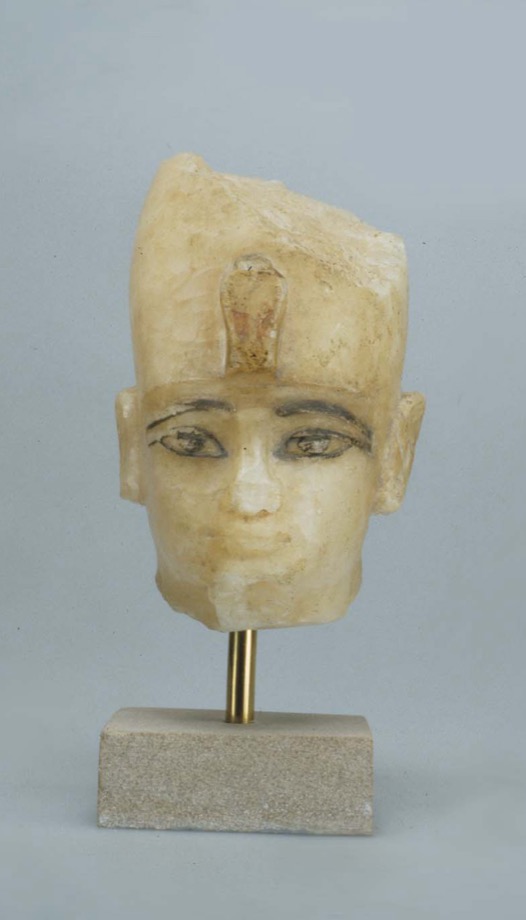
Statue of Amenhotep III
A Reign Spent Entirely on Beauty
He inherited an empire that other men had bled for. Four generations of Thutmosid campaigning had left Egypt with client kings from the Euphrates to the Fourth Cataract, tribute arriving on schedule, and Nubian gold flowing north in quantities that made the Egyptian king the richest human being on earth. Amenhotep III took delivery of all this at perhaps twelve years old and, across nearly four decades on the throne, fought essentially one minor Nubian action. He spent the rest of the reign doing something no Egyptian king had done at anything like this scale: turning revenue into sensation.
The output is almost comic in its abundance. Hundreds of statues of himself, in granodiorite and quartzite and calcite, at every size from palm-sized to seventy feet. Something on the order of six hundred or more black granite statues of the lioness goddess Sekhmet, produced for his mortuary temple precinct and the Mut enclosure at Karnak — a mass of divine images so large that museums across Europe and America are still furnished from it. The Luxor Temple colonnade, with its papyrus columns fifty feet high. The mortuary temple on the west bank, the largest ever built in Egypt, fronted by the two seated colossi that Greek tourists a millennium later would name after Memnon and come to hear sing at dawn.
And at Malkata, his pleasure palace, he had a harbour-lake dug for his queen — the Birket Habu, over a mile long, excavated in fifteen days according to the commemorative scarabs he issued, so that the royal barge, named The Aten Gleams, could be rowed across it. That is the reign in one image: an entire artificial lake, produced at speed, for the sake of an afternoon on the water.
Amenhotep III was an ESFP: dominant Se, a king who spent the greatest fortune of the ancient world on things that could be seen, touched, and enjoyed.
The Aten Gleams
Extraverted sensing is the function that treats the present physical world as the whole point, and Amenhotep's reign is the largest experiment ever conducted in that proposition. Malkata was not an administrative capital, it was a sensory environment: a sprawling mudbrick palace complex with painted ceilings of flying ducks and vine trellises, floors frescoed with pools and papyrus marsh, a festival hall, a village for the workers, and the vast lake beside it. The colours survive well enough to show that a person moving through those rooms was meant to feel surrounded — water underfoot, birds overhead, gardens in every direction.
Even his propaganda is sensory rather than argumentative. Where earlier kings issued campaign annals, Amenhotep issued commemorative scarabs — small glazed objects distributed as far as Syria and Nubia — announcing that he had killed 102 fierce lions with his own arrows in his first ten years, that he had taken 96 wild bulls in a single hunt at Shetep, that his queen's lake was dug in fifteen days, that a Mitannian princess had arrived with 317 women in her train. These are not political claims. They are physical facts, counted, boasted, sent out into the world for the pleasure of the report.
The statuary follows the same instinct. His artists produced the most sensuously finished sculpture Egypt ever made: skin polished to a liquid sheen on hard stone, the youthful almond-eyed royal face repeated in the thousands, colossal quartzite figures whose scale is meant to be felt in the body before it is understood. The Sekhmet programme — hundreds of near-identical lioness goddesses arranged in ranks — was designed as an overwhelming visual experience, an environment of divinity by sheer accumulation. He did not want the idea of splendour to be conveyed. He wanted splendour to be standing in front of you.
The Name Beside His Own
He married Tiye, the daughter of a provincial chariotry officer, very early in the reign — and then did something no pharaoh had done: he announced it. A commemorative scarab issued in his own name gives her full titulary and names her parents, Yuya and Thuya, in an official royal proclamation. He put her name in a cartouche beside his on official objects, had her depicted at his own scale in sculpture, and built her the lake. In a court where dynastic marriages were arranged by protocol, this reads as a personal preference asserted publicly and permanently, at the cost of ordinary decorum.
Introverted feeling in the auxiliary position tends to look like that: private taste made non-negotiable. He accumulated diplomatic marriages too — daughters of the kings of Mitanni, Babylon and Arzawa, plus, if the scarab is literal, several hundred attendant women — and the Amarna letters catch him haggling with foreign kings over gold and bride-price with a certain languid stubbornness. But the wives of state never displaced the one he had chosen. Tashkukhipa, Gilukhipa, the Babylonian princesses: all present, none named on his monuments the way Tiye was.
The same personal warmth shows in how he treated the men he liked. Amenhotep son of Hapu, a commoner scribe from Athribis, was made overseer of all the king's works, granted the extraordinary privilege of his own mortuary temple among the royal ones on the west bank, and honoured to a degree that turned him, centuries later, into a healing god in his own right. Kings did not do that. This one did it because he wanted to.
Gold as an Instrument of State
It is easy to mistake a reign without wars for a reign without policy. Amenhotep's foreign policy was simply conducted in a different currency. The Amarna letters — the cuneiform diplomatic archive that begins in his last decade — show the great kings of Babylon, Mitanni, Assyria, Arzawa and Alashiya writing to him as brothers, and the recurring theme is gold: gold requested, gold promised, gold sent in insufficient quantities, gold as the medium in which alliance is transacted. Kadashman-Enlil of Babylon complains about the amount and about not being sent an Egyptian princess in return. Tushratta of Mitanni sends the healing statue of Ishtar of Nineveh and asks, at length, for more gold, because in Egypt gold is as plentiful as dust.
That system worked. Marriage alliances plus subsidies kept the Levant quiet for a generation with almost no Egyptian blood spent, which is an efficient use of resources by any standard. Tertiary Te here is instrumental rather than architectural: he did not build new machinery, he ran the existing machinery competently and let money do what armies had done for his great-grandfather.
The building programme, likewise, was administered with real capability even if its purposes were aesthetic. Quarrying and moving the Memnon colossi — each carved from a single block of quartzite hauled some four hundred miles from Gebel el-Ahmar — was a logistical undertaking on the order of a military campaign, delegated to Amenhotep son of Hapu and executed. Three sed-festivals were staged in his last decade with enormous ceremonial machinery. The king who is remembered for pleasure was perfectly able to get very large things organized; he simply pointed that ability at magnificence rather than conquest.
The Sun He Did Not Follow
Late in the reign something odd surfaces. The word Aten — the visible disc of the sun — begins appearing with unusual prominence: in the name of the royal barge, in the name of a Malkata palace district, in epithets calling the king the dazzling sun-disc of all lands. In his sed-festivals he was worshipped as a living god, his own statues receiving cult while he was still alive. Something theological was stirring, and it was stirring around the most physical, most visible aspect of divinity available — light itself.
But he never followed it anywhere. Amun's priesthood was funded, not challenged; the traditional pantheon was served with the hundreds of Sekhmets; the Luxor colonnade was built for the Opet procession. Inferior intuition supplies the gleam of an idea without the compulsion to systematize it. He touched the thought and let it lie among the other beautiful things.
His son took the same thought and drove it to its end — abolishing the gods, moving the capital to an empty plain, and renaming himself for the disc. It is one of history's sharpest father-son contrasts: the father for whom the sun was the most gorgeous object in the world, and the son for whom it was the only truth. Amenhotep III died in his fifties, obese and in serious dental pain by the evidence of his mummy, having received from Tushratta a healing goddess sent in hope and, apparently, in vain — a body that had been the reign's instrument giving out before the vision he never quite had could be tested.
Why ESFP Over ESTP
Why not ESTP?
Both types live in the immediate sensory world, but an ESTP uses it — the opening exploited, the risk taken, the opponent read in real time. Amenhotep took no risks worth the name: one small Nubian action in thirty-eight years, and a foreign policy of paying allies rather than outmanoeuvring them. His energies went into aesthetic abundance for its own sake — lakes, colossi, polished quartzite, painted floors, six hundred lionesses. That is Se married to Fi, the pursuit of what is beautiful and what he personally loved, not Se married to Ti hunting for tactical advantage.
The tell is Tiye. A tactician's marriage to a commoner would have been a calculation about factions; Amenhotep's was announced on scarabs, engraved in a cartouche, and rewarded with a private lake, because he wanted her there. The whole reign has that grain to it — appetite and taste, expressed at imperial scale, with the machinery of state running smoothly in the background because competent men were paid to run it. He is the archive's clearest case of dominant Se given essentially unlimited resources, and what it produced was not an empire but an experience.
Connected Figures
Further Reading
- Amenhotep III: Egypt's Radiant Pharaoh — Arielle P. KozloffThe fullest modern biography — statuary, Malkata, the sed-festivals and the king's failing health.
- Egypt's Dazzling Sun: Amenhotep III and His World — Arielle P. Kozloff and Betsy M. BryanThe Cleveland exhibition catalogue; the essential visual record of the reign's art.
- The Amarna Letters — William L. Moran (trans.)The cuneiform diplomatic correspondence, including the gold-haggling with Babylon and Mitanni.
- A History of Ancient Egypt — Nicolas GrimalStandard narrative context for the late Eighteenth Dynasty and the run-up to Amarna.
