 Historical Figure MBTI
#1057 · 8-7-26 · The New Kingdom
Yuya
God's Father
fl. c. 1390 BCE
3 min read
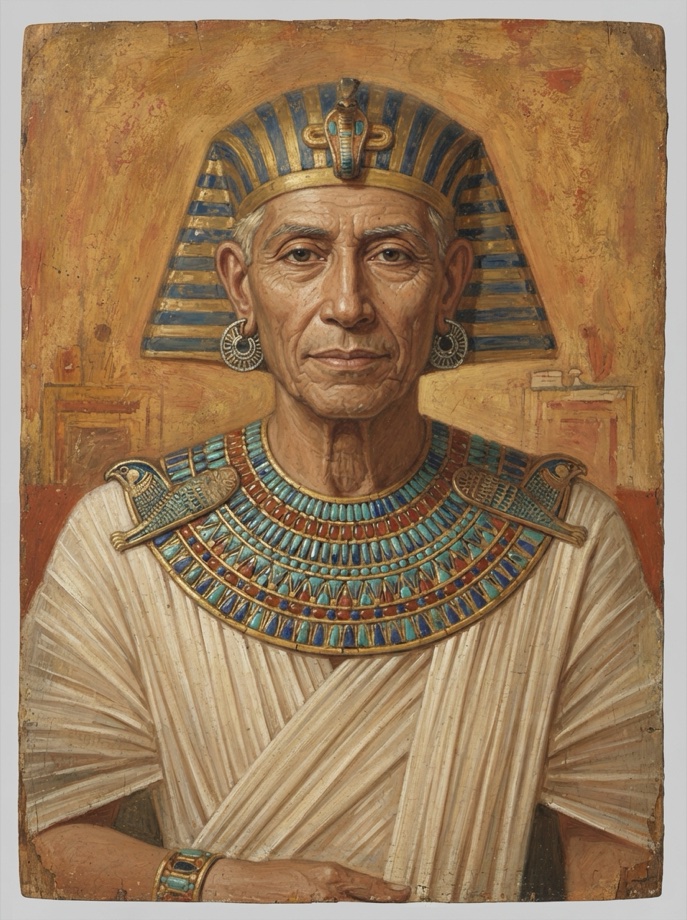
AI-assisted Portrait of Yuya
A Commoner's Tomb Among Kings
Yuya had no royal blood, and by the conventions of the Egyptian court, no obvious claim to greatness. He was a provincial courtier — possibly, scholars debate, of Nubian or other foreign descent — whose fortunes changed entirely when his daughter Tiye married Amenhotep III and became queen. Overnight, the family gained a status no bloodline alone could have bought them, and Yuya himself was granted the rare title “God’s Father,” reserved for a pharaoh’s father-in-law.
What makes Yuya extraordinary today is not the title but the tomb. Discovered nearly intact in 1905, KV46 preserved his mummy with a face so individual, so calm and dignified, that it startled the excavators who first uncovered it. The burial goods around him were lavish enough to rival royalty — a commoner buried, in every material sense, like a king.
Yuya rose not by conquest or cunning, but by being the kind of man a dynasty could quietly trust with its future.
Si — A Life Built on Steady Ground
Everything about Yuya’s rise suggests accumulation rather than ambition — a provincial career built methodically until it intersected, almost by circumstance, with royal favor. The care taken in preserving his own household’s goods and status reflects a man oriented toward stability once earned, not one chasing constant reinvention.
Te — Trusted With Practical Authority
Yuya held military and priestly titles that required real administrative competence, not just ceremonial standing. That a foreign-born commoner could be entrusted with such offices at all suggests a man who delivered results efficiently enough that his usefulness outweighed his lack of pedigree.
Fi — A Quiet, Dignified Self
It is the mummy’s face, more than any inscription, that hints at this: even embalmers who prepared thousands of bodies remarked on Yuya’s unusually composed, individual features. That sense of an intact, private dignity carried through to the grave suggests a settled inner sense of self beneath the borrowed royal trappings.
Ne — inferior
Nothing in Yuya’s record suggests a man reaching for reinvention or possibility beyond his lane. His story is one of steady consolidation within a role handed to him by circumstance, not one of restless exploration — precisely what an underdeveloped Ne looks like paired with a grounded Si-Te core.
Why ISTJ Over ESTJ
Why not ESTJ?
Yuya’s advancement reads as something that happened to him through his daughter’s marriage, then was carefully consolidated — not something he aggressively engineered. An ESTJ builds and asserts structure outward; the evidence for Yuya points instead to a man who absorbed a sudden change in fortune and settled quietly, competently, into it.
ISTJ fits the shape of a life defined by reliability rewarded rather than ambition pursued — a family elevated by trust, and a man who wore that trust well.
Connected Figures
Further Reading
- The Tomb of Yuya and Tjuyu — Zahi HawassOn the 1905 discovery and near-intact preservation of KV46.
- The Rise and Fall of Ancient Egypt — Toby WilkinsonSituates Yuya's family within Amenhotep III's court.
