 Historical Figure MBTI
#1056 · 8-7-26 · The New Kingdom
Tiye
The Commoner Queen
fl. c. 1388 – 1338 BCE
8 min read
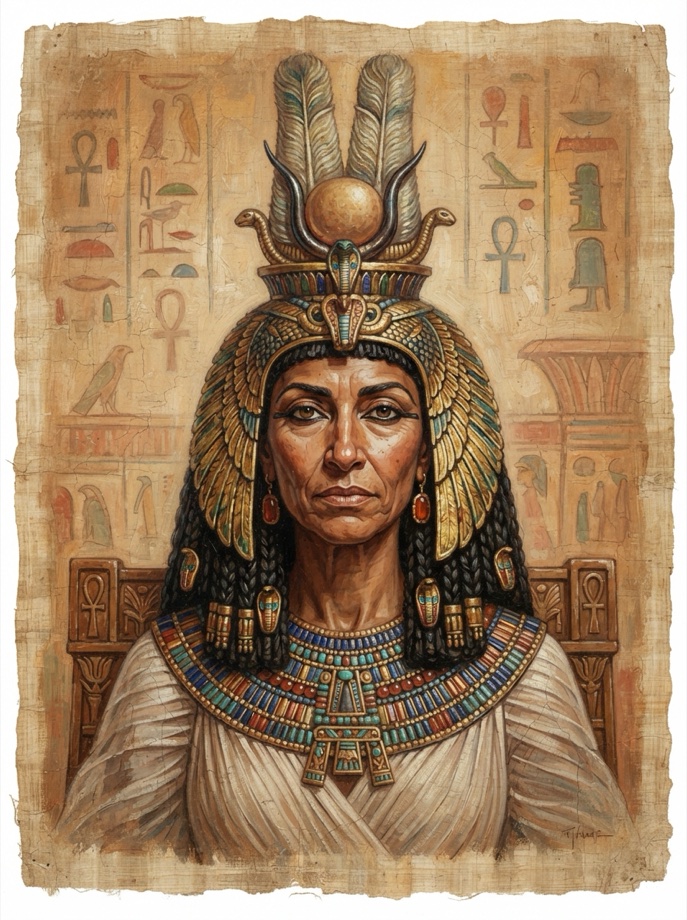
AI-assisted Portrait of Tiye
A Foreign King Writes to the Queen
Sometime after the death of Amenhotep III, Tushratta, king of Mitanni, wrote to Egypt about a matter of gold and broken promises. He wrote to the new pharaoh — and he also wrote a separate letter directly to the dowager queen, telling her that she knew better than anyone what had been agreed with her husband, and instructing her son to consult her, because, he said, she alone knows all the words that we spoke to one another. That letter is one of the most extraordinary documents in the Amarna archive. A foreign head of state, negotiating over the affairs of empires, treated an Egyptian queen as the party with standing and continuity, and told the reigning king to go and ask her.
Nothing in her origins predicted this. Tiye was not royal. Her father Yuya was a provincial officer — Master of the Horse, priest of Min at Akhmim — and her mother Thuya a temple singer; both were prosperous, neither was dynastic. Yet she became Great Royal Wife in the second year of Amenhotep III's reign, her marriage proclaimed on a commemorative scarab that named her parents in the king's own titulary text, and she stayed the central woman of the Egyptian court for roughly fifty years, across two reigns and the most disruptive religious revolution in Egyptian history.
What she assembled in that half-century was not consort's influence but standing. Her name went into a cartouche. She was given her own estate at Gurob with its own administration, her own temple far south at Sedeinga in Nubia where she was worshipped as a form of Hathor, and colossal statuary at a scale equal to her husband's — the Cairo colossus from Medinet Habu shows the royal pair seated side by side, the same height. Foreign kings addressed her. Officials sealed documents to her household. She was a permanent institution wearing the title of a wife.
Tiye was an ENTJ: dominant Te, a commoner who built recognized, externally documented authority and held it across two reigns.
Authority You Can Point At
Extraverted thinking wants power that exists in the record, not in the room — offices, titles, correspondence, seals, things that keep working when you leave. Tiye acquired all of it. Her cartouche is the plainest example: the oval reserved for ruling names, used for her on official objects. So is Sedeinga, a temple built for her cult in Nubia hundreds of miles from court, paired with her husband's at Soleb — a permanent, staffed, revenue-bearing institution in her name. So is the Gurob palace estate in the Fayum, an economic base with its own scribes and stores that she ran and that survived her.
The diplomatic correspondence is the sharpest evidence. Tushratta's letters to her are not courtesies; they invoke her as the reliable witness of state agreements and the person who can move Egyptian policy. That relationship persisted after her husband died, which is the crucial detail — her authority did not lapse with the reign that granted it. It was recognized abroad as belonging to her, and it was still being used as a channel when the king on the throne was her son.
Even the physical record is administrative. Mud sealings and jar labels from the Malkata palace name her household. Amarna reliefs show her arriving at her son's new capital in a formal ceremonial visit and being shown through his sunshade temple, a state occasion recorded on the tomb walls of the steward Huya — who held office in her service, at Akhetaten, years into Akhenaten's reign. A queen with sentimental influence does not get a steward, a temple, an estate, and a foreign policy portfolio. Tiye had all four.
Playing a Fifty-Year Position
The shape of her career only makes sense as a long game. She married very young into a reign that would last thirty-eight years, and she spent it converting a consort's proximity into structures that did not depend on her husband's affection continuing. When Amenhotep III filled his harem with Mitannian and Babylonian princesses and several hundred attendant women, none of them displaced her, because her position was no longer of the kind a rival wife could take. She had built it somewhere the harem could not reach.
Then came the succession, and a son who dismantled the state religion, closed Amun's temples, abandoned Thebes and moved the court to virgin desert at Akhetaten. Almost every powerful figure of the old reign vanishes from the record in that upheaval. Tiye did not. She appears at Amarna in her son's twelfth regnal year, honoured, escorted, with property there and a steward attending her — a woman who had read where the reign was going and positioned herself inside it rather than against it, without ever having to disown the Theban world she came from.
Introverted intuition in the auxiliary slot is what gives that its coherence: a stable internal read of where things are heading, which makes patience look like foresight rather than passivity. She was not improvising from one favour to the next. Over five decades she was consistently found in the position that still had power in it after the next change, which is not luck repeated four or five times.
The Face That Refuses to Flatter
The images of Tiye are strange, and they are strange on purpose. Eighteenth Dynasty queens were normally given the same serene, generic, ageless mask as everyone else; Tiye was given a face. The small yew-wood head from Gurob, now in Berlin, has heavy-lidded eyes, a downturned mouth, deep lines running from nose to chin, and an expression that reads across three thousand years as impatience. The green steatite head in the Egyptian Museum is similarly individual, similarly unsoftened. These are not idealizations. Somebody decided that this woman's actual features carried more authority than the standard beauty.
Her presence was staged at scale, too. The colossal limestone group from Medinet Habu seats her beside Amenhotep III at his own height — an unmistakable visual claim, since Egyptian art encoded status in size and queens were conventionally rendered small, sometimes knee-high beside the king. On temple reliefs she appears as a sphinx trampling Egypt's enemies, an iconography normally reserved for the king. And at Sedeinga she was shown as a divine lioness. She used physical scale and image the way a modern politician uses a podium.
Her mummy — the Elder Lady from tomb KV35, identified by a lock of her hair found in a nest of miniature coffins inscribed with her name in Tutankhamun's tomb — belonged to a woman of about fifty, with long reddish-brown hair still on her head. The DNA and the hair together closed one of Egyptology's oldest identification puzzles, and left the archive with something rare: a great political figure of the Bronze Age whose face is known.
What She Never Explained
For all the documentation, her interior life is a blank. We have no statement from her about the revolution her son launched, about the god her husband's court had served for centuries being shut down, about the abandonment of Thebes where she had lived for forty years. She continued. She visited Akhetaten and was walked through the sunshade temple of the Aten. Whatever she privately thought of any of it stayed private, which is the ordinary fate of inferior Fi in a person whose whole competence is external.
Where feeling surfaces at all, it surfaces through family and is expressed in stone rather than words. She saw to it that her parents, Yuya and Thuya, received a tomb in the Valley of the Kings — an almost unheard-of honour for non-royals, its contents so rich that until Tutankhamun it was the most intact burial ever found in Egypt. That is loyalty to her origins, executed the only way she knew how: as a permanent institutional fact.
And her son kept her close to the end. The shrine built for her burial, later reused and dismantled, was made under his authority; the lock of her hair was still being preserved in the royal family's possession a generation later, buried with her grandson. She was not a warm figure in the record. She was, unmistakably, one people did not let go of.
Why ENTJ Over ESTJ
Why not ESTJ?
An ESTJ excels inside a defined role and makes the existing office work superbly — but Tiye's power had no office to sit in. There was no established Egyptian position that entitled a queen to negotiate with Mitanni, hold a Nubian cult temple, run an independent estate, and remain a policy channel after her husband's death. She built an abstract, portable authority that outlived the reign that created it and survived a religious revolution intact. That is Te directed by Ni — a durable centre of power designed for a future no rulebook covered.
The test is what happened at the transition. Officeholders lose their power when the office is abolished, and Akhenaten abolished a great deal. Tiye's standing passed through the break untouched, because it had never been lodged in the old order's machinery in the first place. Foreign kings still wrote to her; she still had a steward, an estate, and a name in a cartouche. Fifty years earlier she had been the daughter of a provincial horse-master. Almost nobody in the ancient world converted so little inherited advantage into so much recognized, transferable authority.
Connected Figures
Further Reading
- The Amarna Letters — William L. Moran (trans.)Includes Tushratta's letter to Tiye herself, the key evidence for her diplomatic standing.
- Amenhotep III: Egypt's Radiant Pharaoh — Arielle P. KozloffThe reign in which Tiye built her position, with full treatment of her statuary and estates.
- Akhenaten: Egypt's False Prophet — Nicholas ReevesArgues for Tiye's continuing political weight into her son's reign at Amarna.
- Tutankhamen's Curse — Joyce TyldesleyAmarna family context, the KV35 Elder Lady identification, and the afterlife of the dynasty.
- A History of Ancient Egypt — Nicolas GrimalStandard narrative background for the late Eighteenth Dynasty court.
