 Historical Figure MBTI
#1059 · 8-8-26 · The Amarna Period
Akhenaten
The Heretic King
r. c. 1353 – 1336 BCE
13 min read
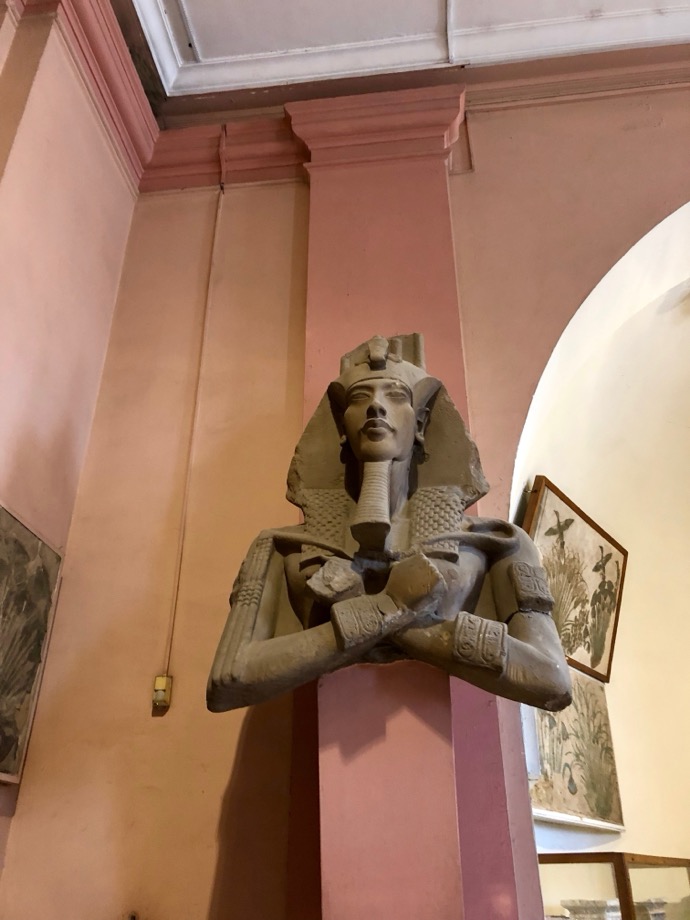
Statue of Akhenaten
The Man Who Closed the Temples
He was born into the most conservative institution the ancient world ever produced. Egypt in the fourteenth century BCE had been running the same religious machinery for well over a thousand years — a pantheon of hundreds of gods, a priesthood of Amun at Karnak that owned land, grain, ships and gold on a scale that rivalled the crown, and a theology of kingship so settled that a pharaoh's job was essentially to keep the wheel turning. His father, Amenhotep III, had played that role brilliantly: three decades of peace, monumental building, diplomatic marriages, a court of unembarrassed luxury. The son inherited all of it. Within five years he had begun dismantling it.
Amenhotep IV changed his name to Akhenaten — "effective for the Aten" — and declared that there was one god, the sun disk, and that its light reached the world through him alone. He shut down temples. He sent workmen out with chisels to hack the name of Amun from monuments across Egypt, including monuments his own father had raised. He abandoned Thebes, the capital, the necropolis, the entire accumulated apparatus of state religion, and marched his court into an empty stretch of desert two hundred miles downriver to build a new city from nothing: Akhetaten, "the horizon of the Aten," the place we now call Amarna. Boundary stelae cut into the cliffs record his oath never to leave it. He was not negotiating. He had seen something, and the world was going to be rearranged to match.
It is the most radical act of imagination in Egyptian history, and it lasted roughly seventeen years. Within a generation of his death his city was stripped, his god was abolished, his name was struck from the king lists, and later scribes referred to him only as "the enemy" or "that criminal of Akhetaten." Everything he built was quarried for other men's temples. What survives survives mostly by accident — rubble reused as fill, a diplomatic archive left in an office floor, a sculptor's studio nobody bothered to loot.
Akhenaten is the archive's purest case of INFJ dominant Introverted Intuition: a single totalizing vision, arrived at inwardly, then imposed on an entire civilization without regard for whether the civilization could survive the transition.
One God, One City, One Image
Dominant Ni does not collect ideas; it collapses them. It takes a crowded field and reduces it to the single principle that, to the person holding it, obviously underlies everything else — and once that reduction happens, the alternatives stop looking like alternatives and start looking like error. Egypt had gods for the sky, the flood, the dead, the scribes, the cats, the cataracts, each with a priesthood and a calendar and a revenue stream. Akhenaten looked at all of it and saw one thing: the disk, the light, the source that made every other thing visible. Not the sun as a deity among deities — Ra had been worshipped forever — but light itself as the only real god, everything else a shadow cast by it.
Watch what he does with that intuition, because the totality is the diagnostic. A merely reformist king promotes a favored cult and lets the others wither. Akhenaten went after the plural form of the word "gods" in old inscriptions. He suppressed Osiris and with him the entire Egyptian machinery of the afterlife, replacing it with a theology in which the dead woke each morning with the sunrise at Amarna. He removed the intermediary priesthood: in Amarna theology, ordinary people worship the Aten through the royal family, and tomb chapels of his own courtiers show them praying not to the disk but to Akhenaten praying to the disk. Even the iconography was stripped — no falcon head, no animal form, no anthropomorphic body at all, just a disk with rays ending in small hands. He deleted the visual vocabulary of three thousand years because it no longer matched what he saw.
And then there is the city, which is Ni made out of mudbrick. He chose a virgin site precisely because nothing had happened there — no prior god held the ground, no prior king's foundation lay beneath. He laid out the boundary stelae first, defining the vision's edges before a single building existed, and swore in the inscriptions that the city would be built where the Aten itself had indicated. Barry Kemp's excavations show what that meant in practice: a capital raised at extraordinary speed using small, hurriedly standardized blocks, with palaces and temples finished first and the workers' housing improvised around them, on ground with no agricultural hinterland worth the name. It was a diagram of an idea, executed at the scale of a national capital, and it was structurally dependent on one man continuing to believe in it.
The Warmth Inside the Heresy
What separates Akhenaten from the cold theorist is that his revolution was, at its center, an intensely felt thing that he wanted other people to feel too. The Great Hymn to the Aten — which the Amarna tombs credit to the king himself, and which reads like nothing else in Egyptian literature — is not a doctrinal statement. It is an outpouring of tenderness toward the created world: the chick that speaks inside the eggshell, the fish leaping in the river, the cattle content in their pasture, the traveller who can see the road again at dawn, the darkness in which "every lion comes forth from his den" and men sleep with their heads wrapped. It is a poem about the sensation of being warmed. Its famous kinship with Psalm 104 is real enough to have unsettled scholars for a century, and the reason is the register, not the theology: both are trying to transmit an emotional experience of the divine rather than argue for one.
Auxiliary Fe also explains the strangest thing about Amarna art, which is its domesticity. Egyptian royal imagery had always been about permanence and hierarchy — the king enormous, frontal, smiting. Akhenaten's artists show him kissing a daughter on the mouth, dandling children on his knee, sharing a meal with Nefertiti, leaning against her, the family grieving openly over a dead princess. When the eldest daughter, Meritaten, appears in state scenes, it is as a participant in the family's shared radiance, not as a dynastic counter. The royal couple are shown under the disk with the rays reaching down to hold ankh signs to their nostrils — the god literally breathing life into a family portrait. He did not just want Egypt to accept the Aten. He wanted Egypt to see how it felt to live in that light, and he used his own marriage as the demonstration.
Fe in the auxiliary is a transmitter, not a barometer, and this is where it curdled. Akhenaten was superbly good at broadcasting a feeling and apparently indifferent to reading the one coming back. He rewarded courtiers who echoed his devotion — the Amarna tomb inscriptions of men like Ay are saturated with the king's own vocabulary — and he seems never to have registered how a nation of thousands of shuttered shrines and unemployed priests actually felt about him. The generals and administrators who survived him, Horemheb chief among them, went on to erase him with a thoroughness that suggests decades of stored resentment he never noticed accumulating.
A System Built Backwards from Its Conclusion
Tertiary Ti is what let him make the vision consistent, and it is visible in the ruthless internal logic of the Amarna program. If the Aten is the only god, then the plural must go from the inscriptions; then the other gods' names must go; then his own father's name, which contained Amun, becomes a problem to be solved; then the afterlife has to be re-founded on sunrise; then the art has to abandon the theriomorphic forms that presuppose other gods; then the king's own titulary must be rewritten, and his name changed. Each step follows from the premise. Almost nothing in the Amarna revolution is arbitrary once you grant the first move — which is exactly the signature of Ti serving Ni rather than testing it.
But tertiary Ti audits inside the system, never at its foundation, and the foundation was never available for examination. He appears to have run no serious analysis of what the plan cost. The Amarna letters — the cuneiform diplomatic archive found in the ruins of his own records office — are the receipt. Vassal rulers in the Levant write in escalating desperation as Amurru and the Hittites pull the northern provinces apart; Rib-Hadda of Byblos sends dozens of increasingly frantic appeals for troops and is eventually driven from his city. The tone of the correspondence is of men shouting into a room where nobody is listening. Egypt's empire in Syria-Palestine was not lost in a battle under Akhenaten; it was mislaid, because the king's attention was two hundred miles up the Nile, in a city that had to be finished.
The same blind spot shows up at home. Amarna's own workmen's village and the excavated cemeteries of the ordinary dead there tell a grim story — stunted growth, spinal injury, heavy labor, a young population dying young — for a capital that existed for less than two decades. He had the logic to make a religion airtight and not the interest to ask whether a state could run on it. When Smenkhkare and then a child king followed him, the system had no redundancy of any kind: it was one man's coherence, and it did not survive his funeral.
The Body That Would Not Be Idealized
Inferior Se is the function that handles the present, physical, resisting world, and in the dominant-Ni type it is the weakest link — either avoided or seized on with peculiar, exaggerated intensity. Akhenaten does both, and the result is the strangest body in the history of Egyptian art. The early colossi from the Gempaaten at Karnak show a king with an elongated skull, a long thin face, heavy hips and thighs, a swollen belly, spindly arms, breasts. It is a deliberate program — the same features spread to depictions of the whole royal family and even, in some reliefs, to courtiers. Scholars have argued for a real pathology and argued equally hard that it is pure theology: the king as the androgynous, self-generating source through whom the Aten's life passes. Either way, the decision to render the royal body as visibly, uncomfortably strange rather than as the eternally athletic ideal is a rupture with everything before it.
The lightest touch here is the sculptor's. In the workshop of Thutmose at Amarna, excavators found the plaster study heads and the painted limestone bust of Nefertiti — work of an observational sharpness Egypt had never permitted itself before. The Amarna style at its best does something no prior Egyptian art does: it looks at a face. That capacity was in the workshop and in the program, and it was the one register in which the king's inner world made contact with real surfaces.
Elsewhere the inferior function simply failed. There is no evidence Akhenaten ever campaigned — the one thing an eighteenth-dynasty pharaoh was expected to do, and the thing his great-grandfathers had built the empire on. He swore not to leave his city and appears to have kept the oath. The administrative and military reality of Egypt continued to exist and he did not engage it; the sensory world got attention only when it could be made to carry the vision. A man who spent seventeen years perfecting the depiction of sunlight lost provinces because he would not look at a map.
Why INFJ Over INTJ
Why not INTJ?
INTJ shares the dominant Ni — the single ruthless vision, the willingness to raze an institution that stands in its way — so the temptation is real. But the INTJ's auxiliary is Te: the vision gets built into systems, delegated, staffed, measured, made to survive its author. Akhenaten built no such machinery. He never institutionalized the Aten cult beyond his own person, never trained a succession of believers, never converted his revolution into administration, and never audited the empire he was letting slip. What he did instead was write a hymn, redesign an artistic language so the light would look right, and put his marriage on the temple walls as the model of how the new faith should be lived. That is Fe: the vision measured by whether it is felt, not by whether it works. An INTJ pharaoh would have kept Thebes and quietly bought the priesthood.
The other tell is his relationship to his own idea. INTJs typically hold a vision at some analytical distance — it is a design, and designs can be revised. Akhenaten was not at any distance from the Aten; he was fused with it, describing himself as the only one who truly knew the god, the unique channel through which its light reached mankind. That is a devotional identification, not a strategy, and it is why the movement had no shape independent of him. When he died, there was nothing left standing that was not him — which is also, precisely, why the restoration under Tutankhamun took only a few years to undo everything.
Connected Figures
Further Reading
- Akhenaten: Egypt's False Prophet — Nicholas ReevesThe skeptical modern reading — Akhenaten as autocrat, his theology inseparable from his grab for absolute power.
- Akhenaten: History, Fantasy and Ancient Egypt — Dominic MontserratA history of how every era has reinvented Akhenaten in its own image, from Freud to the twentieth-century occult.
- The City of Akhenaten and Nefertiti: Amarna and Its People — Barry KempDecades of excavation at Amarna itself — how the city was actually built, staffed, fed, and buried.
- Akhenaten and the Religion of Light — Erik HornungA concise account of Amarna theology on its own terms, by one of the great historians of Egyptian religion.
- The Great Hymn to the Aten (translation) — James P. AllenThe king's own poem in careful translation — the shortest route to what he actually believed.
