 Historical Figure MBTI
#1064 · 8-9-26 · The Amarna Period
Tutankhamun
The Boy King
r. c. 1332 – 1323 BCE
12 min read
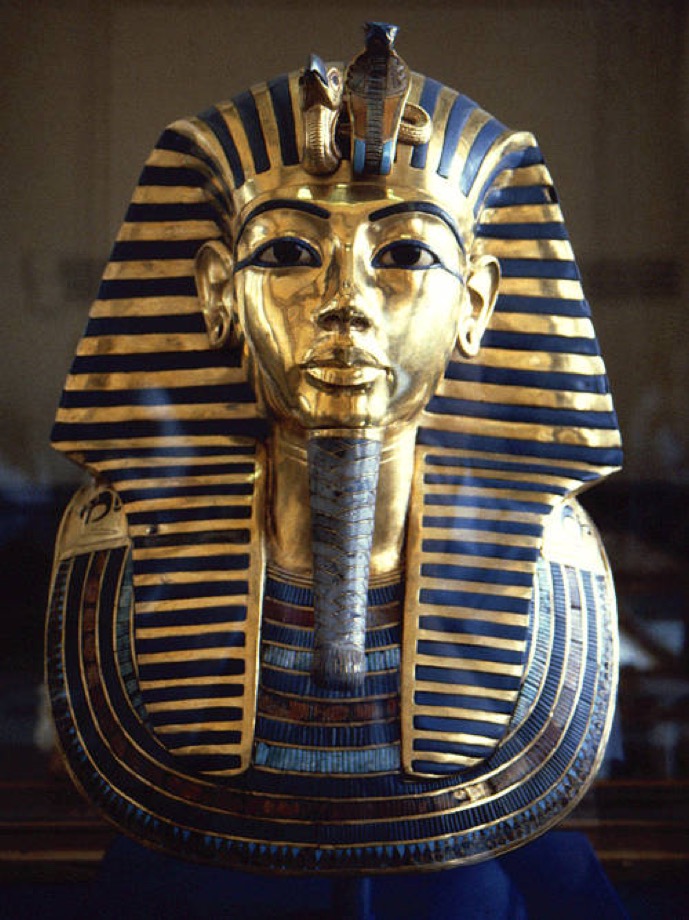
Funerary mask of Tutankhamun
The Most Famous Man in Egypt Never Got to Be Anyone
He was about nine years old when they put the double crown on him, and about eighteen or nineteen when they closed the door of a small, hurriedly finished tomb in the Valley of the Kings and left him there for three thousand two hundred years. Between those two dates lies a reign of roughly a decade in which almost nothing that survives can be confidently called his own decision. Egypt reversed a religious revolution during those years — the greatest theological U-turn in its history — and the men who turned the wheel were standing behind the throne, not on it. The boy signed. The boy was carried in processions. The boy hunted ostrich in the desert and shot at targets from a chariot. Then the boy died, of something — a broken leg gone septic, malaria, a congenital frailty inherited from a family that had married itself into fragility — and the whole apparatus of Egyptian burial was compressed into seventy days and stuffed into a tomb that may have been dug for someone else.
What makes him the most recognizable Egyptian who ever lived is not the reign. It is the accident that his tomb, alone among the royal burials, was overlooked by the robbers and the priests and the quarry crews, so that when Howard Carter widened a hole in a plastered doorway in November 1922 and held up a candle, the answer to what he could see was: everything. Not the state records of a great king — those exist for far greater kings and interest almost nobody — but the contents of a young man's actual life. Chairs he had sat in as a child, with the legs sized for a child. Game boards. A painted box. A lock of his grandmother's hair, sealed inside a nest of miniature coffins. Bundles of flowers, laid on the coffin by a hand that was almost certainly his widow's.
Typing him is an unusual problem, and it deserves an honest caveat up front: the documentary record for Tutankhamun's inner life is thinner than for almost anyone else in this archive. He left no letters we can read as his, no campaign accounts, no reported conversation. He died before a personality has room to become a public record. What we have instead is a single document that sounds authored rather than dictated — the Restoration Stela — and a burial assemblage of extraordinary intimacy. That is faint evidence, and it is indirect, and any reading built on it is a reading of a shadow. But shadows have shapes. This one has a very consistent one.
Tutankhamun is the archive's purest case of dominant Fi with nothing built on top of it — an ISFP whose inner sense of what was right never got the years it needed to turn into anything the world would call a reign.
Fi — Putting Things Right, Quietly
The Restoration Stela is the one surviving text that reads as personally authored, and it is worth noticing what kind of statement it is not. It is not a conqueror's boast. It does not condemn his father by name. It does not threaten anyone. It describes, in a tone closer to grief than to triumph, a country in which the temples had fallen into ruin and their courts had become paths for walking through, in which the gods had turned their backs and would not answer when anyone prayed to them. And then it says, plainly, that the king had taken counsel with his heart to find what was beneficial to his father Amun — and had put it right. Restored the shrines. Recut the images in gold. Reendowed the priesthoods. It is a document about repair, framed as something the king felt he owed rather than something he had won.
That framing is the tell. Fi does not argue from precedent or from institutional obligation; it argues from an interior conviction about what is right that it treats as self-evidently binding, and it tends to phrase even public acts as private answers to a private question. "I took counsel with my heart" is boiler- plate in Egyptian royal rhetoric, yes — but the stela deploys it in a context where a different king would have reached for the language of maat enforced by royal power, of order imposed, of enemies scattered. The boy king's great state document is about a wrong being made less wrong. Whether he composed a word of it himself is unknowable. That the version of him the court chose to project was the earnest restorer rather than the avenging one is itself information about what he was like to be around.
And then there is the burial, which is the strongest Fi evidence in the tomb precisely because none of it was meant to be seen. Kings are buried with propaganda. Tutankhamun was buried with a lock of Queen Tiye's hair, his grandmother's, wrapped and nested and set inside a miniature coffinette — an object of no ritual necessity and no political meaning, kept because someone could not part with it. He was buried with the small chairs and the writing palettes of his childhood. He was buried with objects that depict his wife Ankhesenamun leaning toward him, handing him arrows, anointing him, resting a hand on his arm: an iconography of tenderness so unusual that Egyptologists have spent a century remarking on it. The golden mask was worked to be him and not a generic royal face. A life curated around what was loved rather than what was accomplished is the signature of a dominant Fi that never had to become anything else.
Se — The Chariot, the Bow, the Ostrich Fan
Whatever else the tomb tells us, it tells us what he did with his days. Six dismantled chariots went into the burial, from light hunting vehicles to gilded ceremonial ones. More than four hundred arrows. Bows of every construction, including composite bows sized for a smaller archer and worn at the grip. Throwsticks. Leather armor. An ostrich-feather fan whose gold mount shows the king hunting ostrich in the eastern desert near Heliopolis and states that the feathers came from that hunt — a boy commemorating a specific good afternoon in permanent materials.
This is auxiliary Se doing what Se does: living through the body and the immediate physical field, taking pleasure in speed and craft and the particular weight of a good bow. The forensic evidence complicates the picture and makes it more poignant — CT imaging suggests a clubbed left foot, necrosis in the metatarsals, and the tomb held over a hundred walking sticks, several worn from use. He may not have been able to stand steadily in a chariot at all. But that only sharpens the reading: an adolescent with an impaired foot and a hundred canes was buried with a small armory and a stable's worth of vehicles, because the desert and the bow were what he wanted his eternity furnished with.
Se also shows in the aesthetic register. The Amarna workshops he inherited had been trained to look hard at real bodies and real light, and the objects made for him keep that habit: the painted box with its impossibly fine battle scenes, the alabaster vessels, the mask's inlaid glass and lapis handled with the precision of someone who cared how a surface caught the eye. Fi supplies the private value; Se supplies the medium — objects, textures, materials, the concrete thing you can hold. It is the classic ISFP arrangement, and in his case the objects are all that outlived him.
Ni — The Name He Chose to Wear
He was born Tutankhaten — living image of the Aten, the sun-disk his father had raised above every other god. Sometime around the third year of the reign he became Tutankhamun, living image of Amun, and his wife Ankhesenpaaten became Ankhesenamun, and the court left Akhetaten for Memphis and Thebes. A nine- or twelve-year-old did not engineer that. But he wore it, and the wearing was itself the reign's whole symbolic content: the king's name became the argument. Egypt did not need a decree explaining that the Amarna experiment was over. It needed only to say the boy's name out loud.
Tertiary Ni in an ISFP shows up as a sense for what a thing means rather than a strategy for what it will do — an intuition for symbol and image that runs ahead of any capacity to plan. The restoration was managed as a symbolic campaign of exactly that kind. Old gods recut, old festivals restarted, the whole visual grammar of Egypt reassembled around the person of a child who embodied continuity simply by existing. Whether he understood the theology is unknowable; that he became a symbol, and appears not to have fought it, fits a man whose intuition was for meaning and whose weakness was for mechanism.
The limitation is visible too. Tertiary Ni does not do contingency. Nothing in the reign suggests anyone at its center had a plan for what came after — no heir survived, only two stillborn daughters interred in the tomb beside him, and no arrangement for succession that the court could execute without improvising. When he died the burial itself had to be improvised: a small non-royal tomb pressed into service, shrines assembled in the wrong order, paint still curing on the walls when they sealed it, and fungal blooms growing on that paint for three millennia. A reign long on image and short on machinery.
Te — Other Men Held the Levers
Inferior Te is the function that builds systems, allocates resources, and makes organizations obey. In Tutankhamun's reign it is not weak so much as absent — and the absence was filled, immediately and completely, by two men. Ay, the elderly courtier who had survived Amarna and held the title God's Father, stood beside him as regent and adviser. Horemheb, commander of the army, ran the military and the frontier and carried the executive weight of the state. Between them they did the administrative work of the restoration: the temple endowments, the personnel, the campaigns in Nubia and the Levant that the boy's monuments credit to the boy.
It is not a moral failure to be nine. But it is worth noting that the pattern never broke as he aged. By seventeen or eighteen a New Kingdom pharaoh could be on campaign in his own right; Thutmose III, chafing under Hatshepsut, spent his minority making himself indispensable to the army so that when the regency ended he already commanded it. There is no sign Tutankhamun did anything comparable — no faction of his own, no purge, no move to displace the men managing him. He seems to have accepted the arrangement, which is what inferior Te tends to do: leave the machinery to whoever likes machinery, and get on with what actually matters to you.
The cost arrived after death, and it was total. Ay took the throne and, apparently, sought to legitimize it by marrying the widow — the same Ankhesenamun who, if the Hittite archives at Hattusa describe her, had written in desperation to a foreign king asking for one of his sons because she would not marry a servant. The prince who was sent died on the road. Ay reigned four years. Horemheb followed, and set about erasing the whole Amarna line from the record, Tutankhamun included: his monuments usurped, his name struck from the king lists, his existence administratively deleted. Inferior Te means you do not control the story after you stop being in the room. He was erased so thoroughly that his tomb was forgotten — which is the only reason it survived.
Why ISFP Over ISFJ
Why not ISFJ?
ISFJ is the natural rival reading, and on the surface it fits a boy king who restored the old gods: dutiful, traditional, Si-anchored, serving an inherited order. But ISFJ service is externally referenced — it does what the institution, the family, or the office requires, and it experiences that requirement as coming from outside the self. The Restoration Stela does not sound like that. It sounds like someone describing a wrong he felt and then says he consulted his own heart before fixing it, which is Fi's grammar, not Si-Fe's. And the burial is decisive: an ISFJ's grave goods would be saturated with lineage, precedent, and the proper forms — Tutankhamun's are saturated with particular loves. A lock of a specific grandmother's hair. A specific wife's hand on his arm. A specific hunt's feathers. The evidence is faint, but every scrap of it points inward rather than backward.
The honest version of the verdict is that Tutankhamun is typed from a residue. No speech, no letter, no witness — one stela and a room full of things. But the residue is unusually revealing, because the tomb was assembled by people who knew him and were furnishing him for eternity, and what they thought he would want was not a monument to his office. It was his childhood chairs, his games, his bows, and the people he had loved rendered small enough to take with him. ISFP explains all of that at once, and it explains the reign's emptiness too: Fi gives you a clear sense of what matters and no native machinery for imposing it on a kingdom, and the machinery is the part that takes decades to grow. He got nine years on the throne and died before adulthood. The type is legible; the life it would have produced never happened.
Connected Figures
Further Reading
- The Tomb of Tutankhamen — Howard CarterThe excavator's own account of the discovery and clearance — the primary narrative of what was in the room.
- The Complete Tutankhamun — Nicholas ReevesThe standard object-by-object survey of the tomb, with the archaeology of the burial's improvised assembly.
- The Unknown Tutankhamun — Marianne Eaton-KraussFocuses on the reign rather than the treasure, including a careful reading of the Restoration Stela.
- Amarna Sunset — Aidan DodsonThe end of the Amarna period — Tutankhamun, Ay, and Horemheb, and how the restoration was actually managed.
- King Tutankhamun: The Treasures of the Tomb — Zahi HawassA photographic catalogue of the grave goods, useful for seeing the personal objects at full detail.
