 Historical Figure MBTI
#1065 · 8-9-26 · The Amarna Period
Ankhesenamun
The Widow Who Begged for a Husband
fl. c. 1332 – 1322 BCE
8 min read
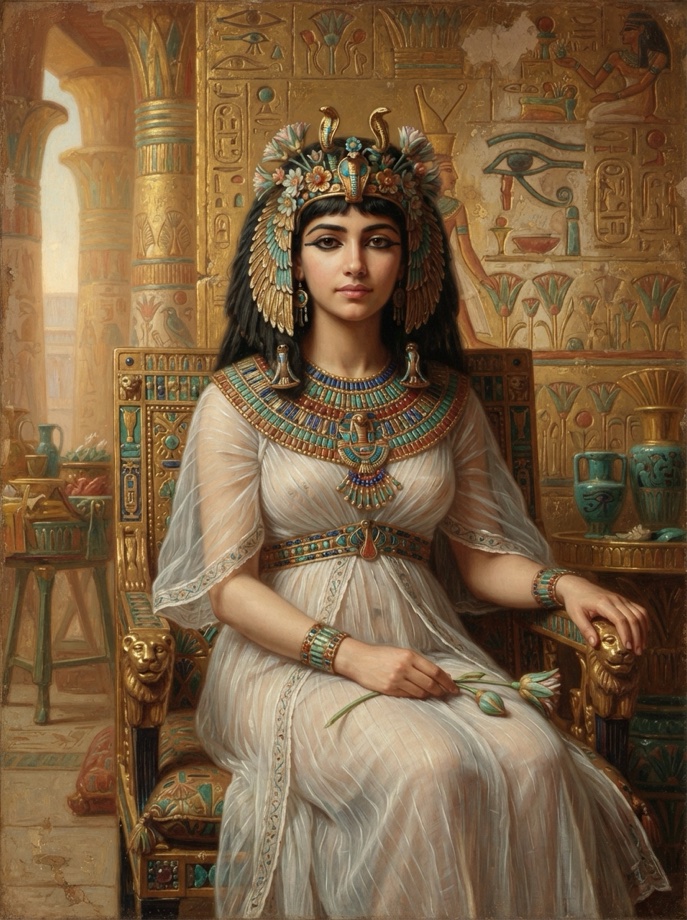
AI-assisted Portrait of Ankhesenamun
A Letter Sent Into the Dark
Almost everything we know about Ankhesenamun comes to us through other people. She appears on the gilded back of her husband’s throne, leaning toward him with an ointment cone in her hand. She appears on temple walls as a daughter among daughters, one of six girls raised inside her father’s strange sun-city at Amarna. She appears in a tomb as a widow performing a funeral rite. In every one of these images she is being placed somewhere by someone else — arranged into a composition, given a role, made to mean something about a man.
And then, once, she speaks. A tablet excavated at Hattusa, the Hittite capital, preserves a letter from an Egyptian queen — almost certainly her — to King Suppiluliuma I, sent in the weeks after Tutankhamun died childless. It is short, desperate, and utterly unlike any other document to survive from a New Kingdom palace. My husband is dead, she writes, and I have no son. Send me one of your sons, and I will make him king of Egypt. Then comes the sentence that has kept Egyptologists arguing for a century: I will never take one of my servants and make him my husband.
It is the voice of a young woman who has understood exactly what is about to be done to her and refuses it. The throne of Egypt was to be transferred through her body to whichever official at court could reach her first — most likely Ay, the elderly courtier who would in fact take both the crown and, on the evidence of a ring bearing their two names, the queen. Rather than accept that, she wrote to the enemy. It was an act with no precedent, no protection, and no plausible path to safety. It was also the only thing she ever did that was unambiguously her own.
Ankhesenamun is an INFP whose dominant Fi turned a diplomatic crisis into a question of personal integrity — she would rather gamble the succession on a foreign stranger than let her own life be handed over as property.
The Line She Would Not Cross
Read the Hittite letter as a diplomat would and it barely makes sense. Egypt and Hatti had been enemies for a generation; Suppiluliuma’s armies were then campaigning in Syria against Egyptian client states. Handing the double crown to a Hittite prince solved no strategic problem and created several. Suppiluliuma himself found it so implausible that he sent an envoy, Hattusa-ziti, to Egypt to verify that the letter was genuine and not a trap — and the queen wrote back a second time, stung, insisting she was not lying to him.
What the letter does make sense as is a moral statement. The objection she raises is not military or dynastic. It is that marrying a subject would be beneath her — that a woman born to Akhenaten and Nefertiti, raised as a king’s daughter and made a king’s Great Royal Wife, cannot be redistributed to a courtier as though she were an office to be filled. Dominant introverted feeling does not argue from consequence; it argues from an interior sense of what one is, and it holds that line even when holding it is expensive. She was willing to import a foreign dynasty rather than violate her own sense of who she was.
The cost came quickly. Suppiluliuma eventually sent his son Zannanza. The prince was killed on the road, almost certainly by the Egyptian faction that stood to lose everything if he arrived. Hatti and Egypt fell into open war over it, and the queen who had written the letter disappears from the record within a few years — surviving only, if the Berlin ring is what it appears to be, as the name paired with Ay’s on a piece of jewelry. Fi does not guarantee victory. It only guarantees that the refusal was real.
The Unthinkable Option
Ne is what made the refusal into a plan. A purely inward resistance would have produced silence, or ritual withdrawal, or a private grief carried into a second marriage. Ankhesenamun did something stranger: she reached outside the entire closed system of the Egyptian court for a solution nobody in that court would have thought of, and she did it fast, in the seventy days between a pharaoh’s death and his burial, while there was still a gap in the succession to exploit.
The idea was genuinely original. No Egyptian queen had ever proposed importing a foreign prince as pharaoh; Egyptian royal women were exported to foreign courts, not the reverse, and the asymmetry was a matter of doctrine. To conceive of the reversal at all required the sideways, boundary-ignoring perception of auxiliary extraverted intuition — the ability to see the rule not as reality but as one arrangement among possible arrangements. She saw a door where the architecture said there was a wall.
It was also, characteristically for Ne in the service of Fi, a plan without a second stage. She had no mechanism to protect the prince on the road, no faction, no soldiers, no fallback if the answer was no. The brilliance was in the conception; the machinery of execution belonged to men like Horemheb, who had armies, and Ay, who had the court. Zannanza died somewhere between Hattusa and the Nile, and with him the only idea Ankhesenamun ever got to have in public.
A Childhood That Would Not Let Go
She was born Ankhesenpaaten, a daughter of the Aten, in a city that had existed for only a few years and would not outlive her by many. Her tertiary Si is legible in how much of that vanished world she carried forward. The intimate, informal warmth of Amarna art — a royal couple touching, sharing a chair, handing each other flowers — reappears on the objects made for her marriage to Tutankhamun, decades of official style away from the stiff formality that would return under Horemheb.
Si also explains the reflex the letter reveals. Her sense of what a queen was, and what could not be done to one, was formed in the household of Akhenaten and Nefertiti, where royal women were painted at colossal scale and shown smiting enemies. Having absorbed that as the baseline, the ordinary Egyptian expectation that a widow was a transferable asset would have registered not as normal but as degradation. She was measuring her situation against a remembered standard nobody else at court still recognized.
No Army, No Faction, No Leverage
The inferior function is where the story breaks. Everything Ankhesenamun needed and did not have was Te: a count of who at court owed her, a plan for the prince’s escort, an understanding that a letter carried by an official courier would be read by officials before it left Egypt. Her scheme depended on secrecy in a bureaucracy built to leave no act unrecorded, and it leaked.
Her second letter to Suppiluliuma is the inferior function under pressure — hurt, insistent, arguing from sincerity when the situation called for guarantees. Why do you not believe me, she asks, in effect; would I lie about this? A Te-led negotiator would have anticipated the doubt and pre-empted it with terms. She could only offer the truth of her own feeling and be astonished that it was not enough.
Then the men who did count things took over. Ay wore the crown for four years and Horemheb for nearly thirty, and both understood exactly what Ankhesenamun never learned: that in Egypt legitimacy was not something you felt, it was something you administered.
Why INFP Over ISFP
Why not ISFP?
Both types lead with Fi, and an ISFP reading would fit a queen who endured her fate privately and expressed herself through the beauty of the objects around her. But Ankhesenamun did not endure. She reached — outward, across a hostile border, toward a solution no one in her world had ever attempted. That is Ne, not Se: not a sensitive response to what was in front of her but the invention of an option that did not exist. An ISFP in her position works within the room. She wrote her way out of it.
The distinction matters because it is the whole of what survives of her personality. Strip out the Hittite letter and Ankhesenamun is a face on furniture, typeable only by guesswork. Put the letter back and you have a specific psychology: a private, value-driven inner life that would not compromise, married to an imagination unconstrained by precedent, and unsupported by any of the practical machinery that would have been needed to make it work. That combination — uncompromising, inventive, strategically defenceless — is INFP under maximum pressure, and it is why the letter reads across thirty-three centuries as a human voice rather than a diplomatic artifact.
Connected Figures
Further Reading
- Amarna Sunset — Aidan DodsonThe standard account of the end of the Eighteenth Dynasty, and the fullest treatment of the Zannanza affair and Ankhesenamun's possible fates.
- The Deeds of Suppiluliuma — Mursili II (trans. Hans Güterbock)The Hittite source that preserves the Egyptian queen's letters, the king's disbelief, and the murder of the prince he sent.
- The Amarna Letters — William L. Moran (ed.)The diplomatic archive that frames Egypt's relations with Hatti and the Levant in the decades before the crisis.
- Nefertiti: Egypt's Sun Queen — Joyce TyldesleyUseful on the Amarna royal women and on what daughters of that household were raised to expect.
