 Historical Figure MBTI
#1067 · 8-9-26 · The Amarna Period
Horemheb
The General Who Erased Amarna
r. c. 1319 – 1292 BCE
8 min read
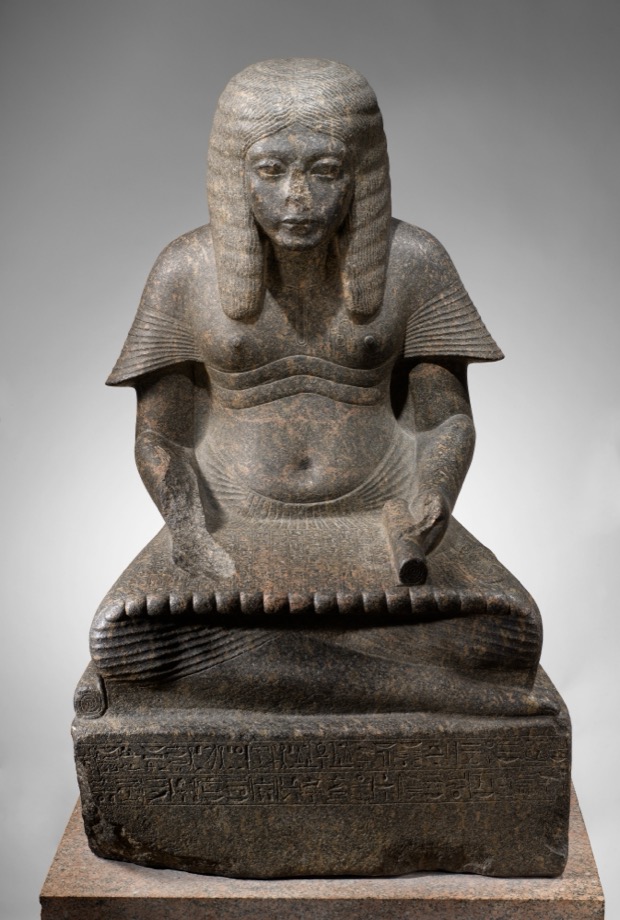
Statue of Horemheb as a scribe
The Man Who Was Still Standing
For roughly a quarter of a century, Horemheb was the most competent man in a collapsing state and did not move. He served through the last years of Akhenaten, through the brief shadow-reign of Smenkhkare, through the whole of Tutankhamun’s childhood as generalissimo and deputy of the king in the entire land, and then through the four years of Ay — a man decades older than himself who had taken the crown that a career soldier with the army behind him could plainly have seized. Horemheb waited. When Ay died, he was the only credible authority left in Egypt, and he took the throne without a fight.
What he did with it is the most thorough act of institutional demolition in Egyptian history. He pulled down the Aten temples at Karnak and Amarna and fed the blocks — the small, easily handled talatat — into the fill of his own pylons at Karnak, so that the heresy literally became the rubble inside the orthodoxy. He usurped the monuments of Tutankhamun by recutting the cartouches. And in the king-list he had carved for himself, he simply removed Akhenaten, Smenkhkare, Tutankhamun, and Ay from the succession and dated his own reign from the death of Amenhotep III, as though the previous three decades had not occurred.
It worked so completely that the entire Amarna period vanished from Egyptian memory for three thousand years. Nobody in the Nineteenth Dynasty could name the heretic king; by the Ramesside era he was referred to, when at all, as “the enemy of Akhetaten.” Egypt did not remember Akhenaten again until European excavators dug him up in the nineteenth century AD.
Horemheb is an ESTJ whose dominant Te treated a religious catastrophe as an administrative defect — something to be identified, excised, and replaced with a functioning system, with no interest whatsoever in what it had meant.
Correction, Not Revenge
It is tempting to read the erasures as hatred. The evidence suggests something colder and more characteristic. Horemheb had served the Amarna kings loyally and well; his own pre-royal tomb at Saqqara, built while he was still a commoner, is decorated in unmistakably Amarna style and shows him receiving the gold of honour from a king he would later delete. There is no sign of a convert’s fury. There is only a man who concluded that a particular arrangement of the Egyptian state had failed, and who then removed every operative trace of it because half-measures leave a system unstable.
The Great Edict of Horemheb, carved on a stela at Karnak and known from further copies, is the same mind working in peacetime. It is a piece of administrative law aimed squarely at official corruption: soldiers and inspectors seizing hides and boat cargoes from private citizens, tax collectors extorting the poor, judges taking bribes. The penalties are physical and specific — the cutting off of noses and banishment to the frontier fortress of Sile. He appointed new judges and regional officials, chose them from the priesthood and the army because those were the institutions that still functioned, and instructed them to take no payment from anyone. It is a compliance regime, written by someone who thinks in terms of enforcement mechanisms.
That is the signature of dominant extraverted thinking: the world is a set of structures that either produce the intended output or do not, and a ruler’s job is to fix the ones that do not. Akhenaten had shut the temples, redirected their revenues, and left the priesthoods of Amun destitute and the provincial administration unsupervised. Horemheb restored the endowments, reopened the temples, staffed them, and audited them. The god was, in a real sense, beside the point. The revenue stream and the chain of command were the point.
The Egypt He Remembered
Horemheb was old enough to remember the reign of Amenhotep III — the last long, rich, uninterrupted period before the crisis — and it is precisely that Egypt he dated his own kingship from. Auxiliary Si gave him a concrete standard of what a working state had looked like, and he did not need to invent an ideal; he had one in memory. The temple restorations reproduced pre-Amarna forms; the titulary, the art, the ritual calendar were all pulled back to a remembered baseline.
Si is also what made the deletion feel legitimate rather than dishonest. To a Te-Si mind, the Amarna decades were not part of the record because they were not part of the tradition: an aberration, a gap, a period during which the proper thing had stopped happening. Removing four kings from the list was not falsification so much as bookkeeping — reconciling the ledger to the way things were supposed to have run.
The same faculty made him a builder of extraordinary practicality. He completed the Ninth and Tenth Pylons at Karnak, restored the great processional routes, and reused Amarna stone as fill rather than quarrying fresh — a decision that preserved tens of thousands of decorated blocks for modern archaeologists, entirely by accident, and which reveals a man constitutionally unable to waste a usable resource.
The Improvised Dynasty
Tertiary Ne appears where the rules ran out. Horemheb had no royal blood and no son. By every conventional criterion he had no business on the throne, so he built a justification from scratch: a coronation narrative in which the god Horus of Hutnesut, his boyhood local deity, personally escorted him to Amun at Karnak during the Opet festival and the god acclaimed him king. Divine selection replaced descent. It is an inventive solution, and it became the template every later usurper in Egypt would use.
He improvised the succession the same way. Rather than let the throne fall to whichever official was nearest — the exact failure mode that had produced Ay — he designated his vizier and army colleague Pa-ramessu, a man from a military family in the Delta with a son and a grandson already living. Continuity of the institution mattered more than continuity of a bloodline. Pa-ramessu became Ramesses I, and the Nineteenth Dynasty, the dynasty of Seti I and Ramesses II, exists because Horemheb chose an administrator over a relative.
The Wife He Did Not Erase
Inferior Fi is the reason Horemheb can be unnerving to read about. He deleted a boy he had served since infancy, an old man who had made him commander, and an entire generation of the royal family, and left no trace of hesitation about any of it. Personal loyalty, private grief, the question of what these people had felt or deserved — none of it registers anywhere in the record he left.
And yet the one place it surfaces is telling. He had built a magnificent tomb at Saqqara as a commoner, and when he became king he abandoned it for the Valley of the Kings — but he did not abandon his first wife, Amenia, who was buried there, nor Mutnodjmet, the queen who died in childbirth late in his reign and whose burial he seems to have arranged with unusual care. A man with a suppressed inferior function does not have no feelings; he has feelings he can express only in the narrow, unofficial spaces where the system is not watching.
Why ESTJ Over ISTJ
Why not ISTJ?
An ISTJ reading is tempting for a man who spent decades as a loyal deputy and then restored the old ways. But Si-led restorers preserve and repair; they do not demolish four reigns, rewrite the king-list, and impose a new legal code with mutilation penalties on the entire bureaucracy. Horemheb was not conserving continuity — he was the disruptive force that manufactured a new continuity by force, top-down, from the throne. The tradition came second; the restructuring came first, and Si supplied the blueprint rather than the motive.
The distinction is clearest if you set him beside his own chosen successors. Seti I would inherit Horemheb’s settlement and lavish a lifetime of exquisite, painstaking craftsmanship on maintaining it — that is Si leading. Horemheb did the violence that made the settlement possible: the demolitions, the recut cartouches, the edict, the appointments, the invented coronation. He is the general who decides the state is broken, and then breaks it further in the specific direction required for it to work again. Te first, tradition second.
Connected Figures
Further Reading
- Amarna Sunset — Aidan DodsonThe fullest modern account of the post-Akhenaten succession and of Horemheb's dismantling of it.
- The Edict of Horemheb — Karnak stela (trans. in Urk. IV / Kruchten)The reign's own legal document: anti-corruption penalties, judicial appointments, and the enforcement machinery in his own words.
- The Memphite Tomb of Horemheb, Commander-in-Chief of Tutankhamun — Geoffrey T. MartinExcavation report on the Saqqara tomb he built as a commoner — the best evidence for his pre-royal career and Amarna-period service.
- Pharaoh Triumphant: The Life and Times of Ramesses II — Kenneth A. KitchenSets out the Delta military family Horemheb chose as his heirs and the dynasty his succession decision created.
