 Historical Figure MBTI
#1068 · 8-10-26 · The Ramesside Age
Seti I
The Restorer
r. c. 1290 – 1279 BCE
8 min read
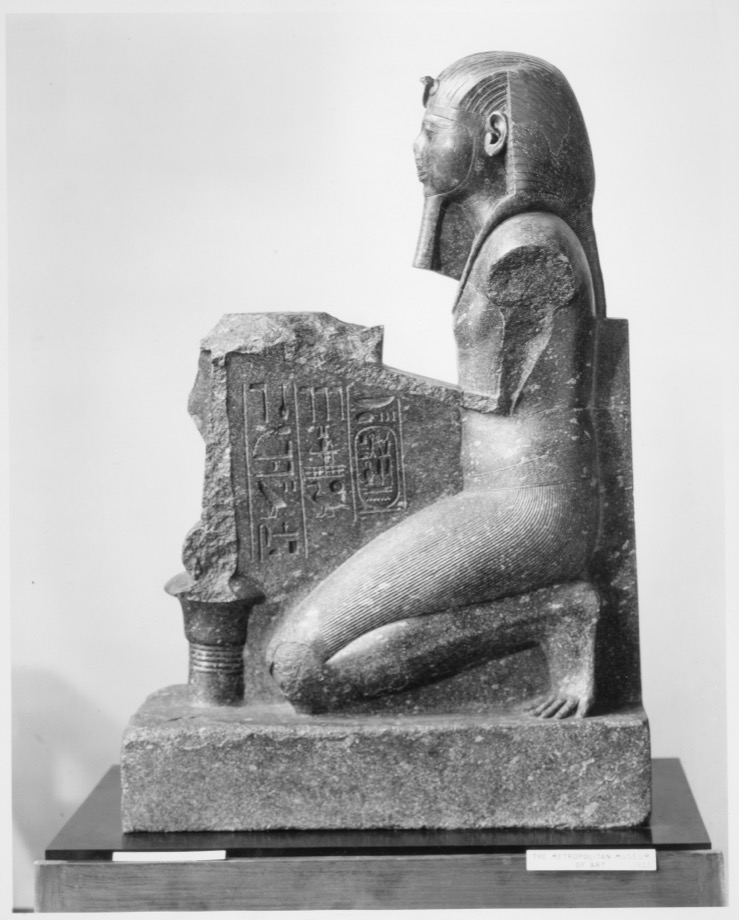
Statue of Seti I
The Finest Hands in Egypt
Walk into the Temple of Seti I at Abydos and the argument makes itself. The raised relief on those walls is the best carving that survives from three thousand years of Egyptian art: figures modelled with a shallow, exact swell that catches raking light, hieroglyphs cut with the crispness of type, faces whose lips and eyelids are rendered to a tolerance no other reign matched before or after. Nothing about it is innovative. Every convention is the old convention, observed with a scrupulousness that reads almost as devotion. It is not a new idea executed well. It is an inherited idea executed perfectly.
That is Seti’s whole reign in one building. He came to the throne about thirty years after Horemheb had bulldozed the Amarna heresy out of the record, the son of a Delta military man whom Horemheb had promoted from vizier to king because there was nobody left with a better claim. Seti inherited a state that had been broken, purged, and hastily reassembled — legitimate on paper, thin in substance, one generation deep. His answer was not to assert something new but to make the restored thing so technically excellent, so obviously continuous with the great past, that nobody could any longer see the join.
His throne name was Menmaatre — the eternal one of the order of Ma’at — and early in the reign he adopted the epithet wehem mesut, “repetition of births,” a formula meaning renaissance that had last been used after the First Intermediate Period. He was announcing, in the oldest available vocabulary, that the interruption was over.
Seti I is an ISTJ whose dominant Si made restoration into an art form — his answer to a broken inheritance was not to reimagine it but to rebuild it with more care than the original had ever received.
Fidelity as a Discipline
The Abydos temple is unusual in plan as well as execution: it has seven sanctuaries, not one, dedicated to Osiris, Isis, Horus, Amun-Ra, Ra-Horakhty, Ptah, and to Seti himself among them. He was not choosing a god. He was reinstalling the entire pantheon at once, in a single building, after a generation in which the state had tried to worship only one thing. The gesture is comprehensive rather than personal, and its logic is the logic of an inventory being restored to completeness.
Down the temple corridor runs his most revealing commission: the Abydos King List, seventy-six cartouches naming the legitimate kings of Egypt from Menes to Seti himself, with the young Ramesses shown reading the offering formula beside his father. It is an act of genealogical piety and one of the foundation documents of Egyptian chronology. It is also a lie of omission, and a very specific one. Akhenaten is absent. So are Smenkhkare, Tutankhamun, Ay, and — quietly — Hatshepsut. Seti was not attacking those reigns. He was declining to record anything that broke the continuity of the line, because the point of the list was continuity itself.
The same instinct sent his workmen up and down the Nile to repair damage done by others. At Karnak, at Abydos, at older monuments across Upper Egypt, Seti’s restoration inscriptions record that he renewed what he found ruined — often taking care to recut the original texts rather than replace them with his own. In an Egyptian king this is genuinely rare; the usual reflex was usurpation. Dominant introverted sensing does not want the credit. It wants the thing put back the way it was.
The Campaigns Behind the Carving
Nothing about Seti was passive. The exterior north wall of the Karnak hypostyle hall carries the register-by-register record of his first campaigns: the road to Gaza secured fort by fort with named wells, the Shasu bedouin cleared from the Sinai route, Yenoam and the Galilee cities taken, Kadesh reached and a victory stela erected there, the Libyans beaten in the west, the Hittites engaged in Syria. He fought in his first regnal year and repeatedly thereafter, and he re-established Egyptian control over a Levantine corridor that had been drifting out of the empire since Akhenaten stopped answering the letters from his vassals.
Auxiliary Te is equally visible in the unglamorous work. He reopened the gold mines of the Wadi Barramiya and had a well sunk on the desert road so the miners would stop dying of thirst — an inscription at Kanais records the arithmetic of it plainly. He restarted quarrying operations at Aswan and the Wadi Hammamat. He rebuilt the state’s revenue base and its logistics before he spent on prestige, and the prestige projects were then executed with the resources actually available.
And he built at scale: the great hypostyle hall at Karnak, one hundred and thirty-four columns over five thousand square metres, was begun and largely raised in his reign, its northern half carved in the exquisite raised relief he preferred before his son finished the rest in cheaper, faster sunk relief. The difference between the two halves of that hall is the difference between the two men, legible in stone.
A Father Naming His Father
Tertiary Fi surfaces in Seti’s treatment of his own family. His father, Ramesses I, had reigned barely sixteen months and left almost nothing; Seti built him a chapel at Abydos, inside his own temple complex, and had the second Abydos list of kings inscribed there. He also named his son for that grandfather and installed him early as co-regent, taking him on campaign as a boy so that the succession would be lived rather than announced.
The devotion is real but it is expressed the way an introverted-feeling function in the third position expresses things: through duty performed impeccably rather than through affection displayed. Seti’s own tomb, KV17 in the Valley of the Kings — the longest and most completely decorated tomb ever cut there, its ceiling carrying the first full astronomical chart in a royal burial — is the most personal object he left, and it is personal only in the sense that no expense or care was spared. He did not tell us what he felt. He showed us what he was willing to spend a decade doing.
The Road Not Taken to Kadesh
Seti reached Kadesh, took it, and let it go. He fought the Hittites, secured his gains, and then appears to have arrived at an accommodation with Muwatalli II rather than pressing the campaign to a decision. Whether one reads that as prudence or as a failure of ambition, it is the mark of a mind that does not chase the unmapped possibility. He restored the empire to its remembered borders and stopped there.
His son, who did chase it, would return to Kadesh in his own fifth year, gamble everything on a battle he nearly lost, and then advertise it as the greatest victory in Egyptian history for the next sixty years. The inferior function of the father is the dominant register of the son. Seti built the machine; Ramesses II found out what could be claimed with it.
Why ISTJ Over ISFJ
Why not ISFJ?
Both types lead with Si, and Seti’s reverence for tradition, his care for his father’s memory, and the tenderness of the Abydos reliefs all point that way. But the auxiliary is wrong. ISFJ restores by serving — smoothing, accommodating, attending to the people in front of it. Seti restored by command: annual campaigns into the Levant, forts and wells built along the Gaza road, mines and quarries reopened by decree, a king-list edited to enforce a version of the past. That is Te in the second seat, firm and impersonal, using the tradition as a specification and the state as the tool that meets it.
The Abydos temple is the proof of both halves at once. Its beauty is Si — the refusal to accept anything less than the finest carving Egypt had ever produced, measured against a remembered standard. Its existence is Te — a vast capital project driven through in eleven years by a king who had first gone out and reconquered the revenue to pay for it. Seti I is what happens when a meticulous traditionalist is also entirely willing to give orders, and it produced the most technically accomplished decade in Egyptian history.
Connected Figures
Further Reading
- Pharaoh Triumphant: The Life and Times of Ramesses II — Kenneth A. KitchenThe standard Ramesside narrative; its opening chapters are the best account of Seti's campaigns and of the co-regency.
- The Temple of King Sethos I at Abydos — Amice M. Calverley and Alan H. GardinerThe great four-volume facsimile record of the Abydos reliefs and the seven sanctuaries, still the primary publication.
- Ramesses: Egypt's Greatest Pharaoh — Joyce TyldesleyAccessible on the family, the succession, and how Seti's groundwork shaped his son's reign.
- The Abydos King List — Inscribed corridor, Temple of Seti IThe seventy-six-cartouche succession Seti had carved — and the reigns it deliberately leaves out.
